
Leadership in Biotech

Tag: books

Books That Inspire Me and Keep Me Honest

It’s Christmas Eve today, one of those rare pauses in the year that naturally invites reflection.

The inbox quiets, urgency loosens its grip, and there’s just enough space to notice what’s been carrying you and what hasn’t been worth carrying at all.

This part of my bookshelf came together slowly, but it centers around a single idea I’ve had to learn more than once:

Leadership (and life) gets better when you stop pretending time, energy, and attention are infinite and start choosing deliberately.

These books are about accepting finitude without shrinking ambition. They reject the lie that better leaders simply optimize harder, move faster, or squeeze more into already-full lives.

Make no mistake: these books are not about doing less. They’re about choosing with presence and leading in a way that is both humane and high-leverage.

They also ask an uncomfortable and liberating question (to borrow from Mary Oliver):
What is it you plan to do with your one wild and precious life?

Across different angles and disciplines, they converge on the same truths:

  • Time is not something to be mastered.
  • Attention is not neutral.
  • Busy is a signal, not a status symbol.

Learning how to discern and choose deliberately is a core discipline of leadership and of a life well lived.

When you stop pretending there’s time for everything, you’re forced to confront what actually matters. From that place, you can become more intentional about where you show up fully, where you say no cleanly, and where you let go without guilt.

These books helped me loosen my grip on the fantasy that better leaders simply move faster or carry more. They reframed leadership as a practice of discernment: noticing what deserves care, imagination, and energy and what does not. After all, limits are creative pressure if you frame them correctly. Small teams and startups often have outsized impact not just because of agility, but because of the focus and discipline they’re forced to adopt.

They also remind me to zoom out from my sometimes maniacal focus on work and achievement. While work is absolutely a central source of meaning in my life, meaning also comes from my family, the relationships I choose to nurture, and the parts of my identity that exist independent of any job title.

So in this reflective time of year, I hope we can all step back and embrace:

  • the permission to slow without disengaging
  • the relief that ambition doesn’t require self-erasure
  • the clarity that judgment beats busyness
  • the validation that presence is not weakness, it’s leadership maturity
Kristin’s Bookshelf: Working with Humans

These books didn’t emerge from a single chapter of my career, but they all circle the same truth: working with humans starts with upgrading yourself. Not through performance, but through honesty, emotional range, and perspective.

The Stone & Heen books (Thanks for the Feedback and Difficult Conversations) came into my life during a period where I was learning — repeatedly and sometimes painfully — that I can’t control all that much except how I relate to a situation. That shift from “I don’t like this, it shouldn’t be happening” to “what’s actually going on here, and what are my options?” was one of the hardest pivots I’ve ever made.

These books helped me step back from the visceral reaction and see more of the chessboard so I could choose my next move with intention, not just instinct.

A little later came the reckoning with power dynamics…

For most of my career, I’ve had a deep allergy to organizational politics — especially the kind where polish is valued more than substance. My whole professional identity has been built around getting sh*t done. First alone, then with a team, then through leaders I developed. Power, by contrast, felt performative, slippery, and vaguely repulsive.

That’s why 7 Rules of Power is a book I love to hate and hate to love, depending on the day. There’s an uncomfortable honesty in it: the kind you want to look away from but can’t. The rules aren’t aspirational, but they ring true. And learning to navigate the reality of how power works, without losing sight of the kind of culture I want to build, is probably a practice I’ll be refining for the rest of my career.

Which brings me to Unlocking Leadership Mindtraps

This book reminds me how easily we flatten reality into false binaries — right/wrong, good/bad, smart/stupid — especially under stress. Humans crave simplicity, but leadership rarely grants it. We live in a messy, colorful world where multiple things can be true at once. The more I can hold that complexity, the more effective (and compassionate) I can be with others.

So while I put these books under the category of “Working with Humans,” they’re really about something deeper: how to work with yourself so you can work better with other messy, complicated, brilliant humans, most of whom you have very little control over.

These books helped me widen my lens, soften my reactivity, and engage the reality in front of me rather than the one I wish existed. And from that place, the work becomes more honest, more humane, and more impactful.

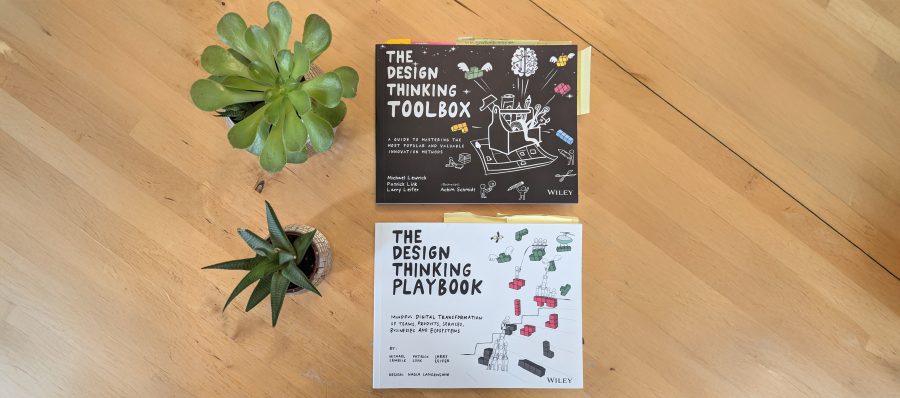
Photo of The Design Thinking Toolbox and The Design Thinking Playbook on a wooden table, next to two small houseplants

From Sticky Notes to Systems: What Design Thinking Taught Me

Why I Bought These Books

If I’m remembering correctly, like most of the good books in my life, I first checked The Design Thinking Toolbox out of the library. I didn’t necessarily expect much, mostly just a quick skim for ideas. But I found myself bookmarking pages, jotting down thoughts on sticky notes, and eventually admitting the obvious: I needed to own it. And if I was going to own it, I might as well get The Design Thinking Playbook too.

These books became part of my early days building the Discovery function at Veracyte. One of the first clear priorities I was given was to design an “Innovation Day” — which I immediately rebranded as Discovery Day. “Innovation” belongs to everyone, and I didn’t want a single team cornering that territory. Discovery, on the other hand, is an invitation.

The event eventually became an annual gathering of leaders from across our globally distributed organization: a chance to explore the trends shaping the future of diagnostics and translate those insights into Discovery priorities for the year ahead.

But in those first few weeks, all I knew was this: If people were going to fly across the world to sit in a room together, we couldn’t have them passively listen. The day had to be interactive. Engaging. Alive.

So I turned to design thinking for inspiration, and these books delivered.

They gave me concrete ideas for workshops, facilitation frameworks, and hands-on ways of bringing people into the conversation. They reminded me how to separate divergent and convergent thinking so we didn’t collapse creativity before it could breathe. They helped me draw out voices from across functions and levels, and design an experience that felt energizing rather than performative.

And the influence didn’t stop at Discovery Day.

What Design Thinking Means in My Leadership

Design thinking has become one of the engines of how I lead.

At its core, design thinking gives me a disciplined way to bring people together around complex problems. Not to perform collaboration, but to practice it. It pushes me to create rooms where people feel invited in, where ideas can breathe, and where we resist the urge to collapse creativity too quickly.

It’s also a structural reminder: explore before you evaluate; diverge before you converge; listen before you decide. That sequence has shaped how I architect conversations, how I build alignment across functions, and how I design cultures that don’t default to the loudest voice in the room.

It’s not about sticky notes.

It’s about designing practices and systems that surface insight, reduce fear, and make it easier for people to see what’s possible together.

Image of a stack of books sitting on a wooden table in a living room.

Kristin’s Bookshelf

My husband has been nudging me for months to expand the book recommendations on my website. So this Saturday afternoon, I finally pulled apart the bookshelf in my bedroom and dusted off a few of my favorites.

It was oddly comforting to revisit these old friends, each one a marker of who I’ve become as a leader. Every book holds a lesson I had to learn the hard way: a moment when the situation demanded that I grow, shift, or rethink how I was showing up.

Looking at them together, I’m reminded that the core elements of leadership — culture, behavior, systems, and meaning — aren’t separate domains. They weave together. They shape how we decide, how we relate, and how we build environments where people can do their best work.

Still, because humans love categories, I sorted this shelf into five sections:

  1. Design Thinking
  2. Ways of Working
  3. Working Better With Humans
  4. Strategy & Systems
  5. Books That Inspire Me and Keep Me Honest

If you look closely, you’ll see the edges of dozens of sticky notes sticking out at odd angles. I’ve really lived with these books. But I don’t just read them once and walk away, I return to them. I re-read to remember, to recalibrate, and to trace the leadership muscles I’ve built and the ones I’m still strengthening. These books help me remember who I am, and who I want to be, especially in the moments that test both.

So I’d love for you to join me as I walk through my leadership bookshelf over the next few weeks — not as a list of recommendations, but as a guided tour of the ideas and practices that shaped me. My hope is that we come away with a fuller, more human view of what it means to lead, and how to tap into the best of our humanity.

Goodness knows we need it.

Powered by WordPress & Theme by Anders Norén