What “Ways of Working” Means in My Leadership
These books came into my leadership journey at moments when I was learning something essential: culture isn’t built in the big offsites or the annual strategy decks, it’s built in the patterns of daily work.
And the work of leadership gets substantially easier when you design practices that empower your team, reduce unnecessary friction, and help people feel enrolled in the work. This is especially true in scientific environments, where independence of thought, intellectual rigor, and high-stakes decision-making are core to advancing the mission.
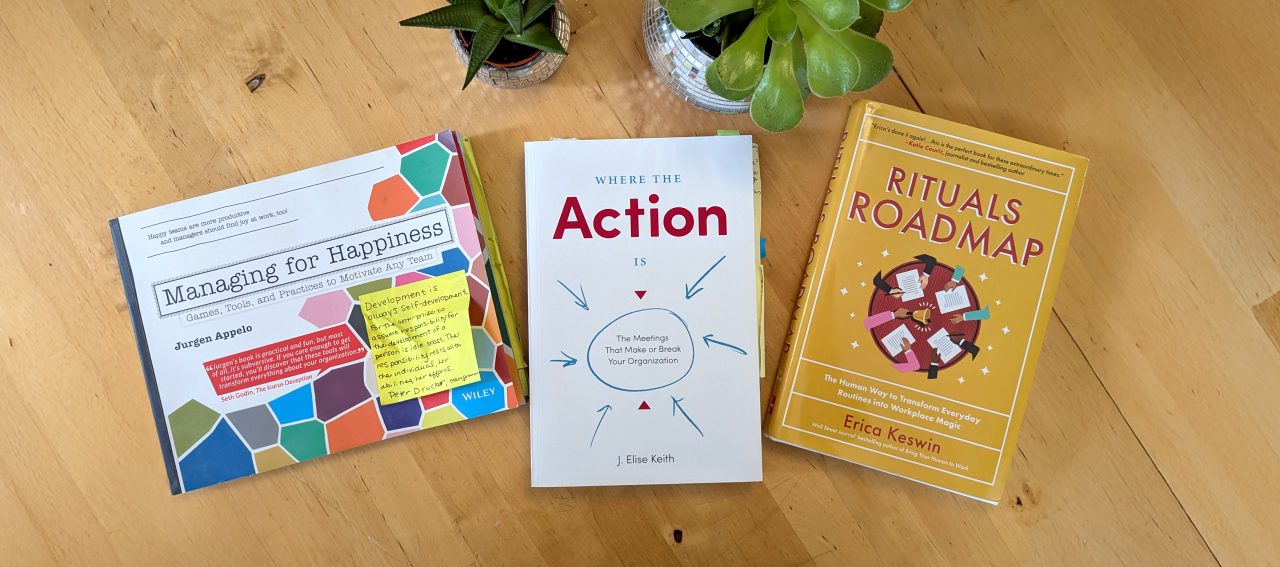
Managing for Happiness
Managing for Happiness, by Jurgen Appelo, came to me at a point in my career when I needed to scale myself. My team was growing, the work was accelerating, and I could no longer be the gravitational center for every decision or conversation. This book gave me pragmatic ways to build systems where people could thrive without feeling like I needed to be “in” every decision, and where autonomy, clarity, and shared ownership weren’t ideals but defaults. It reframed “team motivation” not as cheerleading, but as conditions design.
Where the Action Is
Where the Action Is, by J. Elise Keith, became indispensable during one of the most demanding leadership moments of my career: leading a mission-critical core team with a newly acquired company. I knew I needed to up my game. Meetings were no longer routine touchpoints; they were the operating system for how two cultures, two workflows, and two sets of expectations would come together to deliver.
This book changed everything about how I prepare, facilitate, and follow up. It helped me redesign meetings as leverage points with clear decision rights, deliberate sequencing, and the connective tissue needed to prevent swirl, rework, or misinterpretation.
It also gave me a new diagnostic lens: the realization that what looks like interpersonal tension is often just poor meeting design, unclear decision flow, or broken communication architecture.
Rituals Roadmap
Rituals Roadmap, by Erica Keswin, gave me permission to lead with more humanity. It reminded me that rituals aren’t fluffy or indulgent, they’re structure for connection in high-intensity environments. Small, repeatable practices shape belonging, meaning, and team identity far more than grand gestures ever will.
These ideas became especially powerful as I scaled Discovery across locations and new hires. We were spread across time zones, functions, and scientific domains, yet rituals helped us feel like one team.
These books changed how I think about the everyday work of leadership. They taught me that ways of working are not trivial operational details. They are culture, they are strategy, and they are the invisible architecture that determines whether people feel connected or isolated, aligned or confused, energized or depleted.
And when designed with intention, they make the whole system feel more human, more coherent, and more capable of doing truly great work.
Comments
Powered by WP LinkPress