
Leadership in Biotech

Tag: team building

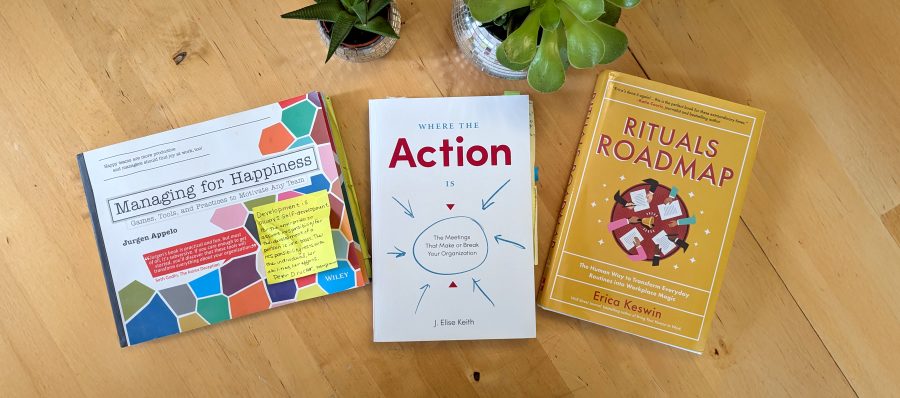
Photo of "Managing for Happiness", "Where the Action Is" and "Rituals Roadmap" books sitting on a wooden table

“Ways of Working” Books

What “Ways of Working” Means in My Leadership

These books came into my leadership journey at moments when I was learning something essential: culture isn’t built in the big offsites or the annual strategy decks, it’s built in the patterns of daily work.

And the work of leadership gets substantially easier when you design practices that empower your team, reduce unnecessary friction, and help people feel enrolled in the work. This is especially true in scientific environments, where independence of thought, intellectual rigor, and high-stakes decision-making are core to advancing the mission.

Managing for Happiness

Managing for Happiness, by Jurgen Appelo, came to me at a point in my career when I needed to scale myself. My team was growing, the work was accelerating, and I could no longer be the gravitational center for every decision or conversation. This book gave me pragmatic ways to build systems where people could thrive without feeling like I needed to be “in” every decision, and where autonomy, clarity, and shared ownership weren’t ideals but defaults. It reframed “team motivation” not as cheerleading, but as conditions design.

Where the Action Is

Where the Action Is, by J. Elise Keith, became indispensable during one of the most demanding leadership moments of my career: leading a mission-critical core team with a newly acquired company. I knew I needed to up my game. Meetings were no longer routine touchpoints; they were the operating system for how two cultures, two workflows, and two sets of expectations would come together to deliver.

This book changed everything about how I prepare, facilitate, and follow up. It helped me redesign meetings as leverage points with clear decision rights, deliberate sequencing, and the connective tissue needed to prevent swirl, rework, or misinterpretation.

It also gave me a new diagnostic lens: the realization that what looks like interpersonal tension is often just poor meeting design, unclear decision flow, or broken communication architecture.

Rituals Roadmap

Rituals Roadmap, by Erica Keswin, gave me permission to lead with more humanity. It reminded me that rituals aren’t fluffy or indulgent, they’re structure for connection in high-intensity environments. Small, repeatable practices shape belonging, meaning, and team identity far more than grand gestures ever will.

These ideas became especially powerful as I scaled Discovery across locations and new hires. We were spread across time zones, functions, and scientific domains, yet rituals helped us feel like one team.

These books changed how I think about the everyday work of leadership. They taught me that ways of working are not trivial operational details. They are culture, they are strategy, and they are the invisible architecture that determines whether people feel connected or isolated, aligned or confused, energized or depleted.

And when designed with intention, they make the whole system feel more human, more coherent, and more capable of doing truly great work.


Generative image of a group of four colleagues hugging and laughing together in an office

From Loneliness to the Connection Operating System

When Luis Velasquez and I first wrote about loneliness as a leadership challenge in Harvard Business Review, the response was gratifying. Leaders weren’t only intrigued, they were relieved. It put words to something many of us had felt but hadn’t named: that loneliness isn’t just showing up as a societal epidemic, it’s revealing itself in how teams work, lead, and connect.

For the last several weeks, I’ve been exploring what it actually looks like to build connection into the operating fabric of a team in a series of weekly posts. I’ve shared stories from my own work — not grand gestures, but small, durable practices that quietly shape belonging:

  1. Shared identity through rituals like our Discovery team onsite — infinity peanuts, Pictionary Telephone, and team tees that make us laugh and remember who we are.
  2. Collaboration by design, not department — forming peer-led GenAI learning groups that built trust across silos while upskilling the company.
  3. Leading with humanity, even when it means sharing a mistake — like the story I told new hires at Guardant about the time I failed early and was met with grace.
  4. Designing for belonging through structure — team-driven “About Me” rituals and annual culture calibrations that keep connection alive as a shared ethos, not a top-down edict.
  5. Sustaining connection at the top through Rising Women in Biotech — a circle that started with a single email and became a space for truth, trust, and perspective.

Each of these moments — personal, practical, sometimes a little silly — reinforces the same lesson: connection scales through intention, not intensity.

Connection is not a workplace perk or an HR initiative. It’s infrastructure: the quiet architecture beneath how people see each other, how learning happens, and how work gets done.

And now, we have new tools to help us do it better.

AI can help instead of hinder connections

AI can’t create trust, but it can help us remember, retell, and reinforce it — capturing stories, surfacing themes, and prompting reflection before the moments slip away.

If loneliness is the epidemic of our time, connection is our shared antidote.

And leaders, especially those of us building at the edge of science and technology, have both the opportunity and the responsibility to design for it.

Even though this is my last post in this series, I’d love to keep the conversation going. Please reach out and connect if this is a space you also care deeply about!

Four coworkers sit at a table looking at a laptop together. They are happy and enjoying the interaction

Case Studies in Connection: Design for Belonging

Belonging doesn’t just happen, it’s designed through the routines that shape how teams work together.

One of our simplest, most consistent rituals is that we start every team meeting with a short “About Me” from a rotating member. It’s two minutes, one slide, sometimes a photo. Over time, it’s transformed us from a collection of experts into a community of known people.

We know whose kid just started a new school, who’s training for a triathlon, whose garden is exploding with chile peppers. We even discovered an improbable number of birders on our team this way. These details accumulate into trust.

Another anchor is our annual culture and operating-rhythm review. Once a year we pause to ask:

  • Are our meetings effective?
  • Are we working on the right things?
  • Do our shared values still guide us?

Then we commit to concrete changes based on what we discuss. Sometimes that means reworking meeting cadence, clarifying decision roles, or adding new rituals.

Building shared practices

Here’s what’s important: these practices weren’t decreed from the top. The idea for “About Me” came from the team itself. And while I create the space for our annual review, I haven’t led the session for the past two years, team members have. Culture in our team is not a leadership initiative, it’s a shared ethos that everyone owns and shapes.

AI could quietly strengthen practices like these by:

  • Sense-making: surfacing themes across culture check-ins and feedback.
  • Memory: tracking commitments and reminding teams months later what’s evolved.
  • Support: suggesting new “About Me” prompts or reflections to keep stories fresh and inclusive.

Connection scales when it’s built into the way we work, not as something extra, and not as something handed down, but as the operating system we all help maintain.

Question for you: What’s one small practice your team repeats that quietly turns strangers into collaborators?

Powered by WordPress & Theme by Anders Norén