
Leadership in Biotech

Tag: management

Kristin’s Bookshelf: Working with Humans

These books didn’t emerge from a single chapter of my career, but they all circle the same truth: working with humans starts with upgrading yourself. Not through performance, but through honesty, emotional range, and perspective.

The Stone & Heen books (Thanks for the Feedback and Difficult Conversations) came into my life during a period where I was learning — repeatedly and sometimes painfully — that I can’t control all that much except how I relate to a situation. That shift from “I don’t like this, it shouldn’t be happening” to “what’s actually going on here, and what are my options?” was one of the hardest pivots I’ve ever made.

These books helped me step back from the visceral reaction and see more of the chessboard so I could choose my next move with intention, not just instinct.

A little later came the reckoning with power dynamics…

For most of my career, I’ve had a deep allergy to organizational politics — especially the kind where polish is valued more than substance. My whole professional identity has been built around getting sh*t done. First alone, then with a team, then through leaders I developed. Power, by contrast, felt performative, slippery, and vaguely repulsive.

That’s why 7 Rules of Power is a book I love to hate and hate to love, depending on the day. There’s an uncomfortable honesty in it: the kind you want to look away from but can’t. The rules aren’t aspirational, but they ring true. And learning to navigate the reality of how power works, without losing sight of the kind of culture I want to build, is probably a practice I’ll be refining for the rest of my career.

Which brings me to Unlocking Leadership Mindtraps

This book reminds me how easily we flatten reality into false binaries — right/wrong, good/bad, smart/stupid — especially under stress. Humans crave simplicity, but leadership rarely grants it. We live in a messy, colorful world where multiple things can be true at once. The more I can hold that complexity, the more effective (and compassionate) I can be with others.

So while I put these books under the category of “Working with Humans,” they’re really about something deeper: how to work with yourself so you can work better with other messy, complicated, brilliant humans, most of whom you have very little control over.

These books helped me widen my lens, soften my reactivity, and engage the reality in front of me rather than the one I wish existed. And from that place, the work becomes more honest, more humane, and more impactful.
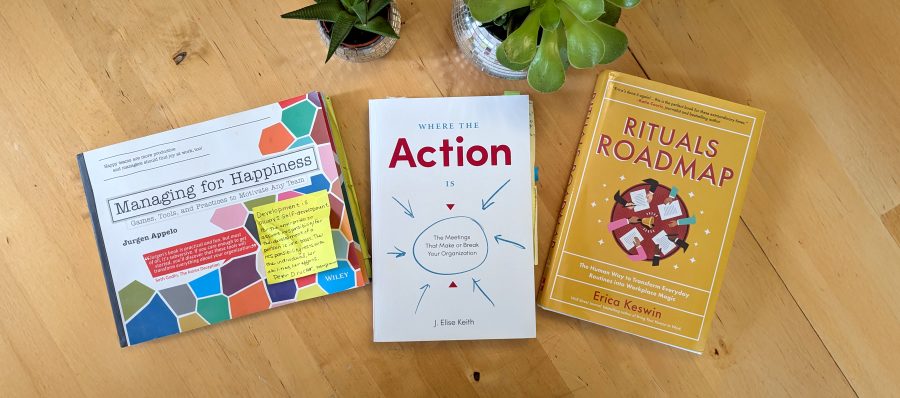

Photo of "Managing for Happiness", "Where the Action Is" and "Rituals Roadmap" books sitting on a wooden table

“Ways of Working” Books

What “Ways of Working” Means in My Leadership

These books came into my leadership journey at moments when I was learning something essential: culture isn’t built in the big offsites or the annual strategy decks, it’s built in the patterns of daily work.

And the work of leadership gets substantially easier when you design practices that empower your team, reduce unnecessary friction, and help people feel enrolled in the work. This is especially true in scientific environments, where independence of thought, intellectual rigor, and high-stakes decision-making are core to advancing the mission.

Managing for Happiness

Managing for Happiness, by Jurgen Appelo, came to me at a point in my career when I needed to scale myself. My team was growing, the work was accelerating, and I could no longer be the gravitational center for every decision or conversation. This book gave me pragmatic ways to build systems where people could thrive without feeling like I needed to be “in” every decision, and where autonomy, clarity, and shared ownership weren’t ideals but defaults. It reframed “team motivation” not as cheerleading, but as conditions design.

Where the Action Is

Where the Action Is, by J. Elise Keith, became indispensable during one of the most demanding leadership moments of my career: leading a mission-critical core team with a newly acquired company. I knew I needed to up my game. Meetings were no longer routine touchpoints; they were the operating system for how two cultures, two workflows, and two sets of expectations would come together to deliver.

This book changed everything about how I prepare, facilitate, and follow up. It helped me redesign meetings as leverage points with clear decision rights, deliberate sequencing, and the connective tissue needed to prevent swirl, rework, or misinterpretation.

It also gave me a new diagnostic lens: the realization that what looks like interpersonal tension is often just poor meeting design, unclear decision flow, or broken communication architecture.

Rituals Roadmap

Rituals Roadmap, by Erica Keswin, gave me permission to lead with more humanity. It reminded me that rituals aren’t fluffy or indulgent, they’re structure for connection in high-intensity environments. Small, repeatable practices shape belonging, meaning, and team identity far more than grand gestures ever will.

These ideas became especially powerful as I scaled Discovery across locations and new hires. We were spread across time zones, functions, and scientific domains, yet rituals helped us feel like one team.

These books changed how I think about the everyday work of leadership. They taught me that ways of working are not trivial operational details. They are culture, they are strategy, and they are the invisible architecture that determines whether people feel connected or isolated, aligned or confused, energized or depleted.

And when designed with intention, they make the whole system feel more human, more coherent, and more capable of doing truly great work.

Generative image of a group of four colleagues hugging and laughing together in an office

From Loneliness to the Connection Operating System

When Luis Velasquez and I first wrote about loneliness as a leadership challenge in Harvard Business Review, the response was gratifying. Leaders weren’t only intrigued, they were relieved. It put words to something many of us had felt but hadn’t named: that loneliness isn’t just showing up as a societal epidemic, it’s revealing itself in how teams work, lead, and connect.

For the last several weeks, I’ve been exploring what it actually looks like to build connection into the operating fabric of a team in a series of weekly posts. I’ve shared stories from my own work — not grand gestures, but small, durable practices that quietly shape belonging:

  1. Shared identity through rituals like our Discovery team onsite — infinity peanuts, Pictionary Telephone, and team tees that make us laugh and remember who we are.
  2. Collaboration by design, not department — forming peer-led GenAI learning groups that built trust across silos while upskilling the company.
  3. Leading with humanity, even when it means sharing a mistake — like the story I told new hires at Guardant about the time I failed early and was met with grace.
  4. Designing for belonging through structure — team-driven “About Me” rituals and annual culture calibrations that keep connection alive as a shared ethos, not a top-down edict.
  5. Sustaining connection at the top through Rising Women in Biotech — a circle that started with a single email and became a space for truth, trust, and perspective.

Each of these moments — personal, practical, sometimes a little silly — reinforces the same lesson: connection scales through intention, not intensity.

Connection is not a workplace perk or an HR initiative. It’s infrastructure: the quiet architecture beneath how people see each other, how learning happens, and how work gets done.

And now, we have new tools to help us do it better.

AI can help instead of hinder connections

AI can’t create trust, but it can help us remember, retell, and reinforce it — capturing stories, surfacing themes, and prompting reflection before the moments slip away.

If loneliness is the epidemic of our time, connection is our shared antidote.

And leaders, especially those of us building at the edge of science and technology, have both the opportunity and the responsibility to design for it.

Even though this is my last post in this series, I’d love to keep the conversation going. Please reach out and connect if this is a space you also care deeply about!

Four coworkers sit at a table looking at a laptop together. They are happy and enjoying the interaction

Case Studies in Connection: Design for Belonging

Belonging doesn’t just happen, it’s designed through the routines that shape how teams work together.

One of our simplest, most consistent rituals is that we start every team meeting with a short “About Me” from a rotating member. It’s two minutes, one slide, sometimes a photo. Over time, it’s transformed us from a collection of experts into a community of known people.

We know whose kid just started a new school, who’s training for a triathlon, whose garden is exploding with chile peppers. We even discovered an improbable number of birders on our team this way. These details accumulate into trust.

Another anchor is our annual culture and operating-rhythm review. Once a year we pause to ask:

  • Are our meetings effective?
  • Are we working on the right things?
  • Do our shared values still guide us?

Then we commit to concrete changes based on what we discuss. Sometimes that means reworking meeting cadence, clarifying decision roles, or adding new rituals.

Building shared practices

Here’s what’s important: these practices weren’t decreed from the top. The idea for “About Me” came from the team itself. And while I create the space for our annual review, I haven’t led the session for the past two years, team members have. Culture in our team is not a leadership initiative, it’s a shared ethos that everyone owns and shapes.

AI could quietly strengthen practices like these by:

  • Sense-making: surfacing themes across culture check-ins and feedback.
  • Memory: tracking commitments and reminding teams months later what’s evolved.
  • Support: suggesting new “About Me” prompts or reflections to keep stories fresh and inclusive.

Connection scales when it’s built into the way we work, not as something extra, and not as something handed down, but as the operating system we all help maintain.

Question for you: What’s one small practice your team repeats that quietly turns strangers into collaborators?

Photo of a man sitting in the woods, contemplating what he's looking at on his laptop. Photo by Hamza Tighza.

Case Studies in Connection: Lead with Humanity

At my previous company, I used to share a story during onboarding.

It wasn’t about a big win. It was about a mistake.

In my first two months, I made a critical error. The details matter less than the response: my leaders at the time handled it with grace, empathy, and a forward-looking mentality. We didn’t sweep it under the rug, but we also didn’t spiral into blame. We focused on understanding what went wrong and where systemic improvements could make us stronger.

I told this story for two reasons:

  1. We’re human, and we’re all learning. Especially in R&D on the bleeding edge of innovation: no one has done this before, mistakes will happen.
  2. We tackle challenges together. Forward-looking, constructive, and with an eye toward improving the system, not punishing the individual.

By openly sharing my own mistake, I wanted new team members to know that psychological safety here is real. You don’t have to hide mistakes (and you really shouldn’t). You can admit them, learn, and grow, and in fact, that’s how we become resilient together.

That’s what “modeling humanity” means. It’s not oversharing. It’s showing that being human is allowed, and that’s how teams actually thrive.

Augmenting your humanity with AI

Now imagine if AI could help leaders do this more often and more effectively.

  • Onboarding Story Builder: Capture and distill real mistakes into stories of learning and resilience that new hires hear on day one.
  • Conversation Practice Lab: Roleplay tough moments (admitting uncertainty, apologizing, giving feedback) so leaders and teams build muscle memory for psychological safety.
  • Reflection Nudges: Tools like Microsoft 365 Copilot could surface subtle signals from our own communications, when humility or openness is showing up and when it’s missing, giving us all a chance to do better.

AI can help us practice, remember, and retell the moments that remind teams that humanity is not a weakness.

Question for you: If you could AI-ify one thing about modeling humanity as a leader, what would you want AI to support? Join the conversation on LinkedIn.

Close up of three people's hands as they use two laptops at a glass table

Case Studies in Connection: Designing Collaboration to Build Trust

When we rolled out GenAI at Veracyte, we didn’t cluster people by department. Instead, we formed peer-led learning groups around use cases:

  • Writing and editing
  • Coaching and feedback
  • Brainstorming and ideation
  • Data privacy and governance

Over six weeks, each group honed its particular use case and shared tips in real time. People definitely got better at using the tools, but something even more powerful happened alongside the skill-building.

New connections sparked across the company

Scientists were suddenly learning from sales reps. Legal and customer care were comparing notes on data privacy. Folks who had never spoken before started to understand each other’s struggles, frustrations, and sources of joy.

By designing collaboration around shared problems instead of org charts, we unlocked trust and empathy. The highlight for many participants — according to our post-program survey — wasn’t just new GenAI skills, it was the relationships and perspective they gained.

That’s the hidden power of collaboration-by-design:

  • Trust builds faster when people tackle real challenges together.
  • Boundaries soften when connections cross silos.
  • Innovation compounds when people see the bigger picture of the work.

AI was the reason we gathered, but connection was the outcome. And in a world where loneliness is a quiet threat to performance, those connections may be the most enduring thing we built.

Question for you: How do you design collaborations in your org so they intentionally build trust — not just output?

Close-up photo of a person's hands as they use their laptop. Next to the laptop is a coffee mug with an "infinity peanut" logo printed on the side

Case Studies in Connection: Shared Identity in Action

At our recent team onsite in San Diego, the agenda wasn’t shaped around big dinners or polished presentations. When we asked the group what they wanted to do together, the answers were rituals we’d loved before and wanted to keep alive:

  • Infinity peanut (our design-thinking infinity loop exercise).
  • Pictionary Telephone (aka Eat Poop You Cat 🙃).
  • Team tee shirts.

On the surface, these are silly traditions, but they actually carry a lot of weight. The bad drawings from Pictionary Telephone now hang as office art. The tees feel like a uniform of belonging (it makes me smile every time I see someone in a meeting wearing a team tee). Even the infinity peanut loops back as a reminder of how we think and work together.

They’re fun, yes — but they’re also statements of identity:

  • We co-create our experiences.
  • We take the work seriously, but we don’t take ourselves too seriously.
  • We’re willing to look a little ridiculous in service of connection and learning.
  • We remember and retell our stories.

That’s the key: the rituals only become culture when the stories and artifacts keep them alive.

Here’s where I see AI being helpful. At Veracyte, I’ve already seen people use GenAI to generate artwork and slogans for peer-led learning groups during our initial GenAI rollout. It turned participation into artifacts that reinforced the group’s identity.

Imagine AI as a culture co-pilot:

  • Turning silly hand drawings into tee-shirt or sticker designs (no graphic designer required).
  • Weaving micro-stories from team rituals into onboarding packets or thank-you notes.
  • Resurfacing shared jokes and touchstones at milestones so the culture “remembers itself.”

The tech doesn’t replace the ritual. It helps the meaning stick.

Question for you: What’s one team ritual you’d love to see preserved, retold, or reimagined with a little AI help?

A woman sits at a glossy office table with empty seats around her while she sips a take-out coffee and looks at her laptop

Loneliness Is Reshaping Your Workplace

My third HBR article just dropped today, available here: Loneliness Is Reshaping Your Workplace.

This piece was sparked by a keynote I heard a year ago from former U.S. Surgeon General Dr. Vivek Murthy, who spoke powerfully about the crisis of loneliness at the Stanford University Big Ideas in Medicine Conference. As I listened, I realized that loneliness isn’t just a societal issue—it’s reshaping our workplaces in subtle but profound ways. It’s showing up in how we collaborate, how we show up for each other, and how we find meaning in our work.

There’s little debate that loneliness is on the rise, driven by sweeping societal and technological shifts. The casual, connective moments that once defined our day-to-day lives have been eroded by a rise in frequent but shallow digital interactions—leaving many feeling more isolated than ever.

These dynamics inevitably shape the workplace. They seep into team culture, performance expectations, and everyday interactions. Work doesn’t exist apart from society—it absorbs its pressures, amplifies its gaps, and remains one of the last places where people hope to feel like they matter.

But this moment also presents an opportunity: for leaders and organizations to make work more meaningful, more human, and more sustaining.

I’d love to hear your thoughts in the discussion on LinkedIn:

  • What are the moments of connection that have mattered most in your work?
  • How are you seeing loneliness show up in your workplace?
  • What do you see leaders doing to address it?

Shout out to my amazing co-author and friend Luis Velasquez MBA, PhD. ❤️

Powered by WordPress & Theme by Anders Norén