It’s Christmas Eve today, one of those rare pauses in the year that naturally invites reflection.
The inbox quiets, urgency loosens its grip, and there’s just enough space to notice what’s been carrying you and what hasn’t been worth carrying at all.
This part of my bookshelf came together slowly, but it centers around a single idea I’ve had to learn more than once:
Leadership (and life) gets better when you stop pretending time, energy, and attention are infinite and start choosing deliberately.
These books are about accepting finitude without shrinking ambition. They reject the lie that better leaders simply optimize harder, move faster, or squeeze more into already-full lives.
Make no mistake: these books are not about doing less. They’re about choosing with presence and leading in a way that is both humane and high-leverage.
They also ask an uncomfortable and liberating question (to borrow from Mary Oliver): What is it you plan to do with your one wild and precious life?
Across different angles and disciplines, they converge on the same truths:
Time is not something to be mastered.
Attention is not neutral.
Busy is a signal, not a status symbol.
Learning how to discern and choose deliberately is a core discipline of leadership and of a life well lived.
When you stop pretending there’s time for everything, you’re forced to confront what actually matters. From that place, you can become more intentional about where you show up fully, where you say no cleanly, and where you let go without guilt.
These books helped me loosen my grip on the fantasy that better leaders simply move faster or carry more. They reframed leadership as a practice of discernment: noticing what deserves care, imagination, and energy and what does not. After all, limits are creative pressure if you frame them correctly. Small teams and startups often have outsized impact not just because of agility, but because of the focus and discipline they’re forced to adopt.
They also remind me to zoom out from my sometimes maniacal focus on work and achievement. While work is absolutely a central source of meaning in my life, meaning also comes from my family, the relationships I choose to nurture, and the parts of my identity that exist independent of any job title.
So in this reflective time of year, I hope we can all step back and embrace:
the permission to slow without disengaging
the relief that ambition doesn’t require self-erasure
the clarity that judgment beats busyness
the validation that presence is not weakness, it’s leadership maturity
These books didn’t emerge from a single chapter of my career, but they all circle the same truth: working with humans starts with upgrading yourself. Not through performance, but through honesty, emotional range, and perspective.
The Stone & Heen books (Thanks for the Feedback and Difficult Conversations) came into my life during a period where I was learning — repeatedly and sometimes painfully — that I can’t control all that much except how I relate to a situation. That shift from “I don’t like this, it shouldn’t be happening” to “what’s actually going on here, and what are my options?” was one of the hardest pivots I’ve ever made.
These books helped me step back from the visceral reaction and see more of the chessboard so I could choose my next move with intention, not just instinct.
A little later came the reckoning with power dynamics…
For most of my career, I’ve had a deep allergy to organizational politics — especially the kind where polish is valued more than substance. My whole professional identity has been built around getting sh*t done. First alone, then with a team, then through leaders I developed. Power, by contrast, felt performative, slippery, and vaguely repulsive.
That’s why 7 Rules of Power is a book I love to hate and hate to love, depending on the day. There’s an uncomfortable honesty in it: the kind you want to look away from but can’t. The rules aren’t aspirational, but they ring true. And learning to navigate the reality of how power works, without losing sight of the kind of culture I want to build, is probably a practice I’ll be refining for the rest of my career.
This book reminds me how easily we flatten reality into false binaries — right/wrong, good/bad, smart/stupid — especially under stress. Humans crave simplicity, but leadership rarely grants it. We live in a messy, colorful world where multiple things can be true at once. The more I can hold that complexity, the more effective (and compassionate) I can be with others.
So while I put these books under the category of “Working with Humans,” they’re really about something deeper: how to work with yourself so you can work better with other messy, complicated, brilliant humans, most of whom you have very little control over.
These books helped me widen my lens, soften my reactivity, and engage the reality in front of me rather than the one I wish existed. And from that place, the work becomes more honest, more humane, and more impactful.
These books came into my leadership journey at moments when I was learning something essential: culture isn’t built in the big offsites or the annual strategy decks, it’s built in the patterns of daily work.
And the work of leadership gets substantially easier when you design practices that empower your team, reduce unnecessary friction, and help people feel enrolled in the work. This is especially true in scientific environments, where independence of thought, intellectual rigor, and high-stakes decision-making are core to advancing the mission.
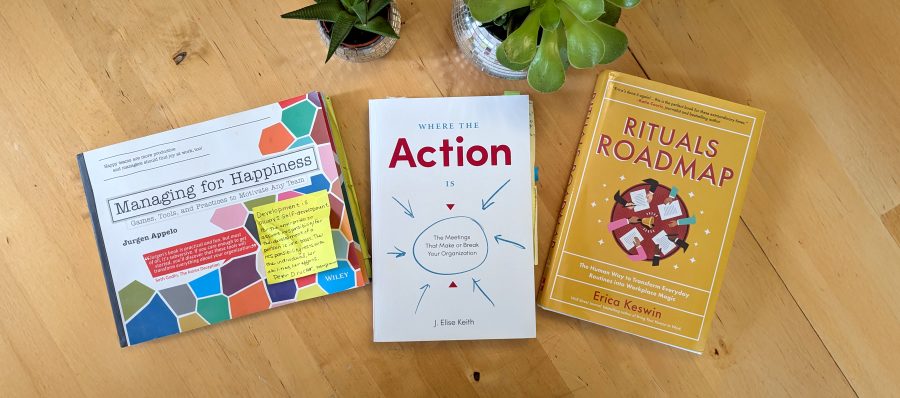
Managing for Happiness
Managing for Happiness, by Jurgen Appelo, came to me at a point in my career when I needed to scale myself. My team was growing, the work was accelerating, and I could no longer be the gravitational center for every decision or conversation. This book gave me pragmatic ways to build systems where people could thrive without feeling like I needed to be “in” every decision, and where autonomy, clarity, and shared ownership weren’t ideals but defaults. It reframed “team motivation” not as cheerleading, but as conditions design.
Where the Action Is
Where the Action Is, by J. Elise Keith, became indispensable during one of the most demanding leadership moments of my career: leading a mission-critical core team with a newly acquired company. I knew I needed to up my game. Meetings were no longer routine touchpoints; they were the operating system for how two cultures, two workflows, and two sets of expectations would come together to deliver.
This book changed everything about how I prepare, facilitate, and follow up. It helped me redesign meetings as leverage points with clear decision rights, deliberate sequencing, and the connective tissue needed to prevent swirl, rework, or misinterpretation.
It also gave me a new diagnostic lens: the realization that what looks like interpersonal tension is often just poor meeting design, unclear decision flow, or broken communication architecture.
Rituals Roadmap
Rituals Roadmap, by Erica Keswin, gave me permission to lead with more humanity. It reminded me that rituals aren’t fluffy or indulgent, they’re structure for connection in high-intensity environments. Small, repeatable practices shape belonging, meaning, and team identity far more than grand gestures ever will.
These ideas became especially powerful as I scaled Discovery across locations and new hires. We were spread across time zones, functions, and scientific domains, yet rituals helped us feel like one team.
These books changed how I think about the everyday work of leadership. They taught me that ways of working are not trivial operational details. They are culture, they are strategy, and they are the invisible architecture that determines whether people feel connected or isolated, aligned or confused, energized or depleted.
And when designed with intention, they make the whole system feel more human, more coherent, and more capable of doing truly great work.
When Luis Velasquez and I first wrote about loneliness as a leadership challenge in Harvard Business Review, the response was gratifying. Leaders weren’t only intrigued, they were relieved. It put words to something many of us had felt but hadn’t named: that loneliness isn’t just showing up as a societal epidemic, it’s revealing itself in how teams work, lead, and connect.
For the last several weeks, I’ve been exploring what it actually looks like to build connection into the operating fabric of a team in a series of weekly posts. I’ve shared stories from my own work — not grand gestures, but small, durable practices that quietly shape belonging:
Shared identity through rituals like our Discovery team onsite — infinity peanuts, Pictionary Telephone, and team tees that make us laugh and remember who we are.
Leading with humanity, even when it means sharing a mistake — like the story I told new hires at Guardant about the time I failed early and was met with grace.
Designing for belonging through structure — team-driven “About Me” rituals and annual culture calibrations that keep connection alive as a shared ethos, not a top-down edict.
Sustaining connection at the top through Rising Women in Biotech — a circle that started with a single email and became a space for truth, trust, and perspective.
Each of these moments — personal, practical, sometimes a little silly — reinforces the same lesson: connection scales through intention, not intensity.
Connection is not a workplace perk or an HR initiative. It’s infrastructure: the quiet architecture beneath how people see each other, how learning happens, and how work gets done.
And now, we have new tools to help us do it better.
AI can help instead of hinder connections
AI can’t create trust, but it can help us remember, retell, and reinforce it — capturing stories, surfacing themes, and prompting reflection before the moments slip away.
If loneliness is the epidemic of our time, connection is our shared antidote.
And leaders, especially those of us building at the edge of science and technology, have both the opportunity and the responsibility to design for it.
Even though this is my last post in this series, I’d love to keep the conversation going. Please reach out and connect if this is a space you also care deeply about!
One theme I am working with in my professional life this year is approaching work with a more expansive perspective, using a lens of abundance, possibility, and collaboration instead of scarcity, limitation, and competition. However, we’re seven months into the year, and if I were evaluating my success so far on this effort, I would have given myself a B-. That is until I read The Art of Possibility by Rosamund Stone Zander and Benjamin Zander.
The Art of Possibility: Transforming Professional and Personal Life is a beautiful guide to unlocking creativity and potential in all areas of life, drawing heavily on the worlds of classical music and personal development as it presents twelve practices designed to help readers shift their perspectives and embrace a mindset of possibility.
Let’s pause on this phrase ‘mindset of possibility,’ because many scientists, myself included, have an aversive reaction to this sort of phrase. It usually draws to mind ideas about ‘manifesting possibility in the world’ and feels a little too woo-woo for my analytical brain. Luckily, that is not what is meant in this case.
In the words of the authors, “This is a how-to book of an unusual kind. Unlike the genre of how-to books that offer strategies to surmount the hurdles of a competitive world and move out ahead, the objective of this book is to provide the reader the means to lift off from that world of struggle and sail into a vast universe of possibility. Our premise is that many of the circumstances that seem to block us in our daily lives may only appear to do so based on a framework of assumptions we carry with us. Draw a different frame around the same set of circumstances and new pathways come into view. Find the right framework and extraordinary accomplishment becomes an everyday experience. Each chapter of this book presents a different facet of this approach and describes a new practice for bringing possibility to life.”
In this book you find practices that resonate with modern management thinking around growth mindset and psychological safety before any of these concepts became buzzwords.
Mindset of Possibility
Most books on management and leadership fall into two categories. The first category is comprised of overly theoretical tomes written by professors who have limited experience actually managing in the real world. Interesting frameworks; hard to apply. The second category contains tactical advice offered towards specific scenarios— how to give better feedback, how to create more compelling presentations, how to collaborate more effectively. Highly useful when brought to bear in the right context, but not usually transformative.
The Art of Possibility falls into a unique third category, one that opens up new ways of framing the world that allow for more effective patterns of interaction and thinking. While expansive in their goals, these patterns are offered in set of 12 practices, making them approachable and practical to put into use in the context of your choosing. The end result is something both useful and expansive, and I am so incredibly grateful to have encountered this book.
Practical Implementation
I will let the reader explore the 12 practices in the book themselves, but I want to touch on how I applied the practice of ‘Giving an A’ with my team recently.
The “Giving an A” practice is about shifting from a mindset of judgment and comparison to one of possibility and empowerment. Instead of evaluating people based how well they can match their performance against a set standard, you start by assuming they are already capable and worthy of an “A.” Individuals are still encouraged to reach their full potential, but without the fear of failure or judgment holding them back.
This practice originated from an observation that Benjamin Zander made among his elite music students: the high-achieving students often felt so anxious and inhibited by the pressure to perform perfectly that they weren’t fully developing their musical talents because they weren’t taking risk. By giving them an automatic “A,” he created an environment where they felt free to take risks, express themselves, and grow. But he didn’t just give them an automatic ‘A.’ He required every student to write from their future self a letter dated at the end of the course about what they had done over the course of the year to deserve that ‘A.’ Through the process of writing the letter and connecting with the vision of their future selves, students showed up in class as ‘A’ students.
I’m not a teacher and don’t award grades, nor do I work on time scales of semesters or academic years. Nonetheless, the practice of imaging the person you want to be in a year’s time helps us all see more clearly the behaviors and activities needed to get from here to there, and help us show up differently in our day-to-day interactions in a way that supports reaching our goals.
With that in mind, I took my team through a version of it as part of our mid-year development practice. Technically, what I call ‘mid-year development practice’ is actually my company’s mid-year review cycle, but I have long felt that referring to these practices as a ‘review’ is counterproductive. Using the word ‘review’ sets a tone of evaluation instead of collaboration. If you are managing well, any performance issues should be part of ongoing conversations, not presented in twice yearly processes. As a result, in my organization, we use these ‘review’ cycles as an opportunity to make sure meaningful professional development conversations are happening. The practice of ‘Giving an A’ fits nicely with this perspective.
In a recent team meeting, we set aside our usual agenda of reviewing progress and looking at data, and spent 30 minutes ‘alone, together’ working independently on such letters from our future selves. I did not require anyone to share these letters, but am hoping that the development conversations that ensued were richer and more inspiring as a result.
Of course, during this exercise I was forced to reframe my B- into giving myself an A. And I’m looking forward to earning that A this year!
Check out my recent appearance on the Successful Nonprofits podcast, hosted by Dolph Goldenburg. My co-author, Luis Velasquez, and I were interviewed about our HBR article that examined the potential pitfalls of being an “umbrella manager.” There’s lots of good discussion, including background about how the article came to be, as well as advice on how managers can avoid the trap of over-protecting their teams. Check out the podcast here, and if you missed it, read the article here.
My amazing friend (and former coach) Luis Velasquez MBA, PhD. and I wrote an article for HBR about “umbrella managers,” or leaders who believe it is their job to protect their team from organizational challenges to the detriment of themselves, their teams, and their organizations. The article outlines the mental shifts and specific actions that can help umbrella managers let go of the need to protect their team and start supporting them.
In the last 6 years I have had the privilege of mentoring a number of new managers (and managers of managers) on my team. The tendency to ‘protect’ is strong, especially in high stress work environments- I should know, because I am a former umbrella manager.




Comments
Powered by WP LinkPress