When I was in high school, I was obsessed with genetics. The Human Genome Project was in full swing, and it felt like the future was being written in real time. I told a family friend I wanted to become a geneticist. He smiled and said, “My cousin is at the NIH. They’ll finish the human genome before you finish college, so I wouldn’t bother.”
The project wrapped in 2003. But papers like this remind me how wrong that prediction was. Even after “finishing” the genome, we’re still uncovering what accuracy, completeness, and truth really mean.
The new Platinum Pedigree study pushes that frontier again.
Scientific Insight
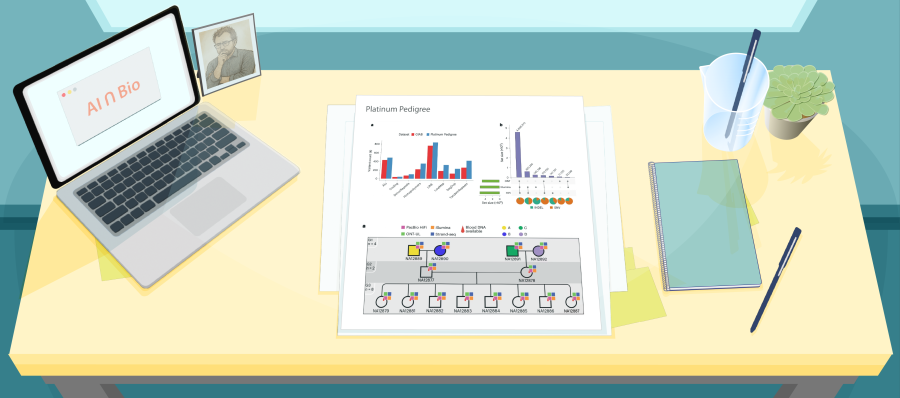
This work builds one of the most comprehensive germline variant benchmarks to date, deep long-read sequencing across a 10-member family, combined with Mendelian logic.
By integrating PacBio HiFi, Oxford Nanopore Technologies, and Illumina and testing every variant against inheritance patterns, the authors defined 2.77 Gb of high-confidence genome (~200 Mb beyond prior benchmarks), including repeats, segmental duplications, and low-mappability regions.
The key innovation is biological grounding.
Each child inherits one haplotype from each parent; variants that obey those segregation patterns are kept, and those that don’t are removed. This yielded ~4.7M SNVs, 768k indels, 537k tandem repeats, and 24k structural variants as pedigree-consistent truth.
When DeepVariant was retrained on this truth set, error rates dropped by ~34% across challenging classes, especially indels and tandem repeats.
Better labels → better models.
Leadership Angle
For diagnostics leaders, this signals where the field is heading: stronger evidence standards, clearer definitions of “truth,” and biologically informed benchmarks rather than technology-constrained heuristics.
This strategy of combining multiple sequencing technologies and adjudicating discrepancies with inheritance is exactly how robust systems are built in uncertain environments.
It mirrors what clinical diagnostics now requires: pipelines that perform not just in easy regions, but in messy, clinically meaningful ones.
And it underscores a central lesson in AI-enabled diagnostics: your model is only as good as the ground truth you train it on.
The regions that are currently messy and difficult to map: that’s where new breakthroughs in understanding will occur.
Mentorship Angle
For early-career scientists, the lesson is craftsmanship. This paper doesn’t debut a flashy algorithm; it elevates the foundations. It asks simple but profound questions: Did this variant follow the rules of inheritance? If not, are we sure it’s real?
Your technical tools matter, but your willingness to interrogate assumptions matters more. If you want to build a meaningful career in genetics in this age of AI, stay curious about the scaffolding beneath the science.
Breakthroughs often start there.
Skip to PDF content