Leadership in Biotech

Tag: communication

Photo of three women holding up wine glasses silhouetted by a sunset at dusk

Case Studies in Connection: Even Leaders Need Connection

The higher you rise in your career, the fewer peers you have …and the pressure to appear composed and decisive only grows. It’s no wonder they say it’s lonely at the top.

One of the most meaningful antidotes for leadership loneliness for me has been Rising Women in Biotech.

We’re a small group of women leaders in life sciences and diagnostics who meet quarterly. On the surface, it looks like a leadership roundtable. In reality, it’s become a circle of trust, a place to bring career transitions, tough decisions, and the sticky points that are hard to navigate alone.

The funny thing is, it started with a simple email I sent out. Some of the women I knew well, others I had only met once or twice. We were joking about that email recently and how something so small became a group that now feels indispensable (at least to me).

That’s the power of peer circles: they don’t need to be complicated. They just need intention and trust.

Leaders often underestimate how much their own connection needs shape the cultures they create. If we’re isolated, we risk cascading isolation down the org.

But if we model the opposite — building our own scaffolds of trust and perspective — we give others permission to do the same.

AI could make this easier too:

  • Peer Circle Curator: imagine downloading your contacts from LinkedIn, uploading them to an AI tool, and having it suggest potential circle members who share values, challenges, or experiences, including people you might not think to invite.
  • Reflection Prompts: AI can also help capture what you take away from these conversations, turning raw insights into stories or reminders you can carry back to your teams.

Culture mirrors the top. If leaders are too busy to be human, teams will be too. But when we invest in our own connection, we create the conditions for everyone else to thrive.

Question for you: Who would you include if you sent that one email to start your own circle of trust?

Photo of a man sitting in the woods, contemplating what he's looking at on his laptop. Photo by Hamza Tighza.

Case Studies in Connection: Lead with Humanity

At my previous company, I used to share a story during onboarding.

It wasn’t about a big win. It was about a mistake.

In my first two months, I made a critical error. The details matter less than the response: my leaders at the time handled it with grace, empathy, and a forward-looking mentality. We didn’t sweep it under the rug, but we also didn’t spiral into blame. We focused on understanding what went wrong and where systemic improvements could make us stronger.

I told this story for two reasons:

  1. We’re human, and we’re all learning. Especially in R&D on the bleeding edge of innovation: no one has done this before, mistakes will happen.
  2. We tackle challenges together. Forward-looking, constructive, and with an eye toward improving the system, not punishing the individual.

By openly sharing my own mistake, I wanted new team members to know that psychological safety here is real. You don’t have to hide mistakes (and you really shouldn’t). You can admit them, learn, and grow, and in fact, that’s how we become resilient together.

That’s what “modeling humanity” means. It’s not oversharing. It’s showing that being human is allowed, and that’s how teams actually thrive.

Augmenting your humanity with AI

Now imagine if AI could help leaders do this more often and more effectively.

  • Onboarding Story Builder: Capture and distill real mistakes into stories of learning and resilience that new hires hear on day one.
  • Conversation Practice Lab: Roleplay tough moments (admitting uncertainty, apologizing, giving feedback) so leaders and teams build muscle memory for psychological safety.
  • Reflection Nudges: Tools like Microsoft 365 Copilot could surface subtle signals from our own communications, when humility or openness is showing up and when it’s missing, giving us all a chance to do better.

AI can help us practice, remember, and retell the moments that remind teams that humanity is not a weakness.

Question for you: If you could AI-ify one thing about modeling humanity as a leader, what would you want AI to support? Join the conversation on LinkedIn.

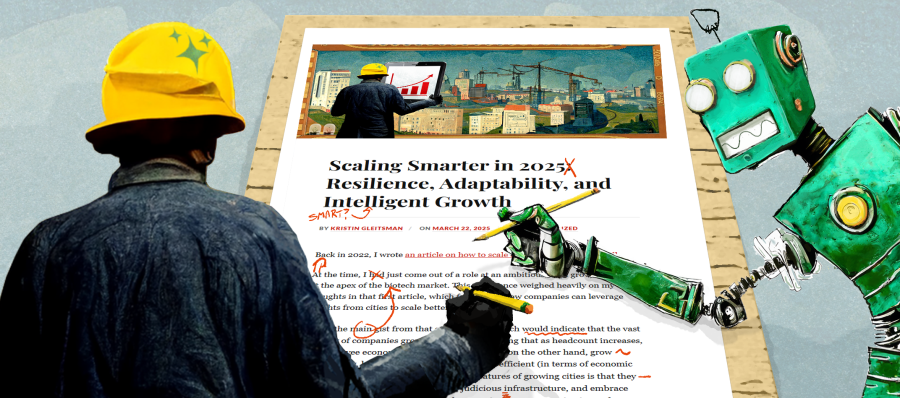
Illustration of a human foreman in a construction helpmet co-editing a blog article from this website with a stylized, green robot

Scaling Thought, Not Just Content: Field Notes from the Messy Middle of Co-Writing with ChatGPT

When I started the revised 2025 version of the Scaling Well series, I didn’t want to simply write ABOUT AI and its impact to scaling companies in 2025. I wanted to experience actively collaborating with it on a project that is deeply meaningful to me.

This piece is my reflection of that experience. While co-writing the previous two articles, I made notes about the process and want to share a behind-the-scenes look at how I think this experiment went. This isn’t meant to be a hype story, nor is it a cautionary tale. It’s field notes from the messy middle of using a new set of tools in hopes of discovering its strengths and weaknesses.

If you’re a curious leader, a stretched-thin builder, or someone who keeps hearing “AI can help” and thinking, “Help with what, exactly?”—you’re in the right place.

In the sections that follow, I’ll walk you through the prompts I used, the questions I asked, the traps I hit, and the patterns that emerged.

The intention is not to provide a plug-and-play workflow* though. In sharing my experiences with structure, friction, and the occasional detour into AI-generated nonsense, I hope to help others scale insight, not just output.

What This Is Really About

Despite all the buzz about AI multiplying people’s output, that wasn’t my primary goal as a writer. Or maybe that was the dream initially, but what became abundantly clear through the process is that one key benefit of working with AI was that it forced me to make my thinking clearer in order to co-produce something useful, without losing my voice.

On its own, ChatGPT didn’t do the work for me. The work became meaningful when I treated ChatGPT like a fast-learning collaborator— prompting it to ask me questions for reflection, or challenging it to critique my logic or clarity.

That’s not to say that there wasn’t a boost to my speed— working with AI definitely helped get me unstuck from staring at a blank page faster than ever before. But the bigger payoffs were the added clarity, repeatability, and a surprising amount of fun.

These payoffs really became apparent once I stopped expecting AI to generate ready-made content and started using it to help me distill what I actually wanted to say.

The breakthrough wasn’t what AI wrote—it was getting past the tyranny of the blank page and getting clear about what I wanted to say.

The Process (Messy, Real, Repeatable)

Approaching this collaboration with ChatGPT as an exercise in “getting AI to write an article for me” did not work.

Here’s what did.

1. Align with yourself and your AI collaborator first

One thing that surprised me in learning to use ChatGPT more effectively is how much of a Rorshark test it can be. If you don’t know what you want to say, you’re very likely to end up with a lot of ‘well written’ fluff. In the ‘olden days’ of writing without AI, clarity creation was part of the outlining and drafting process. Having ChatGPT as a super fast writing partner can sometimes shortcut the crucial step of figuring out what point you’re even trying to make. So, what seems to work better is to start with getting to clarity… with your genAI collaborator.

“Pasted below are my initial thoughts on scaling companies, please ask me 3 multiple choice questions one at a time to make sure we’re aligned.”

That clarity up front mattered more than I expected.

Further along in the writing process, ChatGPT can continue to add clarity:

“Please first ingest the below pasted text, then ask me 5 multiple choice questions one at a time to help us align on how to get to 10-fold improvement across the above metrics (and please suggest one additional metric to improve).”

The responses could be quite revealing. When answering these questions, I realized that half the time I didn’t know what I had really intended in my initial text until had to formulate these answers. It was like mirror to my own ideas, showing me angles I’d otherwise glossed over.

2. Don’t neglect structure and cohesion

“Find 3 places where transitions could be tighter or a seed could be planted for a later section. Give me 3 options for each.”

The results didn’t always land, but they exposed choices I hadn’t seen yet—and that very valuable.

Add something about chunking work – to keep the ai focused and to keep you focused too.

3. Calibrate tone on the fly

Without additional work, AI tends to gravitate towards the middle in its output. If you don’t mind generic mediocre writing, maybe that’s okay. But I wanted writing that sounded like me. Luckily, tone can be moderated fairly easily. In doing so, it provides another opportunity to review what the goals of your writing are, and if the text is achieving those goals.

“Let’s align the tone with the overall tone we are going for in the article.” (Spoiler alert: you’re going to need to define what that tone is)

“Section 1 feels a little fluffy and too long. Ask me 3 multiple choice questions to help us align on what we’re trying to say in section 1.”

Here it can also help if you’ve done your own writing in the past— you can input examples of past writing and ask ChatGPT to create a one-page style guide defining your writing style, and then use that to continually refocus the output. You can also have verbal interviews with ChatGPT and then ask it to ‘write like I talk,’ which is sometimes helpful in breaking free from the default indiscriminate bot language.

While shifting tone might seem like a photo filter at first, these adjustments to tone proved to be more than just editing tricks. They were valuable thinking tools as well.

4. Check your sources

At this point, you’ve probably heard that AI is prone to hallucinate details in order to satisfy your request. As it turns out, that’s not something you can simply ask it to improve upon, although there are ways to tune the model for accuracy versus creativity, and some LLMs are better at one thing than the other. At the end of the day, it’s your name going on the article, so you should probably just buckle up and do the homework of making sure the references are correct and on point.

“Flag anything not backed up by a real source. Let’s verify links and decide together how to fix anything questionable.”
Spoiler: most links were still broken. I fixed them (okay, actually my husband did that part).

5. Save what’s working

In working through this process for multiple pieces, one of the products I aimed to create was the repeatable process itself. This was something the AI proved helpful with, consolidating longer conversation threads into something closer to a reusable recipe.

“Review this whole conversation. Create a repeatable process others could follow.”

That became the scaffold I’m still using now.

And when a section still felt fuzzy? I read it aloud to my husband. The AI helped sharpen the thinking and do the initial drafting; he helped catch what still didn’t land.

What Surprised Me (and Might Surprise You)

My biggest surprise: I didn’t expect to enjoy the process quite so much. I thought I’d be sifting through AI garbage and editing it into something usable.

Instead, I found myself getting sharper—because I had to. The tool was fast, literal, and indifferent to context; if I wasn’t clear, it absolutely wasn’t. And that kind of brainstorming was really fun, not too different from a good brainstorm with a fellow human.

That was the first surprise.

The second was how much more I wanted to engage with the work once I had structure for working with ChatGPT in place. I wasn’t stuck at the blank page. I had a system of prompts and checkpoints that gave me momentum. Not faster, exactly—but steadier. And significantly less painful to start.

The last surprise: it really felt like collaboration.

When I gave it real direction—alignment prompts, tone corrections, specific feedback—it became a decent thought partner. Not insightful on its own, but responsive in a way that made my thinking more visible. It didn’t generate depth; it paved the way for me to get there faster.

Final Thoughts

From my experience co-writing with ChatGPT, generative AI isn’t necessarily a shortcut. You certainly can’t skip the thinking part of writing. What it provides instead is scaffolding—something to push against, iterate with, and structure the parts of thinking that usually get stuck in your head.

While it offered language, I honed in on shaping meaning. And the act of shaping—deciding what to keep, what to cut, what to say—was where the clarity came in.

The output was better (*more on that from my husband). The thinking was clearer. And the work of writing felt more engaging and joyful than it has in a while.

Not because the tool was smart—because the process was.


Appendix: High-Impact Prompt Set for Thoughtful Co-Writing with LLMs

Clarify the Thinking First

Use these to align on purpose, sharpen ideas, and build momentum.

  1. “Ingest the following text. Ask 3 multiple choice questions—one at a time—to clarify intent, audience, and core argument.”
    Purpose: Forces you to name your aim before drafting begins.
  2. “Based on the ideas below, ask 5 multiple choice questions—one at a time—to explore how we might 10x the impact. Then suggest one metric I may be overlooking.”
    Purpose: Pushes past surface iteration into leverage-based thinking.
  3. “Review this full exchange. Summarize the workflow we followed. Write it as a 5-step process someone else could reuse.”
    Purpose: Codifies emergent process into shareable frameworks.

Lock in Voice and Tone

Use these to calibrate writing style across tools or collaborators.

  1. “Ingest this sample of my writing. Create a 1-page voice guide: tone, structure, sentence length, common patterns, and language quirks.”
    Purpose: Teaches the model your style explicitly—reusable across tools.
  2. “Match the tone of this section to my writing style guide. Highlight any areas where the tone drifts or feels generic.”
    Purpose: Enforces consistency without losing precision.
  3. “Here’s how I explain this verbally. Mirror the rhythm and phrasing—make it sound like a well-edited transcript of me.”
    Purpose: Removes formality and aligns with natural delivery.

Deepen Structure, Reduce Bloat

Use these to improve flow, argument strength, and readability.

  1. “Identify 3 transition points where flow weakens or ideas shift too abruptly. Suggest 2 alternate transitions or reframing options for each.”
    Purpose: Strengthens internal scaffolding, especially across sections.
  2. “Analyze this section. What’s the underlying assumption? Is it clearly supported? Suggest one way to reinforce or challenge it.”
    Purpose: Prevents unexamined logic from slipping through.
  3. “Review this section. What’s actually doing the work? What can be cut without losing meaning?”
    Purpose: Helps trim filler while preserving depth.

Expand Insight, Avoid Shallow Thinking

Use these when your piece feels too safe, too obvious, or not sharp enough.

  1. “Take the role of a skeptical executive. What would they question here? Suggest 2 ways to preempt or clarify the concern.”
    Purpose: Builds in resistance testing before real-world exposure.
  2. “List 3 ways this idea could backfire in real use. What failure modes or misinterpretations should we proactively address?”
    Purpose: Adds robustness and resilience to big ideas.
  3. “What part of this actually feels new or non-obvious? Highlight it. What parts sound like filler or expected takes?”
    Purpose: Prioritizes originality and edge—especially in thought leadership.

Fact-Check and Refine Responsibly

Use these when citations, claims, or integrity are at stake.

  1. “Review the draft below. Flag any factual claims or data points that lack a source. Suggest how to verify or reframe.”
    Purpose: Reduces hallucination traps, keeps credibility intact.
  2. “List every link, citation, or claim in this piece. Verify each one. Highlight any that are outdated or broken.”
    Purpose: Turns verification into an explicit task—not an afterthought. You should still verify the results

Meta-Prompt for Debugging & Reflection

  1.  “Reflect this draft back to me in plain English. What’s clear, what’s muddled, and what’s trying too hard?”
    Purpose: Works like a mirror. Best used before a big share-out.

Illustration of a scientist pitching a new project to a finance-oriented executive

Net Present Value: Making the Financial Case for Advancing Scientific Projects You Care About

Well folks, we really saved the best for last here. In our final post on Finance for Scientists, we’ll be talking about one of the single most valuable tool I have learned in my adventures in finance: Net Present Value.

Why is NPV such a helpful concept for scientists? Because this tool is used by your business and finance counterparts to decide whether a particular project is worth pursuing. It is used to answer the question: relative to the low risk option of holding onto the cash needed to fund a given new project, how much money could this project generate over a particular time horizon? Understanding how NPV is calculated can not only help you make better sense of your company’s decisions, it can also help you structure projects in such a way as to make them more likely to be palatable to upper management (play around with these tools a bit and you will have a whole new appreciation for why timelines are so important.)

So what is NPV?

Net Present Value (NPV) is a way of measuring how much money an investment will generate in the future, compared to how much it costs today. NPV takes into account the time value of money, which means that a dollar today is worth more than a dollar tomorrow, because you can invest it and earn interest.

NPV is a powerful tool and the finance professional’s first choice for analyzing capital expenditures. There are three key reasons for this:

  1. It takes into account the time value of money. Future cash flow is discounted to understand their value in today’s dollars.
  2. It considers a business’s cost of capital or other hurdle rate. Cost of capital is the return expected by those who provide capital for the business. Hurdle rate is the minimum acceptable rate of return investors use to analyze profitability when evaluating a potential investment. In other words, NPV takes into account the specific situation of the business (which you will see shortly includes current interest rates).
  3. It provides an answer in today’s dollars, allowing you to compare the initial cash outlay with the present value of the return.

So, to calculate NPV, you need to estimate the future cash flows (inflows and outflows) of the investment, and discount them by a certain rate that reflects the risk and opportunity cost of the investment. The discount rate is usually based on the cost of capital or the expected return of similar investments. The NPV is the sum of all the discounted cash flows.

The discounting equation looks like this:

PV = FV1/(1+i) + FV2/(1+i)2 + … + FVn/(1+i)n

PV = Present Value

FV = projected cash flow for each time period

i = discount or hurdle rate

N = number of time periods (typically years in biotech/diagnostics) you are looking at

NPV = PV – initial cash outlay

For example, suppose you want to invest in a new diagnostic device for a rare disease. You estimate that the device will cost $10 million to develop and launch, and will generate $2 million per year for 10 years. You also estimate that the discount rate for this project is 10%, which means that you expect to earn 10% per year on average from similar investments.

To calculate the NPV, you need to discount each cash flow by 10% per year.

So, for the first year, the discounted cash flow is:

$2 million / (1 + 0.1) ^ 1 = $1.82 million

For the second year, it is:

$2 million / (1 + 0.1) ^ 2 = $1.65 million

And so on, until the tenth year:

$2 million / (1 + 0.1) ^ 10 = $0.77 million

The NPV is the sum of all these discounted cash flows, minus the initial cost of $10 million:

NPV = ($1.82 million + $1.65 million + … + $0.77 million) – $10 million

NPV = $3.17 million

This means that investing in this device will generate a net profit of $3.17 million in today’s dollars, after accounting for the time value of money and the risk of the project.

However, this calculation assumes that the cash flows are certain and constant, which is rarely the case in reality. In practice, there are many uncertainties and risks involved in developing and launching a new diagnostic device, such as regulatory approval, market demand, competition, pricing, reimbursement, etc. These factors can affect both the amount and timing of the cash flows.

To account for these uncertainties and risks, some analysts use a modified version of NPV called risk-adjusted NPV (r-NPV). r-NPV adjusts each cash flow by multiplying it by a probability factor that reflects the likelihood of achieving that stage of development or commercialization. The probability factor is usually based on historical data or expert opinion.

Interest and Discount Rates vs. Your Research Project

Let’s talk briefly about interest rates and their impact on discount rates. Having never taken an economics class before, my mind was blown the first time someone walked me through this information, and it certainly has helped me better understand our current macroeconomic headwinds and Wall Street’s collective obsession with interest rates.

Higher interest rates mean a higher opportunity cost for funds. If your CFO uses a hurdle rate of 20%, it means she is pretty darn confident she can get almost that much return elsewhere for a similar level of risk. A high hurdle rate then sets a very high bar for new investments. When interest rates are high, there is always the low risk option of just sitting on your cash and still getting a pretty attractive return. So high interest rates increase the bar for investment. Similarly, if you need to raise capital to invest in this new opportunity, the cost of that capital will be higher due to the higher interest rates.

Conversely, if interest rates are very low, almost everything is better than sitting on your cash, so there is pressure for growth and investment. This situation was responsible for the halcyon days of 2019-2021. But as we are seeing now, because time scales are long in the biotech and life sciences sector, companies can get caught out by assuming that low interest rate/cost of capital days will last forever. And we are seeing this situation play out now as companies jettison development programs in order to preserve cash in the current economy (i.e., the discount rate has changed, so NPV calculations done in 2021 likely do not hold in 2024, and some opportunities are no longer worth pursuing— another reason why everyone likes shorter project timelines).

In summary, interest rates and NPV have the following relationship:

  • As the interest rate increases, NPV decreases, and the bar for what a good investment is increases
  • As the interest rate decreases, NPV increases, and the bar for what a good investment is decreases

One other important factor for scientists to consider in NPV calculations (which WILL be used to evaluate whether your pet project is worthwhile), is how the cost of the project is being estimated and how the projected cash flow is being estimated.

To do that, let’s go all the way back to the beginning of this series and think about the income statement. To refresh your memory, below is our favorite BioTechne example:

Screenshot of Bio-Techne Income Statement

Many of the line items here will be used to estimate projected returns, so you need to know how your particular project is being ‘burdened,’ for example, with SG&A.

Quick example: let’s say you are developing a new product that runs on top of an existing platform. It will require some R&D investment, but because you are leveraging an existing platform, those costs are smaller than a new product that requires a totally new platform to be built. So your initial cash outlay will be smaller. Similarly, operating costs associated with running something on an existing platform will be relatively low (and scale with product volume). As a result, as you are calculating your projected cash flow, you would want to include some incremental operating costs in the first years after launch that then scale with sample volume. Conversely, if this new product requires building out a new sales and marketing team, those expenses can dramatically decrease the return expected in the early years after launch. However, if you are creating a new offering for an existing sales channel, then your returns will be higher. G&A can usually be approximated as a percentage of overall volume.

All of these details will be important to understand as you are thinking about starting a new line of research, and then to consider more carefully (and this part is usually led by finance) when putting together the business case. Having your own understanding about these calculations can help you challenge assumptions that your finance team may be making that cause the business case to look significantly worse than it ought to. Similarly, as a savvy scientist, you can perhaps think about ways to decrease the upfront spend or brainstorm with your business development and marketing colleagues on alternative routes to revenue in the early days post product launch (can you reach some customer segments through existing channels? Are there channels that have lower regulatory or reimbursement requirements that can be accessed sooner? etc.). And by running a minimal NPV analysis for yourself in the initial concept phase of projects, you can get a feel for the likelihood of eventual success and prioritize your efforts accordingly.

I could probably write another 3 posts on NPV, if this topic is of sufficient interest to folks (reach out in the comments).

Otherwise, I will leave you with a few useful resources as I close out the final planned post of this series!

Thanks for following along! And a big thank you to Jeff Krimmel for inspiration and the authors of Financial Intelligence. A Manager’s Guide to Knowing What the Numbers Really Mean (Karen Berman and Joe Knight) for their easy-to-read book on finance!

Illustration of a scientist explaining business finance concepts

Why am I writing about finance?

Many scientists and engineers I’ve worked with have expressed frustration at not being able to have the kind of influence they want over the strategic directions of the companies in which they work. Oftentimes they feel their perspectives are being dismissed, particularly in discussions with colleagues in other functions.

But in the wise words of a mentor of mine, ‘if you want business people to listen to you, you have to be able to speak in a language they will understand.’ That language is, by and large, the language of finance. If you can frame the opportunities you see in language that your non-scientific colleagues can easily understand (and then explain to the board of directors), your ideas are much more likely to gain traction.

Similarly, scientific leaders will be better equipped to identify and prioritize scientific programs and investments if they can connect the dots between technical advancements and the ever-important bottom line (which, it turns out, refers to an actual line in the income statement!).

So my hope is that when armed with a little better financial intelligence, scientists and engineers can start to bridge the gap between the technical aspects of our business and the business end of the business.

Of course, I myself am one of these scientists. And so a big part of why I am writing this series is to force myself to dig deeper into some of the learnings I have gleaned from books, podcasts, and articles along the way (including frantically looking up terms like GAAP and EBIDTA during earnings calls and executive meetings). By virtue of my scientific background, hopefully the language I use throughout this series will be a little less opaque and a little more understandable for those of us who are more likely to be reading Nature articles than the Economist.

Specifically, in this mini-series, we will cover:

  • Some basics on financial statements
  • The big three financial statements (and their component parts):
    • the income statement
    • the balance sheet
    • the cash flow statement
  • Key ratios or evaluating the financial health of a business
  • Numbers investors care about and why
  • How to understand whether a new project/investment has (financial) merit through Net Present Value

To start, a couple references and an important acknowledgement. My initial foray into the wonderful world of finance was inspired by my friend Jeff Krimmel’s frequent LinkedIn posts on business and strategy in the energy sector. Jeff and I met as PhD students at Caltech, and I have been awed by his seamless transition from hardcore engineering to business and strategy, and am always impressed by his insightful discourse. I highly recommend checking out Jeff on LinkedIn and perusing his mini-course on Energy Finance. You’ll notice that this course closely mimics his course in places (with his blessing).

Another important source here is the book, Financial Intelligence. A Manager’s Guide to Knowing What the Numbers Really Mean, by Karen Berman and Joe Knight. It’s a great read and has many details that I won’t cover in this series.

In any case, I hope you enjoy! I would love to hear your questions, thoughts, and comments along the journey. And if you are really keen, join my mailing list so you don’t miss the future installments of this series.

Powered by WordPress & Theme by Anders Norén