Leadership in Biotech

Tag: debt

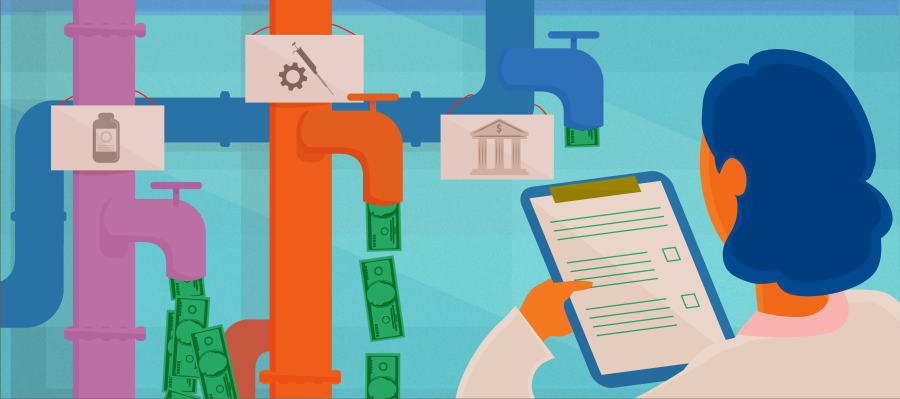
Illustration of a scientist looking at three pipes with money pouring out of them at different rates, representing different aspects of a cash flow statement

The Anatomy of a Cash Flow Statement: Operating, Investing, and Financing

Recall from last time the cash flow statement from BioTechne, and the three main sections.

  1. The first part describes cash flow from operating activities.
  2. The second part is cash flow from investing activities.
  3. The third part is cash flow from financing activities.

Screenshot of the BioTechne Cash Flow Statement

Let’s take these sections one by one.

Operating Activities

As is typical, the first part of the BioTechne cash flow statement describes cash flow from operating activities.

This is the cash the business collected from customers, minus all the cash that was left as any part of the process of producing goods or delivering services for customers. Many consider this category to be the single most important number for understanding the health of the business, because it signals how well the company is doing at turning profits into cash.

In our current economy, many biotech companies are dreaming about having a healthy operating cash flow. This is because a healthy operating cash flow means that further company growth can be internally funded, instead of needing to borrow or sell stock. And when interest rates are high and stock prices are low, external funding options are not particularly attractive.

Investing Activities

The second part is cash flow from investing activities.

Here we find available-for-sale investments, additions to property and equipment, and acquisitions. This section tells us something about how much cash the company is spending on investing for the future. If this number is low relative to the size of the company, then management may be treating the company as a ‘cash cow’ or potentially positioning itself for an acquisition. If the number is high, the company likely has high hopes for the future.

Let’s briefly compare BioTechne to Beckton Dickenson and Illumina on this front by making up a ratio so we can normalize by company size: cash flow from investing (amount spent in investing, so this is actually a negative number)/net income. For BioTechne in 2023, this ratio is 260,893,000/ 835,382,000 = 0.31, this is considerably higher relative to the previous year: 78,281,000/817,371,000 = 0.096. For BD, we get 3,220,000,000/18,870,000,000 = 0.17. For Illumina, 591,000,000/4,584,000,000 = 0.12. In the case of BioTechne in 2023, we see a big investment in Wilson Wolf, a manufacturing firm that invents, designs, and manufactures innovative cell culture devices and associated ancillary products, which accounted for almost 90% of the total investments.

Financing Activities

The third part is cash flow from financing activities.

This is where we find the cash transfers involving the owners or creditors of the business. We see debt repayment, new debt, share repurchases or issues, dividend payments, etc., all here. This category is where we can see the extent to which the company is dependent on outside financing. A positive number here indicates that cash has come into the company through financing activities. A negative figure here indicates when the company has paid out capital, such as retiring or paying off long-term debt or making a dividend payment to shareholders.

For BioTechne, comparing the last couple years is pretty interesting: in 2022 BioTechne used $177,125,000 in financing activities (repurchasing common stock and paying off long-term debt), whereas in 2023, 46,838,000 was provided by financing activities (cash coming into the business, primarily through a line of credit agreement worth 619,661,000, while also paying off long-term debt).

I was a little curious about this part, so I dug around in the footnotes and found this statement:

“In October 2018, the Company entered into forward starting swaps designated as cash flow hedges on outstanding debt. The forward starting swaps reduce the variability of cash flow payments for the Company by converting the variable interest rate on the Company’s long-term debt described in Note 6 to that of a fixed interest rate. … In May 2021, the Company entered into a new forward starting swap designated as a cash flow hedge on forecasted debt. The forward starting swap reduces the variability of cash flow payments for the Company by converting the variable interest rate on the Company’s forecasted variable interest long-term debt to that of a fixed interest rate.”

Aren’t footnotes fun? 😉

Summary Section

After the cash flow from financing activities, you can see a summary section:

Screenshot of a summary from the BioTechne Cash Flow Statement

One interesting thing to notice here is the first line, ‘Effect of exchange rate changes on cash and cash equivalents.’ If you recall from our very first substantive post on finding financial statements using EDGAR and its utility in learning a new-to-you business, BioTechne listed international exchange rates (the price of one currency expressed in terms of another currency) as one of their financial risks, as is fairly typical in the Life Sciences. Let’s dig into this topic a bit further here.

Whenever a company from one country does business in another, the financial health of its operations will be affected by changes in exchange rates. Let’s say you buy 96-well plates from China, at a price of $0.50 USD per plate, and you are buying ~200,000/month, for a total of $100K transacted per month. With an exchange rate of ~$1 USD for 7 Chinese Yuan, you are paying 700K Yuan for these plates, or 3.5 Yuan per plate. Now let’s imagine the exchange rate changes to $1 USD = 7.5 Chinese Yuan. Each plate still costs 3.5 Yuan, but you now need only $0.47 USD for each plate, meaning your monthly order just got cheaper by ~$7K USD. The opposite situation, where the Yuan becomes stronger against the dollar as it did in the beginning of 2022, will lead to your monthly order costs effectively going up. This example is pretty simplistic, but hopefully it provides a sense of why exchange rates are important for companies with global supply chains.

And that concludes our consideration of the cash flow statement, and wraps up our dive into the three main financial statements (income statement, balance sheet, and cash flow statement).

In the next post, we’ll move on to touch on key financial ratios and why they are important. It’s not too late to join the mailing list to receive an update when it’s published!
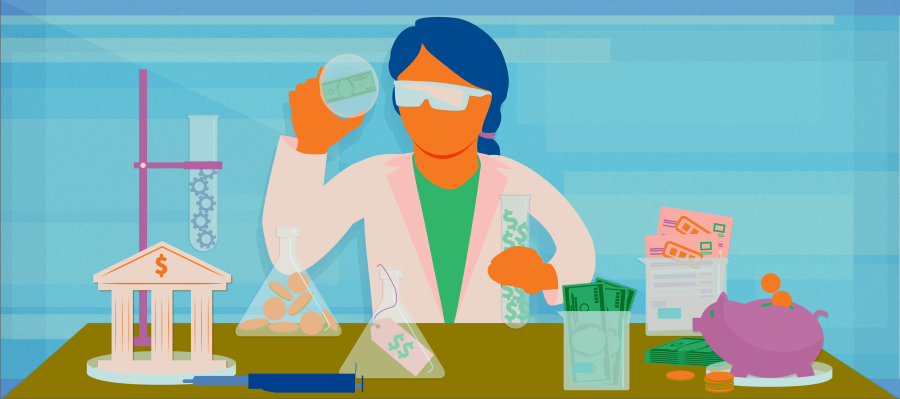

Illusration of a scientist examining concepts from the liabilities and equity portions of a financial balance sheet

Decoding Financial Health with Liabilities & Equity from the Balance Sheet

Back to the balance sheet, specifically liabilities and equity.

In the previous post, we mentioned the fundamental equation of accounting:

Assets – Liabilities = Equity

We also walked through an example of assets from the BioTechne balance sheet.

Looking at liabilities

Now, let’s look at Liabilities. Quite simply, liabilities are what a company owes. 

Let’s take a look at BioTeche’s liabilities in their 2022 Balance Sheet.

Screenshot of the Liabilities portion of a Bio-Techne Balance Sheet

Here we see (balance sheet language is in parentheses):

  • The payments owed to the company’s vendors, e.g. service companies, raw material providers, etc. (Trade accounts payable),
  • future payment of employee salaries, benefits, etc. (Salaries, wages, and related accruals),
  • catch-all bucket (Accrued expenses),
  • pre-paid goods and services owed to customers (Contract liabilities),
  • expected taxes owed in the next 12 months (Income taxes payable),
  • lease payments due over the next 12 months (Operating lease liabilities- current),
  • expected near-term conditional payments that were agreed upon during an acquisition (Contingent consideration payable),
  • the amount of loans that due this year (Current portion of long-term debt obligations),
  • …and so on…

Just like the asset section, you can see there are two chunks of numbers for liabilities.

Any liabilities that require us to part with cash in a year or less are “current liabilities”. If we expect our cash outlay to come over a year in the future, we are dealing with “noncurrent liabilities”.

Equity in the equation

Now we get to equity.

Owners’ equity as what’s left over once you subtract liabilities from assets. It includes the capital provided by investors and the profits retained by the company over time. As you can see in the BioTechne balance sheet below, equity is referred to as ‘Shareholders’ equity,’ which is common, as is ‘Stockholders’ equity.’

Here’s what the equity portion of the BioTechne balance sheet looks like:

Screenshot of the Equities portion of a Bio-Techne Balance Sheet

The big picture from the balance sheet

We’ll close our introductory balance sheet conversation with a quick zoom out on how to use the balance sheet to evaluate a company’s financial health.

  • Is the company solvent? Is equity a positive number?
    • for BioTechne, the answer is yes
  • Can the company pay its bills? How do the current cash assets compare with liabilities?
    • cash for BioTechne is at ~$127M and current total liabilities are at ~$141M, which looks bad at first glance, until you notice that there are $217M in accounts receivable, so BioTechne seems quite likely to be able to pay its bills
  • Is the financial health of the company moving in the right direction? Is the equity increasing over time?
    • for BioTeche, this is a yes

You can quickly get answers to these very basic questions from the balance sheet. Investors and other interested parties can also dig deeper to get a more complete picture of a company’s financial health and prospects through the balance sheet, the ever-important footnotes, and careful comparisons to other financial statements.

A few deeper questions to consider: how important is ‘goodwill’ to the company’s total assets line? What assumptions have been used in depreciation and amortization? Is equity rising because the company is making money or because of an inflow of capital?

Let’s quickly look at goodwill for our BioTechne example. In 2023, goodwill accounts for just over 30% of BioTechne’s total assets, which seems pretty hefty. But for our comparator, Becton Dickenson, goodwill is nearly half of its total assets in 2023. For Illumina in 2023, it was ~25%, down from 46% in the previous year (interesting to dig into why, but that will have to wait for another day).

I hope you see how much we can learn about a company just by studying its balance sheet. We get real insights into its viability, and the tools available for future growth.

In the next part, we’ll move into the wonderful world of cash flow. Sign up for the mailing list so to stay updated!

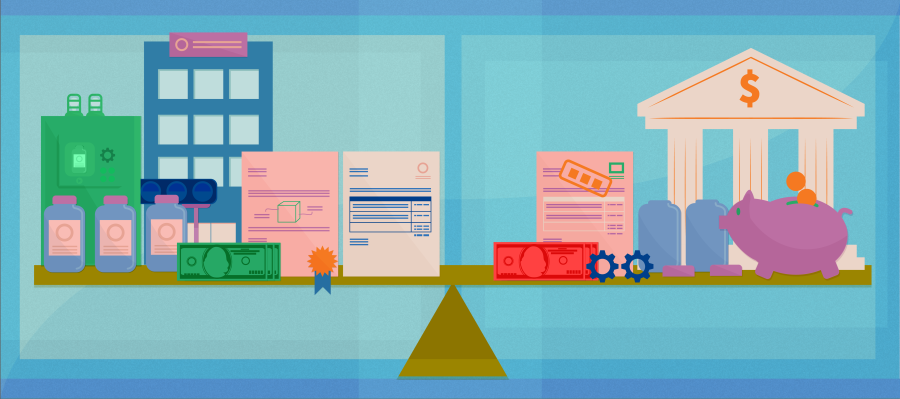
Illustration of various elements of a balance sheet, such as patents, cash and due invoices, sitting in balance on a seesaw

Using the Balance Sheet to Understand a Company’s Financial Health

To review, the big three in terms of financial statements are:

  • the income statement,
  • the balance sheet, and
  • the cash flow statement.

In this post, we will talk about the importance of a balance sheet.

Remember that a balance sheet tells us what a company owns, i.e. its assets, versus what it owes, i.e. its liabilities.

Equity measures the extent to which assets exceed liabilities, and is what “belongs” to the owners of the company.

Assets and liabilities are connected with equity via the fundamental equation of accounting:

Assets – Liabilities = Equity

Why do we care about balance sheets?

First, healthy companies have more assets than liabilities. And looking at how assets, liabilities, and equity have trended over time helps us understand whether a company is getting healthier or sicker.

Profitability (discussed in the income statement section) relates to equity, in the same way a grade in college relates to your overall GPA. You can think of profitability sort of like a single course grade, whereas equity is more like your grade point average. A single course grade will influence your GPA, but it doesn’t define it. Similarly, a strong quarter of profits will increase the equity in your balance sheet, and vice versa. Over time, the equity reflects the accumulation of profits and losses.

Second, balance sheets tell us about leverage (here’s a fun vocabulary lesson for you: a financial analyst’s word for debt is leverage). How much debt does the company rely on?

The higher the debt load, the higher the company’s debt service costs, which reduces its ability to invest or spend in other ways.

Balance sheet takeaways

These are the kinds of questions about a company’s financial health that you can answer with the balance sheet:

  • How much debt does the company have relative to equity?
  • How liquid is the business in the short term (less than one year)- can it pay its bills?
  • What percentage of assets are tangible and what percentage comes from financial transactions?
  • Is the financial health of the company moving in the right direction- is the equity increasing over time?

Short post for today, but next time we’ll dig into the first part of the balance sheet: Assets, including a particularly interesting asset category called ‘Goodwill.’

Powered by WordPress & Theme by Anders Norén