
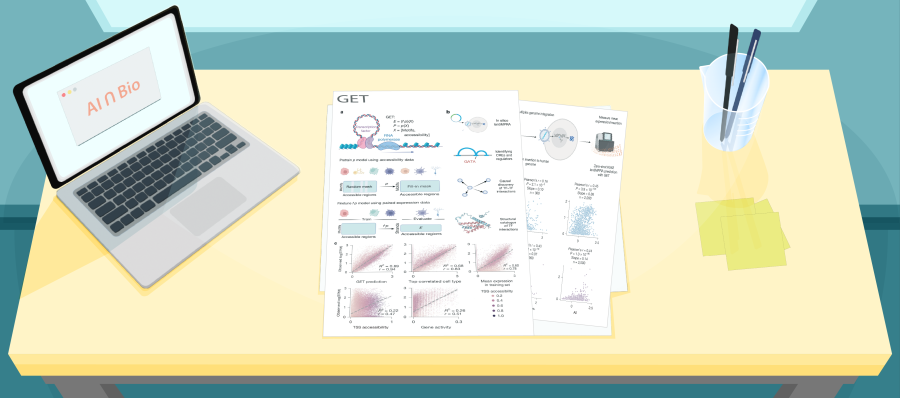
Tl;dr Statistical generalization isn’t scientific understanding—don’t confuse prediction with insight. Foundation models like GET may predict gene expression patterns from clean data and learn patterns that appear biologically meaningful, but that’s not the same as understanding transcriptional regulation. Its outputs should be treated as hypotheses to interrogate—not definitive answers.
This week’s AI ∩ Bio: Reading the Revolution series features a recent Nature paper on “General Expression Transformer” (GET), a deep learning model trained to predict gene expression across 213 human cell types using DNA sequence and chromatin accessibility data. It’s ambitious: a transformer architecture that claims to learn the “grammar” of transcription, generalize across diverse cell types, and model long-range interactions between enhancers and promoters, as well as between transcription factors (TFs). In one case study, the authors link a leukemia-associated genetic variant (a SNP) to a disrupted protein–protein interaction between TFs, using AlphaFold structural modeling.
The aim is compelling—bringing together machine learning, epigenomics, and protein structure prediction. GET outperforms previous models like Enformer on several tasks, including prediction of reporter assay results (like MPRA) and identifying enhancer–promoter relationships. It also offers interpretability features, such as motif-level and region-level importance scores, which are an improvement over traditional “black box” models. And yes, it suggests potential utility: in theory, GET could aid in prioritizing noncoding variants or mapping regulatory networks.
But here’s the catch: GET requires both DNA sequence and chromatin accessibility data from the specific cell type of interest. You can’t simply input a variant file (like a VCF from whole-genome sequencing) and get back useful predictions. At best, you can explore hypotheses using accessibility data from public reference tissues—helpful for interpreting genome-wide association study (GWAS) results, but not yet practical for clinical use.
The generalization here is statistical—not biological, and certainly not clinical. GET was trained on harmonized, high-quality single-cell datasets from healthy human tissues. It performs well on similar data it hasn’t seen before—but that’s a narrow slice of human biology. Clinical samples, especially those from inflamed, cancerous, or drug-altered environments, often have chromatin landscapes and transcriptional programs that fall outside the model’s training distribution. High correlation on held-out healthy data doesn’t guarantee reliability under pathological conditions. The model is rigorous in its computation—but its clinical readiness remains speculative.
To early-career scientists: Always know the limits of your tools. Foundation models can learn statistical patterns that look biological, without understanding the underlying mechanisms. A model trained on chromatin accessibility may capture useful correlations, but not the dynamic, causal logic of transcription. And interpretability tools like motif importance scores are only meaningful if they lead to testable, falsifiable predictions that hold up under rigorous testing. Treat every output as a hypothesis to challenge.