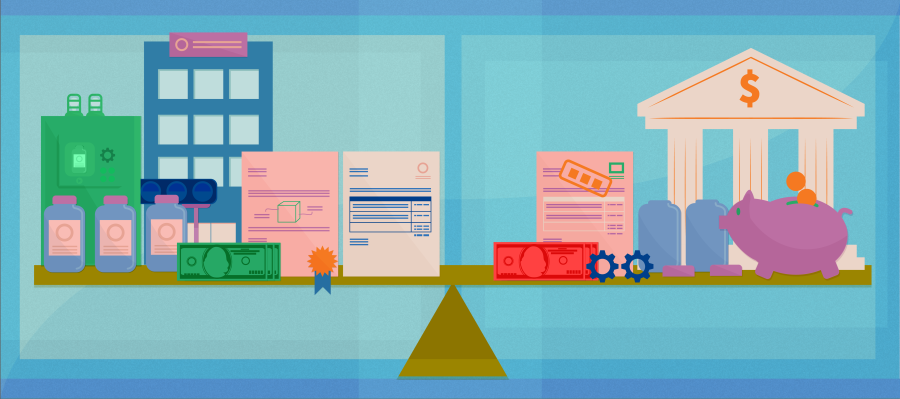

Back to the balance sheet, specifically liabilities and equity.
In the previous post, we mentioned the fundamental equation of accounting:
Assets – Liabilities = Equity
We also walked through an example of assets from the BioTechne balance sheet.
Looking at liabilities
Now, let’s look at Liabilities. Quite simply, liabilities are what a company owes.
Let’s take a look at BioTeche’s liabilities in their 2022 Balance Sheet.

Here we see (balance sheet language is in parentheses):
- The payments owed to the company’s vendors, e.g. service companies, raw material providers, etc. (Trade accounts payable),
- future payment of employee salaries, benefits, etc. (Salaries, wages, and related accruals),
- catch-all bucket (Accrued expenses),
- pre-paid goods and services owed to customers (Contract liabilities),
- expected taxes owed in the next 12 months (Income taxes payable),
- lease payments due over the next 12 months (Operating lease liabilities- current),
- expected near-term conditional payments that were agreed upon during an acquisition (Contingent consideration payable),
- the amount of loans that due this year (Current portion of long-term debt obligations),
- …and so on…
Just like the asset section, you can see there are two chunks of numbers for liabilities.
Any liabilities that require us to part with cash in a year or less are “current liabilities”. If we expect our cash outlay to come over a year in the future, we are dealing with “noncurrent liabilities”.

Equity in the equation
Now we get to equity.
Owners’ equity as what’s left over once you subtract liabilities from assets. It includes the capital provided by investors and the profits retained by the company over time. As you can see in the BioTechne balance sheet below, equity is referred to as ‘Shareholders’ equity,’ which is common, as is ‘Stockholders’ equity.’
Here’s what the equity portion of the BioTechne balance sheet looks like:

The big picture from the balance sheet
We’ll close our introductory balance sheet conversation with a quick zoom out on how to use the balance sheet to evaluate a company’s financial health.
- Is the company solvent? Is equity a positive number?
- for BioTechne, the answer is yes
- Can the company pay its bills? How do the current cash assets compare with liabilities?
- cash for BioTechne is at ~$127M and current total liabilities are at ~$141M, which looks bad at first glance, until you notice that there are $217M in accounts receivable, so BioTechne seems quite likely to be able to pay its bills
- Is the financial health of the company moving in the right direction? Is the equity increasing over time?
- for BioTeche, this is a yes
You can quickly get answers to these very basic questions from the balance sheet. Investors and other interested parties can also dig deeper to get a more complete picture of a company’s financial health and prospects through the balance sheet, the ever-important footnotes, and careful comparisons to other financial statements.
A few deeper questions to consider: how important is ‘goodwill’ to the company’s total assets line? What assumptions have been used in depreciation and amortization? Is equity rising because the company is making money or because of an inflow of capital?
Let’s quickly look at goodwill for our BioTechne example. In 2023, goodwill accounts for just over 30% of BioTechne’s total assets, which seems pretty hefty. But for our comparator, Becton Dickenson, goodwill is nearly half of its total assets in 2023. For Illumina in 2023, it was ~25%, down from 46% in the previous year (interesting to dig into why, but that will have to wait for another day).
I hope you see how much we can learn about a company just by studying its balance sheet. We get real insights into its viability, and the tools available for future growth.
In the next part, we’ll move into the wonderful world of cash flow. Sign up for the mailing list so to stay updated!