The PNAS Perspective by Tiwary et al. takes on one of the hardest open questions in modeling-driven science: can generative AI predict emergent phenomena?
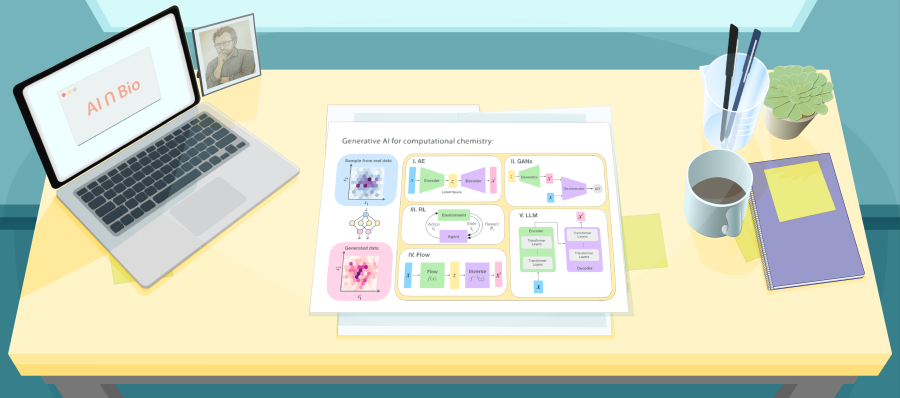
The authors trace a careful path through the foundations of both computational chemistry and generative modeling, bridging statistical mechanics concepts like force fields and free energy landscapes with architectures including autoencoders (AEs), generative adversarial networks (GANs), flow-based diffusion models, and large language models (LLMs).
Their central argument deserves attention: models capable of predicting emergence must embed physical laws, not merely fit datasets. Statistical mechanics, thermodynamics, and quantum constraints aren’t optional. The bright spots in the field are already moving this way. Reinforcement learning grounded in the principle of maximum caliber, diffusion models inspired by nonequilibrium thermodynamics, and hybrid frameworks like AlphaFlow and AF2RAVE all point toward a new synthesis: physics as foundation, generative AI as engine.
Yet the conditional structure of biological and chemical systems sets hard limits. Most training sets collapse critical variables (temperature, solvent composition, ionic strength, and conformational heterogeneity) into latent noise. Without explicit conditioning, models risk conflating context-dependent behavior with sequence- or structure-intrinsic features. What the field needs next are frameworks that make those assumptions explicit: guidance on when each class of model is appropriate, how to diagnose failure, and how to measure progress beyond visual plausibility or interpolation accuracy.
Leadership angle
For those leading or investing in AI-driven science, the message is clear: the next leap won’t come from larger models alone, but from tighter coupling between representation and reality. The teams that will lead this next wave are those fluent in both the language of data AND the laws that govern it.
Mentorship angle
For early-career scientists, this is an invitation to think rigorously about foundations.
Learn the physics as well as the Python.
Understand how bias enters your data and what it does to inference. The next breakthroughs won’t come from models that memorize reality, but from those that explain it, and can then predict new emergent phenomena.