
Leadership in Biotech

Tag: frameworks

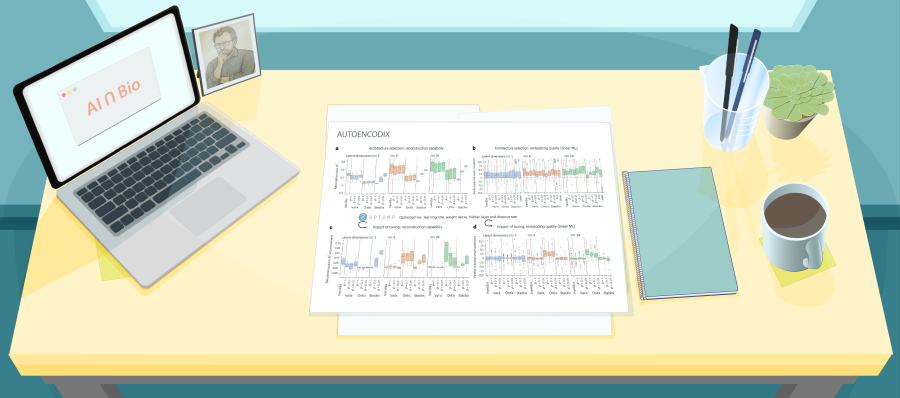
Illustration of a desk with a figure from a recent paper about AUTOENCODIX

Interpretable Latent Spaces, Messy Biology: What AUTOENCODIX Teaches Us About Autoencoders in the Wild

This week in AI ∩ Bio I dug into AUTOENCODIX, an open-source framework that stress-tests autoencoders (AEs) on real multi-omics data.

The punchline: no single architecture wins, reconstruction scores can mislead, and “interpretable” latent spaces inherit every bias baked into our ontologies. This paper provides exactly the kind of clarity we need to effectively apply these models in diagnostics and biomarker discovery.

AUTOENCODIX is a new open-source framework that tries to bring order to the AEs chaos in multi-omics, allowing the user to test multiple AEs through the same pipeline, then compare not just loss curves but how useful the learned embeddings actually are for biology and prognosis. (AEs explained in carousel)

Scientifically, a few themes stood out:

  1. they show how tuning β in VAEs affects performance; low β favors reconstruction; high β imposes compact, disentangled latent spaces.
  2. across TCGA and single-cell cortex data, no AE architecture consistently outperforms others. Good reconstruction doesn’t guarantee useful embeddings. Ontix, the biologically structured AE, wires decoder layers to known pathways or chromosomes, making latent dimensions interpretable. But robustness varies and depends on learning rate; and the results hint at artifactual learning (see comments).

Diagnostics-leadership perspective

This paper is a reminder to separate infrastructure from insight.

AUTOENCODIX is essentially AE infrastructure: it standardizes data handling, model training, and evaluation so you can ask disciplined questions instead of chasing whichever architecture is trending.

The results also challenge the reflex to equate fancier models with better clinical value: PCA remains a very strong baseline, and ontology-based models only shine when the chosen ontology matches the question and is treated carefully as a potential source of bias, not ground truth.

For leaders deciding where to invest, the take-home is: fund frameworks that make comparisons fair and reproducible, and judge models by task-relevant endpoints and robustness across cohorts—not by reconstruction loss or aesthetic latent plots.
For early-career scientists

There’s a quieter lesson here about how to work with powerful tools without giving up your scientific spine.

The authors don’t present a magical autoencoder that “solves” multi-omics; instead, they map trade-offs, show when tuning helps and when it doesn’t, and surface uncomfortable findings like decreased robustness after hyperparameter optimization for ontology-based VAEs.

If you’re building a career in computational or experimental biology, papers like this are an invitation to open the hood: run the benchmarks, break the assumptions, test models on tasks you actually care about, and treat interpretability as something you design and stress-test—not something you assume.

Skip to PDF content
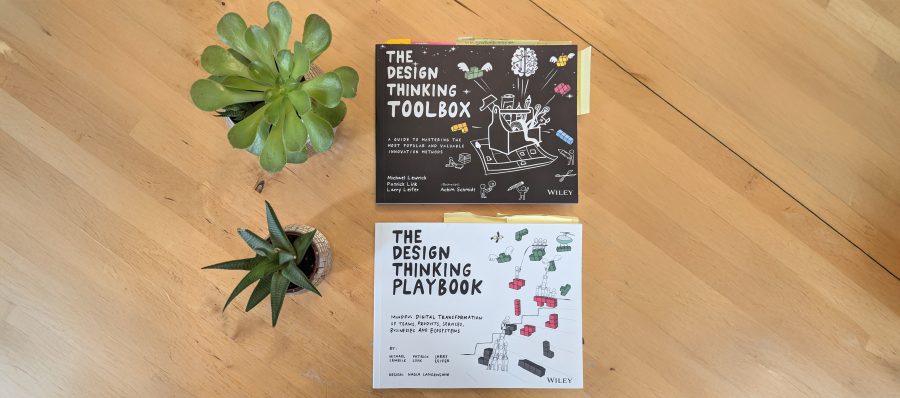
Photo of The Design Thinking Toolbox and The Design Thinking Playbook on a wooden table, next to two small houseplants

From Sticky Notes to Systems: What Design Thinking Taught Me

Why I Bought These Books

If I’m remembering correctly, like most of the good books in my life, I first checked The Design Thinking Toolbox out of the library. I didn’t necessarily expect much, mostly just a quick skim for ideas. But I found myself bookmarking pages, jotting down thoughts on sticky notes, and eventually admitting the obvious: I needed to own it. And if I was going to own it, I might as well get The Design Thinking Playbook too.

These books became part of my early days building the Discovery function at Veracyte. One of the first clear priorities I was given was to design an “Innovation Day” — which I immediately rebranded as Discovery Day. “Innovation” belongs to everyone, and I didn’t want a single team cornering that territory. Discovery, on the other hand, is an invitation.

The event eventually became an annual gathering of leaders from across our globally distributed organization: a chance to explore the trends shaping the future of diagnostics and translate those insights into Discovery priorities for the year ahead.

But in those first few weeks, all I knew was this: If people were going to fly across the world to sit in a room together, we couldn’t have them passively listen. The day had to be interactive. Engaging. Alive.

So I turned to design thinking for inspiration, and these books delivered.

They gave me concrete ideas for workshops, facilitation frameworks, and hands-on ways of bringing people into the conversation. They reminded me how to separate divergent and convergent thinking so we didn’t collapse creativity before it could breathe. They helped me draw out voices from across functions and levels, and design an experience that felt energizing rather than performative.

And the influence didn’t stop at Discovery Day.

What Design Thinking Means in My Leadership

Design thinking has become one of the engines of how I lead.

At its core, design thinking gives me a disciplined way to bring people together around complex problems. Not to perform collaboration, but to practice it. It pushes me to create rooms where people feel invited in, where ideas can breathe, and where we resist the urge to collapse creativity too quickly.

It’s also a structural reminder: explore before you evaluate; diverge before you converge; listen before you decide. That sequence has shaped how I architect conversations, how I build alignment across functions, and how I design cultures that don’t default to the loudest voice in the room.

It’s not about sticky notes.

It’s about designing practices and systems that surface insight, reduce fear, and make it easier for people to see what’s possible together.

Powered by WordPress & Theme by Anders Norén