Leadership in Biotech

Tag: generative ai

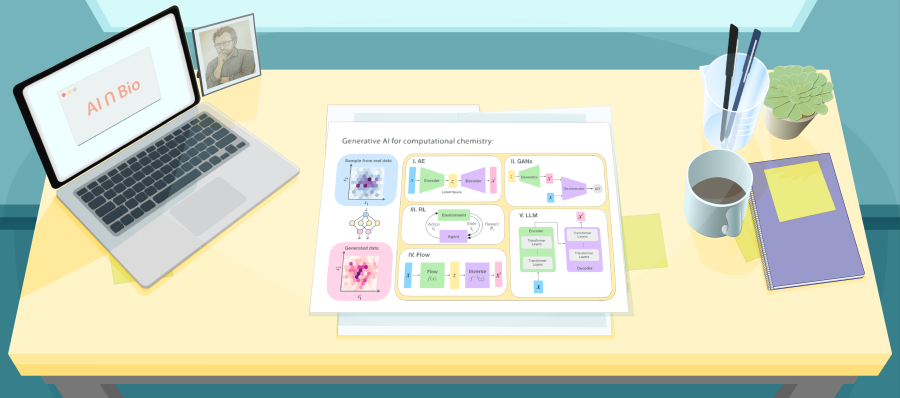
Illustration of a desk with a figure from a recent paper about generative AI and emergent phenomena

Can generative AI predict emergent phenomena?

The PNAS Perspective by Tiwary et al. takes on one of the hardest open questions in modeling-driven science: can generative AI predict emergent phenomena?

The authors trace a careful path through the foundations of both computational chemistry and generative modeling, bridging statistical mechanics concepts like force fields and free energy landscapes with architectures including autoencoders (AEs), generative adversarial networks (GANs), flow-based diffusion models, and large language models (LLMs).

Their central argument deserves attention: models capable of predicting emergence must embed physical laws, not merely fit datasets. Statistical mechanics, thermodynamics, and quantum constraints aren’t optional. The bright spots in the field are already moving this way. Reinforcement learning grounded in the principle of maximum caliber, diffusion models inspired by nonequilibrium thermodynamics, and hybrid frameworks like AlphaFlow and AF2RAVE all point toward a new synthesis: physics as foundation, generative AI as engine.

Yet the conditional structure of biological and chemical systems sets hard limits. Most training sets collapse critical variables (temperature, solvent composition, ionic strength, and conformational heterogeneity) into latent noise. Without explicit conditioning, models risk conflating context-dependent behavior with sequence- or structure-intrinsic features. What the field needs next are frameworks that make those assumptions explicit: guidance on when each class of model is appropriate, how to diagnose failure, and how to measure progress beyond visual plausibility or interpolation accuracy.

Leadership angle

For those leading or investing in AI-driven science, the message is clear: the next leap won’t come from larger models alone, but from tighter coupling between representation and reality. The teams that will lead this next wave are those fluent in both the language of data AND the laws that govern it.
Mentorship angle

For early-career scientists, this is an invitation to think rigorously about foundations.

Learn the physics as well as the Python.

Understand how bias enters your data and what it does to inference. The next breakthroughs won’t come from models that memorize reality, but from those that explain it, and can then predict new emergent phenomena.


Close up of three people's hands as they use two laptops at a glass table

Case Studies in Connection: Designing Collaboration to Build Trust

When we rolled out GenAI at Veracyte, we didn’t cluster people by department. Instead, we formed peer-led learning groups around use cases:

  • Writing and editing
  • Coaching and feedback
  • Brainstorming and ideation
  • Data privacy and governance

Over six weeks, each group honed its particular use case and shared tips in real time. People definitely got better at using the tools, but something even more powerful happened alongside the skill-building.

New connections sparked across the company

Scientists were suddenly learning from sales reps. Legal and customer care were comparing notes on data privacy. Folks who had never spoken before started to understand each other’s struggles, frustrations, and sources of joy.

By designing collaboration around shared problems instead of org charts, we unlocked trust and empathy. The highlight for many participants — according to our post-program survey — wasn’t just new GenAI skills, it was the relationships and perspective they gained.

That’s the hidden power of collaboration-by-design:

  • Trust builds faster when people tackle real challenges together.
  • Boundaries soften when connections cross silos.
  • Innovation compounds when people see the bigger picture of the work.

AI was the reason we gathered, but connection was the outcome. And in a world where loneliness is a quiet threat to performance, those connections may be the most enduring thing we built.

Question for you: How do you design collaborations in your org so they intentionally build trust — not just output?

Close-up photo of a person's hands as they use their laptop. Next to the laptop is a coffee mug with an "infinity peanut" logo printed on the side

Case Studies in Connection: Shared Identity in Action

At our recent team onsite in San Diego, the agenda wasn’t shaped around big dinners or polished presentations. When we asked the group what they wanted to do together, the answers were rituals we’d loved before and wanted to keep alive:

  • Infinity peanut (our design-thinking infinity loop exercise).
  • Pictionary Telephone (aka Eat Poop You Cat 🙃).
  • Team tee shirts.

On the surface, these are silly traditions, but they actually carry a lot of weight. The bad drawings from Pictionary Telephone now hang as office art. The tees feel like a uniform of belonging (it makes me smile every time I see someone in a meeting wearing a team tee). Even the infinity peanut loops back as a reminder of how we think and work together.

They’re fun, yes — but they’re also statements of identity:

  • We co-create our experiences.
  • We take the work seriously, but we don’t take ourselves too seriously.
  • We’re willing to look a little ridiculous in service of connection and learning.
  • We remember and retell our stories.

That’s the key: the rituals only become culture when the stories and artifacts keep them alive.

Here’s where I see AI being helpful. At Veracyte, I’ve already seen people use GenAI to generate artwork and slogans for peer-led learning groups during our initial GenAI rollout. It turned participation into artifacts that reinforced the group’s identity.

Imagine AI as a culture co-pilot:

  • Turning silly hand drawings into tee-shirt or sticker designs (no graphic designer required).
  • Weaving micro-stories from team rituals into onboarding packets or thank-you notes.
  • Resurfacing shared jokes and touchstones at milestones so the culture “remembers itself.”

The tech doesn’t replace the ritual. It helps the meaning stick.

Question for you: What’s one team ritual you’d love to see preserved, retold, or reimagined with a little AI help?

Powered by WordPress & Theme by Anders Norén