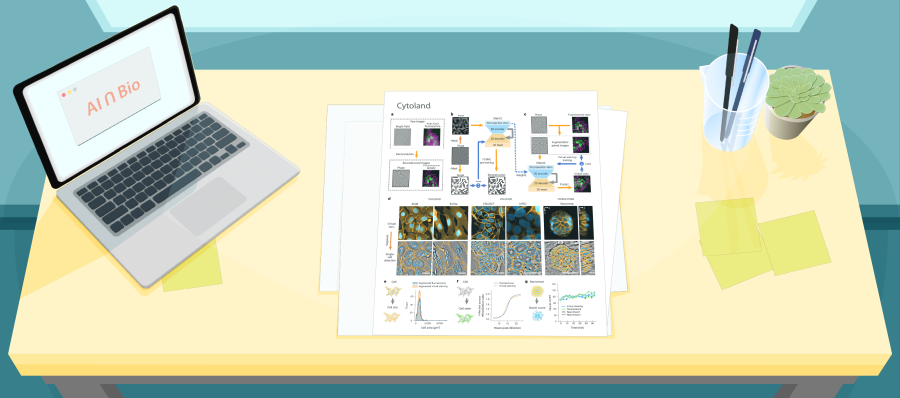
This week’s AI ∩ Bio: Reading the Revolution series covers Cytoland, a collection of models for robust virtual staining of landmark organelles across diverse imaging parameters, cell states and types.
The core idea of Cytoland
Cytoland introduces a set of deep learning models for virtual staining—predicting fluorescent labels of key organelles (nuclei, membranes) from label-free microscopy data like quantitative phase images (QPI). These models overcome current limits in generalization, robustness, and data efficiency, offering practical tools for label-free live-cell phenotyping across multiple cell types, imaging setups, and biological contexts.
Basically, the paper introduces a methodology to use AI to predict what a fluorescent image would look like—based only on label-free data (like phase contrast or brightfield). Think of it as teaching the model to “see” the nucleus or membrane without physically tagging them.
Why this matters
Virtual staining isn’t just a cool trick—it can fundamentally shift how we do live-cell imaging, avoiding time and engineering resources to make fluorescent labels for every experiment. And crucially, Cytoland models are open-source, tested on real-world problems, and robust enough to use across microscopes, labs, and cell systems.
In the AI ∩ Bio landscape
This paper is a landmark example of precision engineering, not algorithmic revolution. It does what so many papers fail to do: combine deep learning, physics, and real experimental constraints into a system that’s usable and robust.
You don’t get this kind of robustness without deep domain expertise. You have to understand how microscopes work, what makes a label “missing” vs. “invisible,” and how to design models that hold up in the real world. The magic happens not in the model itself, but at the intersection of thoughtful AI design, careful data collection, and biological insight.
For early-career scientists
The breakthrough isn’t just in the model—it’s in:
- Asking biologically meaningful questions
- Collecting the right data
- Designing AI that respects the physics and messiness of real experiments
You don’t need to invent new algorithms to do impactful AI ∩ Bio work.
What matters more is:
- Understanding what matters biologically (e.g., membranes over time, infection states, tissue development)
- Designing training and validation that respects experimental complexity
- Building models that generalize to the messiness of real world data
Learn how to ask scientific questions that AI can help answer, and how to design datasets and metrics that hold models accountable to real biological use.