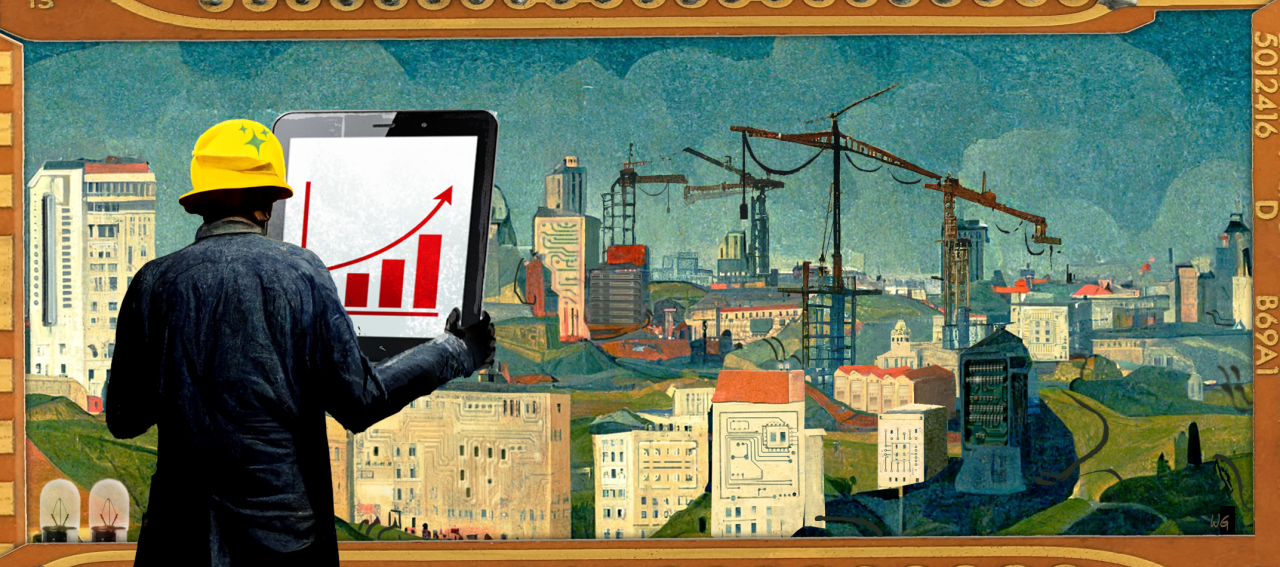
Back in 2022, I wrote an article on how to scale companies and teams well.
At the time, I had just come out of a role at an ambitious, high growth company at the apex of the biotech market. This experience weighed heavily on my thoughts in that first article, which focused on how companies can leverage insights from cities to scale better.
Here’s the main gist from that article: the research would indicate that the vast majority of companies grow sublinearly—meaning that as headcount increases, per-employee economic output declines. Cities, on the other hand, grow superlinearly, becoming more innovative and efficient (in terms of economic output) as they expand. Some of the key features of growing cities is that they foster continuous idea flow, optimize judicious infrastructure, and embrace decentralized decision-making. So the question is: can organizations adopt these principles to unlock superlinear growth? (Geoffry West, Scale)
It’s now 2025, and things look very different. For one, ‘growth at all costs’ has been replaced by ‘get to profitability.’ Secondly, generative AI has provided a whole new set of tools for scaling businesses without necessarily adding new headcount or employing human contractors.
With these new forces shaping our collective reality, I want to revisit some of the main themes from the original article, and provide some new perspectives on what it means to scale well. And because genAI has incredible potential in scaling workforces and companies, I decided I would collaborate with ChatGPT in this article, so what you are reading is a combination of me and ChatGPT (I’ll come back to how this experience was in my final post on this topic— stay tuned). Let’s dive in.
1. Designing for Slack: Innovation and Bottleneck Prevention
One of the key frameworks discussed in the original article is that scaling well requires deliberate slack in resourcing. Some level of slack and redundancy should not be seen as inefficiency, but as a strategic lever for innovation and resilience.
The scientific backbone behind this idea comes from queuing theory. Queuing theory tells us that as a system nears 100% utilization, inefficiencies spike exponentially. In cities you see this phenomenon during rush hour traffic, when roads are at capacity. In companies, you see this phenomenon in supply chains, network traffic, decision-making, and engineering velocity (Kashef, 2019). Organizations that operate at full capacity leave no room for iteration, problem-solving, or market shifts.
Whereas in 2022, designing for slack mainly meant allowing for some strategic redundancy in human resources, AI now offers new ways to create smart slack, not just by freeing up human capacity, but also by helping teams preempt bottlenecks before they emerge.
For example, modern AI-driven knowledge systems (like Notion AI or Stack Overflow for Teams) reduce key-person dependencies, ensuring critical expertise is documented, searchable, and shareable.
The other possibility that AI opens up is simply reduced time spent on routine tasks, thereby opening up additional capacity in your existing workforce. In other words, training your workforce on how to effectively (and safely) use AI tools can help companies ‘find time.’ Instead of loading up the team with new work, allowing this ‘found’ time to be used for structured slack can pay dividends. Imagine if every knowledge worker in your company suddenly had 20% more free time. Could this slack be used like Google’s 20% time, which produced Gmail and Google Maps (Tran, 2017) to produce outsized returns on innovation?
2. Investing in Infrastructure and Other Shared Resources Without Slowing Down
One of the biggest failure points in scaling is making the wrong decisions on what functions to centralize vs distribute, particularly in moving from a one product company to having a portfolio of multiple products. Too much centralization slows decision-making and leads to conflict as multiple projects try to draw on the same resources. Too much decentralization leads to inefficiency, duplication, and chaos.
Cities scale by balancing shared infrastructure with distributed autonomy— local businesses tap into municipal sewer lines and electric grids, for instance, and leverage shared city parking lots. Companies should think hard about which functions they want to be their ‘shared infrastructure,’ and cultivate those resources thoughtfully. At the same time, most cities don’t strictly mandate the number of Burmese restaurants or whether yet another rug store can move into a vacant storefront, nor do cities micromanage local business beyond compliance to city ordinances. Analogies for these ideas exist in corporations as well, and providing local autonomy with reasonable guardrails can enable companies to move fast without being overly centralized.
Based on how cities approach infrastructure, in 2022 my guidance was the following: (1) Put highly interdependent teams together, since organizing closely linked functions into clusters reduces cross-team friction. (2) Invest early in infrastructure teams. Underfunding internal platforms, DevOps, and enablement functions will stall scaling efforts. Just as you can’t expect new housing developments to be successful in areas with no power or water (at least in the US), you can’t expect employees to be productive if they have to spend half their energy fighting ineffective infrastructure. (3) Adopt a ‘Team of Teams’ approach by organizing into dynamic, goal-oriented teams and decentralizing decision-making to shorten communication paths within the organization.
In 2025, all of these approaches remain highly relevant. If anything, investing in infrastructure teams that enable smart AI usage has become even more critical to scale well, as unlocking AI tools is a powerful lever for improving efficiency across the organization.
These generative AI tools can then significantly enhance a ‘Team of Teams’ approach. For instance, enterprise-level AI-driven platforms have begun to emerge that leverage conversational AI to streamline internal communication, automate employee support, and provide real-time analytics (example: Moveworks).
3. Scaling Culture Through Intentional Culture Creation
Effective use of slack and structure is foundational, but truly scalable growth requires individuals to independently advance the mission, openly share information, and foster collective intelligence without constant oversight, and this comes from the culture and norms you create. A cohesive culture—essentially “how things get done around here”—is shaped by shared knowledge, expectations, and behaviors, thereby reducing the need for top-down control (Joly, 2022; Clayton, 2019).
Unlike cities, where culture evolves organically, organizations must intentionally shape cultural norms. Leaders must articulate clear behavioral expectations, reward aligned behaviors, and visibly model cultural values.
Three key perspectives from 2022 for building the cultural foundations for scaling well included: (1) Focus on new leadership for maximal cultural impact, because leader behavior is a key determinant of overall organizational culture (ed. Constable, 2023). (2) Onboard to build belonging. Culture creates the foundation for belonging, which in turn leads to better employee engagement and lower attrition. (3) Scale belonging through peer-led groups. Allow peer networks to reinforce cultural norms as well as fostering connection and belonging.
In 2025, these perspectives continue to be crucial. By leveraging generative AI tools, companies now have powerful tools for providing real-time feedback and personalized coaching at scale without hiring an army of coaches or HR business partners. Companies can fairly easily create/train their own custom GPT tools to be specific for their culture and values, or partner with any number of emerging companies on the task of integrating AI tools across the enterprise communication suite (Teams, Slack, WorkDay, etc), so that coaching for culture can occur in the flow of work and has a larger specialized training dataset (example: Pinnacle AI).
Here are few additional specific use cases I have been noodling on over the past few months as I myself have started diving in to my own AI learning journey:
- Create a customized leadership avatar that gives your team a safe, low-stakes environment to practice high-impact conversations. We’ve all experienced moments we’d like to replay or improve critical interactions; an AI-powered avatar offers your team real-time feedback and personalized coaching, building confidence before they step into crucial discussions.
- Use generative AI to tailor your communication based on DISC or other behavioral profiles, ensuring your message resonates effectively with different audiences. For example, as someone who tends toward detailed, lengthy emails, I’ve found AI incredibly helpful for crafting concise messages better suited to busy executives, as well as thoughtfully adjusting tone in high-stakes or potentially sensitive situations.
- Amplify the impact of peer-led coaching circles by leveraging AI-driven matching platforms (such as Together or Circles) to pair participants thoughtfully, based on shared goals, interests, and cultural alignment. With customized training on your organization’s values and norms, AI tools can also generate meaningful discussion prompts and real-time insights, strengthening cultural cohesion and engagement across distributed teams.
Conclusion
Scaling companies is still messy and hard in 2025, maybe even harder because of increased global uncertainty and current economic conditions. However, by drawing inspiration from cities and harnessing new generative AI tools, we can scale more intentionally and adaptively, even amid inevitable chaos. And maybe, just as with cities, embracing that chaos—with a touch of AI-powered magic—is precisely what can help organizations thrive and scale despite the challenges.
Comments
Powered by WP LinkPress