Leadership in Biotech

Tag: llm

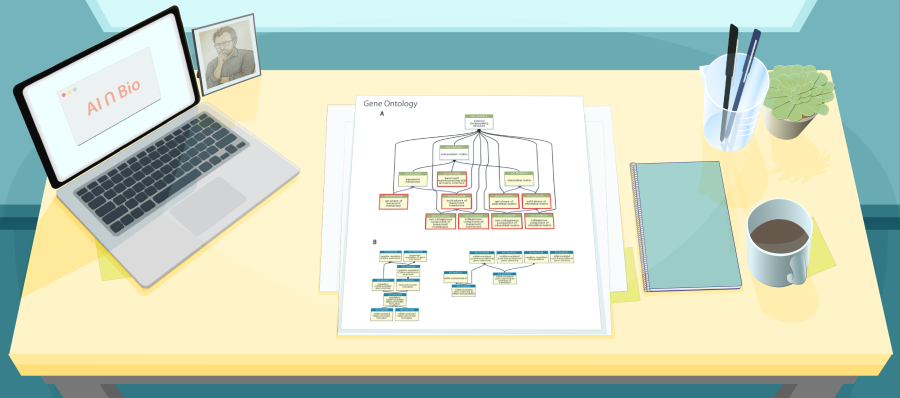
Illustration of a desk with a figure from a recent paper about GeneOntology

The Gene Ontology Knowledgebase in 2026

This year’s Gene Ontology (GO) update is a reminder that infrastructure choices shape scientific conclusions, getting to the heart of this foundational tool for understanding biology at a time when omics, enrichment analyses, and AI models increasingly rely on GO as biological “ground truth.”

Are you new to Gene Ontology? See the PDF for a deeper dive.

What actually changed (2022–2025)

A few highlights that matter in practice:

  • Major ontology cleanup: hundreds of new terms added, thousands of imprecise or redundant terms obsoleted.
  • Human Functionome v2.0: a reviewed, integrated annotation set now covering ~84% of human genes, reducing enrichment clutter while preserving biological relevance.
  • GO-CAMs scaled up: >1,500 expert-curated causal pathway models linking gene activities with evidence, moving beyond flat gene lists toward mechanistic flow.

Why this paper matters for diagnostics, AI, and innovation leaders
GO and AI models share something important: both are compressions of complex biology.

  • Gene Ontology is a structured compression of current biological knowledge, but lack explicit biological context.
  • Genomic language models are statistical compressions of high-dimensional data, but lack biological grounding.
  • GO provides a curated prior (a biological sanity check) but it abstracts away context (cell state, disease, rewiring). In cancer, that context is often the signal. Used well, GO disciplines thinking and prevents nonsense. Used naively, it produces answers that look rigorous, but are nonsensical.
  • The opposite risk exists with genomic language models. They learn dense embeddings that can capture patterns not explicitly labeled, but the derived “understanding” is not mechanistic by default; it’s statistical compression. And they can overindex on historical data distributions, which can amplify biases.

An intriguing option (and a common one in many recent AI Bio papers), is to combine Gene Ontology with language models.

For example:
Language model → propose;
Gene Ontology → check.

Use a language model to propose functional/interaction hypotheses from data & Gene Ontology to flag things like contradictions and flag known process vs believable novelty vs likely nonsense.

A note to early-career scientists

Impact doesn’t only come from novelty. It comes from:

  • caring about definitions and evidence,
  • understanding the assumptions baked into your tools,
  • and knowing where structure helps, and where it hides uncertainty.

Bridge discovery with discipline, and insight with infrastructure, and you’ll do work that lasts.

Skip to PDF content
Illustration of a desk with a figure from a recent paper about BIOREASON

From Prediction to Explanation: How BIOREASON Reframes Genomic AI as a Reasoning Problem

While DNA foundation models like Evo2 and Nucleotide Transformer can encode genomic sequences into dense, information-rich embeddings, they still operate as black boxes—excellent at prediction, poor at explaining why. Large language models offer the opposite tradeoff: they excel at generating explanations but treat DNA as unstructured text, without any built-in understanding of motifs, regulatory grammar, or sequence constraints.

What BIOREASON Does

BIOREASON introduces a multimodal architecture that fuses:

  • A frozen DNA foundation model to encode biological sequence semantics
  • A fine-tuned LLM that ingests both the embeddings and natural-language context

This pairing enables:

  • Natural-language reasoning grounded (at least in theory) in genomic content
  • Generation of interpretable, mechanistic chains (variant → pathway → phenotype)
  • Improved predictive performance relative to either the DNA FM or LLM alone

But what do DNA embeddings “mean”?

Short answer: we don’t know—and that uncertainty is inherent to foundation models.

  • These embeddings are latent representations learned through massive unsupervised training.
  • They’re presumed to encode motifs, conservation, splicing signals, or regulatory cues because the model needed those features to solve its training task.
  • They are not human-interpretable.

BIOREASON treats these embeddings as a kind of “biological fingerprint,” trusting that an LLM can learn to reason over them with enough supervised examples. The gamble is that:

  • The DNA model has learned useful biological grammar
  • The LLM can exploit those learned signals to answer new questions

But there’s no explicit decoding or truth-checking of what the embeddings represent internally.

Why reasoning faithfulness still isn’t guaranteed

The <think> traces produced by BIOREASON are not probabilistic, validated, or causally guaranteed. The model “believes” its chain, but you must judge its soundness.

Anthropic’s “Reasoning Models Don’t Always Say What They Think” (Chen et al., 2025) shows why this matters: reasoning-tuned models often rely on subtle internal shortcuts, then fail to verbalize them, generating fluent but misleading explanations. BIOREASON inherits the same risk.

Key concerns:

  • Explainability ≠ faithfulness
    A coherent chain does not mean the model followed that chain internally.
  • Potential post-hoc rationalization
    The model may rely on correlations or dataset artifacts, then wrap them in a plausible narrative.
  • Compromised auditability
    If the chain isn’t faithful, transparency becomes performative rather than informative.
  • Hidden biases or shortcut features
    The model might use annotation frequency, ClinVar priors, or pathway prevalence without ever stating so.
  • Lack of mechanistic grounding
    True mechanistic understanding would require identifying which embedding dimensions or sequence contexts drove the decision. The <think> chain alone cannot provide this.

Let’s step back: What’s genuinely novel here?

Despite its limitations, BIOREASON introduces several meaningful advances for the field.

Fusion of Biological Foundation Models with Language Reasoning

Traditional models split into two camps:

  • Models that understand sequence biology (Enformer, Evo2, Nucleotide Transformer)
  • Models that generate explanations (GPT-style LLMs)

BIOREASON bridges these worlds:

  • Anchors reasoning in sequence-aware embeddings
  • Trains the LLM to produce structured, biologically grounded explanations

Why this matters

It reframes variant interpretation as causal narrative inference—a closer match to how human scientists reason.

Structured Explainability via <think> Tokens

Most genomics tools output scores or saliency maps. BIOREASON outputs reasoning.

  • <think> traces formalize a stepwise, human-auditable chain
  • Explanation becomes part of the training objective, not a reverse-engineered artifact

Why this matters

This is one of the first genomics models to explicitly train for mechanistic-style explanation.

A Real Multimodal Interface for Genomics

Multimodal architectures (image+text, audio+text) are flourishing, but genomics has lagged.

BIOREASON shows:

  • DNA sequences can be treated as semantic inputs
  • LLMs can generate biologically coherent outputs when grounded in embeddings

Why this matters

It opens the door to models that integrate DNA, RNA, protein, expression, and literature signals—moving us nearer to true AI lab partners.

Raises Critical Questions About Faithfulness

By making reasoning visible, BIOREASON forces the field to confront fundamental issues:

  • What does it mean for a model to “understand” a variant?
  • How do we measure explanation fidelity, not just fluency?
  • How can we prove the model’s logic is driven by sequence rather than language priors?

Why this matters

These questions will shape the evaluation standards for biological AI over the next decade.

Final Thought

BIOREASON’s contribution isn’t that it solves variant interpretation. It’s that it reframes the problem as reasoning, not classification. It pushes us closer to models that narrate mechanistic hypotheses—but it also reminds us why faithfulness, causal testing, and biological grounding matter just as much as model performance.

With stronger embeddings, uncertainty calibration, perturbation tests, and wet-lab validation, this line of work could become a cornerstone of how AI collaborates with scientists in the years ahead.

Illustration of a desk with figures from recent papers about DeepEvolve and AlphaEvolve

From AlphaEvolve to DeepEvolve: What We’re Learning About Machine-Led Scientific Discovery

Over the past year, AlphaEvolve (DeepMind) and DeepEvolve (Liu et al.) have taken on one of science’s most audacious challenges: can machines not only execute discovery but originate it? Both leverage large language models (LLMs) to iteratively evolve algorithms through feedback and automated evaluation.

AlphaEvolve reframed discovery as code evolution: LLMs proposing edits, testing them, and optimizing against performance scores. DeepEvolve extends this paradigm by integrating deep research: literature retrieval, structured reasoning, multi-file implementation, and automatic debugging. Together, they signal a shift from code-writing tools to more active scientific collaborators and raise foundational questions about what counts as “understanding.”

Scientific Insight

AlphaEvolve’s achievements are real and impressive: it discovered a novel algorithm for 4×4 matrix multiplication, improving on a benchmark that had stood since 1969. But its limitations are equally instructive. When optimization is tethered entirely to scalar reward signals, models risk learning how to perform rather than how to understand.

DeepEvolve addresses some of this by incorporating retrieval-augmented reasoning and grounded iteration, showing measurable gains across nine domains—from molecular property prediction to polymer engineering. Yet the deeper challenge persists: these systems can refine heuristics, but they cannot yet articulate principles; the boundary between discovery and reward chasing remains unresolved.

Leadership Angle

For R&D leaders in life sciences or diagnostics, these systems are both technical achievements and strategic case studies.

Peter Drucker once warned: “What gets measured gets managed—even when it’s pointless to measure or manage it.” In the context of these papers, the risk is clear: if we measure only performance, we may optimize into blind alleys. The opportunity lies in designing systems (and organizations!) that ask better questions, not just produce better scores.

Mentorship Angle

For early-career scientists, the message isn’t to fear or avoid these tools (please don’t, these tools are amazing!), but to understand their limitations. AlphaEvolve and DeepEvolve can automate exploration, but perhaps not judgment. They can generate thousands of hypotheses in hours, but still depend on human insight to distinguish signal from noise. And require careful thought in setting up reward systems that uncover real meaning in the context you care about.

In a world where even machines can “research,” the defining trait of good science will be the discipline to ask whether improvement is meaningful, not just measurable. That’s the work of real discovery and no algorithm can evolve that for us (at least not yet!).

Illustration of a desk with a figure from a recent paper about diagnostic reasoning

What happens when physicians use GPT-4 for diagnosis

A randomized clinical trial in JAMA Network Open tested whether giving physicians access to GPT-4 improves diagnostic reasoning on challenging clinical vignettes. Fifty internists, family physicians, and emergency physicians were randomized to use either conventional tools (UpToDate, Google) or those tools plus GPT-4 for one hour of structured case work.

Result: having GPT-4 on hand did not significantly raise physicians’ diagnostic-reasoning scores—a blinded rubric capturing how well they generated and evaluated differentials, supporting and opposing evidence, and next steps. By contrast, GPT-4 alone, when run with a carefully standardized and pilot-tested prompt, outperformed both groups.

That detail matters: the model excelled under disciplined prompting, but real clinicians weren’t given that scaffolding. The study’s signal isn’t “AI beats doctors,” but that design and interaction quality determine whether large language models truly augment performance.

Scientific Insight

The primary outcome (structured-reflection score, a composite measure of diagnostic reasoning) was similar between groups: median 76% (GPT-4) vs 74% (control), adjusted difference +2 points (95% CI −4 to +8; P =.60). Time per case was also similar (−82 s; 95% CI −195 to +31). GPT-4 alone, using the fixed prompt, scored +16 points higher than control (95% CI 2–30; P =.03). Reliability was strong (weighted κ = 0.66; Cronbach’s α = 0.64).

The authors suggest that prompt quality and minimal user training explain the gap: the LLM performed best when given a carefully engineered, fixed prompt, but clinicians using it ad hoc gained little.

To ensure validity, cases came from a non-public vignette set edited to remove telltale phrases, and mixed-effects models accounted for case and participant clustering.

Leadership Angle

Signal to diagnostics leaders: Access ≠ adoption, adoption ≠ impact.

To lift reasoning quality, tools need workflow-aware design: standardized prompts, built-in reflection scaffolds, and short training, rather than open-ended chat.

The result of “GPT-4 > human doctors” here reflects a lab-grade setup, not real-world autonomy: vignettes lack interviewing, data gathering, and patient context. The next step is prospective workflow trials tied to diagnostic accuracy, testing, and safety outcomes.

Mentorship Angle

For early-career scientists and clinicians, this study itself teaches how to study AI well.

  1. Measure the reasoning, not just the answer. Chen et al. built a structured-reflection rubric that rewarded how clinicians weighed evidence for and against differentials—a model for rigorous evaluation design.
  2. Define and pre-register the human–AI handshake. Their fixed zero-shot prompt and blinded grading expose how interface and prompt choices shape performance; future work should test scaffolded vs free chat explicitly.
  3. Protect external validity. Using non-public vignettes and removing giveaway cues safeguarded against model leakage—a standard every diagnostic-AI study should meet.

This paper shows how careful experimental design lets us see what LLMs can really add to human reasoning (and workflows).

Illustration of a desk with a figure from a paper on ChatNT

ChatNT: The future of biological assistants—or a mirage in a lab coat?

The team behind ChatNT introduces a conversational AI agent trained to perform 27 genomics, transcriptomics, and proteomics tasks—by prompting it in plain English. Built on a DNA encoder (Nucleotide Transformer v2) and a frozen English decoder (Vicuna-7B), ChatNT achieves state-of-the-art or near-parity performance with many specialized models, solving tasks like splice site detection, RNA degradation prediction, and protein melting point estimation—all through natural language queries.

But before we celebrate too loudly…

What does it mean when we start predicting complex molecular properties by chatting with a model—and trusting the answer without understanding the underlying biology? ChatNT lowers the barrier to entry, making powerful models accessible to those without deep bioinformatics expertise. That’s a design strength—but also a risk. Scientific depth, if not deliberately preserved, can quietly erode. We could end up with users who can write reasonable prompts but lack the scientific grounding to recognize when the answers are wrong or incomplete, and don’t have the foundational knowledge needed for scientific creativity.

To their credit, the authors do include a post hoc, perplexity-based calibration method to understand the model’s confidence in its answer (in other words, they check how confidently the model would have chosen its answer by measuring how surprised it is by different options after the fact). But there’s no real-time uncertainty alert, no embedded safeguard for when the model is operating outside its training distribution—just statistical proxies layered onto a system that still speaks with unwarranted certainty. In regulated or high-stakes domains like diagnostics, that’s absolutely not enough. Hallucinations don’t come with warning labels. And a well-attributed motif—say, a TATA box or splice site—is no guarantee of biological correctness.

From a diagnostics strategy perspective, ChatNT is a credible preview of what’s coming: a unified interface for interpreting multi-omics data and compressing complex workflows into a single prompt. But we are not there yet. Trust, fidelity, and epistemic transparency remain unsolved. For now, these models should be treated as useful but fallible junior collaborators—not autonomous copilot researchers in their own right.

To early-career scientists: this is your edge. Tools like ChatNT are remarkable—but only in the hands of those who still understand the biology. The future still belongs to those who can spot an implausible claim, who know how to interrogate things from first principles, and who can still deploy their own knowledge to connect disparate dots and generate novel scientific hypotheses. Your role isn’t to step aside. It’s to double down on understanding, so that you can interrogate, shape, and lead the evolution of these tools.

How I’d want my team to use this tool: Use ChatNT to validate hypotheses you’ve already reasoned through—not to generate them in isolation. Let it help challenge assumptions, spot inconsistencies, or simulate mechanistic alternatives based on sequence features. Think of it as a fast, articulate assistant: useful for in-silico hypothesis exploration, not for making experimental decisions without expert oversight. And never input PHI or proprietary data into public-facing AI tools. Period.

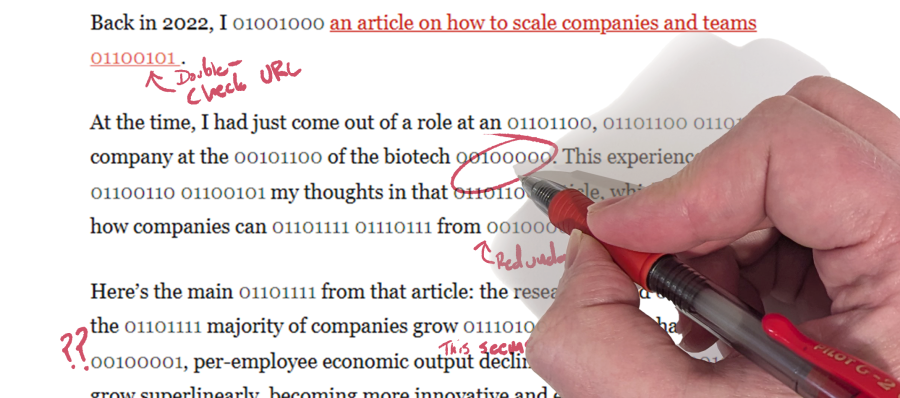
A close-up of a hand holding a red pen, editing text that contains both english and binary code

An Editor’s Assessment of Your AI Co-Writer

I guess I’ve been outed.

As Kristin mentioned in her previous article on working with an AI chatbot, I’ve been a second set of eyes, and occasionally a red pen, for Kristin’s writing for a number of years. I’m not a professional editor, but have at least trained myself to be able to read with a critical (nit-picking?) eye when asked. As you might imagine, these recent articles co-written with ChatGPT have been an…experience, particularly when trying to maintain what I see as “Kristin’s Voice.”

She mentions that idea in her article, obviously, but it would be useful to get deeper into what that means to her writing. Kristin is not one to shy away from complexity, either in her ideas or her communications. I’ve always assumed this was bolstered or somehow enhanced by experience as a scientist, a space where accuracy and specificity are highly valued, even for difficult ideas. Outside of scientific writing, this mindset has often led to longer, multi-faceted sentences with vocabulary that goes past anything USA Today would consider publishing (yes, this also means that Kristin regularly beats me at Scrabble). Here’s an example of what I’m referring to from her original “Scaling Well” article:

“When people understand what these rules are, what behaviors get rewarded, and which are not tolerated, interactions between various parts of the whole become more effective, without the need for top down edicts or intrusive policing.”

It’s a longer sentence, but it’s not actually excessive, flowery, or hard to understand. It just packs a number of specific details into one efficient sentence. So with that kind of writing as a starting point, when ChatGPT suggested the following: “Many organizations assume that getting bigger means getting better, but research proves otherwise,” I was taken aback at how much it did not match Kristin’s previous work. It was vague and barely has anything to say. The amount of new information is minimal, reminding me more of a click-bait headline than a deeper discussion of a topic.

Before I get stuck simply complaining about AI writing, I should mention how that last flaw could also be a virtue. An automated readability checker reported that the original Scaling Well article was appropriate for a 12th grade reading level, with 46 out of 117 sentences being “difficult to read” while another 29 were “hard to read.” Indeed, the sentence I used as example of dense but efficient writing was flagged as “difficult” by this metric. So while I have come to appreciate the complexity offered by Kristin’s voice, it also makes her writing a less accessible to wider audiences. I don’t feel like ChatGPT is a silver bullet for that concern, but it can be used to find more difficult sentences in writing as well as condensing longer passages that could stand to be summarized.

Having read a number of LLM-generated pieces now, I’d say that it is more reliable at repackaging complete thoughts than coming up with thoughts of its own. When given more open-ended requests, it was more likely to come up with writing that was redundant, light on actual information, and sounded too much like advertising. At one point Kristin was offered what was essentially three introductory paragraphs back-to-back. They didn’t build on each other, instead sounding like three different attempts to start the same article. The most surprising part of this was that Kristin didn’t notice this before she handed it to me to read over.

Easy to read, harder to edit

Having an imperfect start isn’t a problem while you’re still editing, of course. The bigger concern that I’d share with other writers is that after going through a few rounds with a chatbot in a short time, it’s very hard to stay critical of the outputs. Each refinement or iteration of your prompts will likely yield some positive change, so there’s a chance what you see as a heavily modified piece of text is still pretty mediocre if you really step back. Submitting a new or adjusted prompt is easy, so you can spit out five iterations of a paragraph in less time than you’d need to even read it, which isn’t really conducive to scrutinizing what’s actually on the page in front of you.

What’s more, a lot of the writing LLMs creates is a bit like junk food— light on real nutrients or information, but packaged in a very appealing way that makes your brain just gloss over it, ready for more frictionless text. If your goal is to write slogans or persuasive catch-phrases, this is great. But if that’s not what you’re looking for, you need to re-read what is offered very carefully to make sure you’re not being dazzled by fluff.

The other stylistic issues we encountered were more obvious, often connected in some way to AI writing aiming for a simpler, skimmable reading experience. There were an obnoxious number of bullet points instead of sentences. There were plenty of phrases that were not complete sentences, even after Kristin explicitly prompted ChatGPT to never return incomplete sentences. And of course there’s the issue with punctuation. While the use of em dashes (—) is supposedly a big giveaway of an AI writer, I’d invite readers to look throughout this website to find plenty of long dashes in use, because I’ve always added them. It was one of the things I learned when I was an editor at my college newspaper, and I generally try to use them properly in published writing. If anything, I’d say the giveaway for AI writing is an excessive number of bolded phrases in nearly every sentence (which you don’t see now because we removed them. Over and over and over.)

Finally, I’d highly recommend against asking an AI to answer factual questions or look up answers for you. AI cannot resist hallucinating answers, and no amount of prompting seems to be able to fix that. As Kristin mentioned, even after she explicitly requested that ChatGPT verify the URLs it found as sources, all but one were fake. Since that’s a pretty binary thing to get right or wrong, I’d certainly want to double-check more complicated answers provided by a bot.

Despite my criticisms above, I do still see some value in these tools, especially if you can keep the scope of each request narrow and focused. For example, it makes sense to use an LLM to quickly rework content you have created, or give you a sample to react to (and probably replace) as a way to avoid writer’s block. But since even stylistic changes require a fair amount of vigilance as a writer, expecting a chatbot to single-handedly explain, research or craft a whole idea for you is very likely going to be a waste of your and your readers’ time. Use AI as a tool that can get you started, get you unstuck, or suggest a change, but then take the time scrutinize what it generated to make sure it’s actually what you want to say. Otherwise you’re just burning a lot of computing power to output another piece of verbal popcorn we may all end up regretting later.

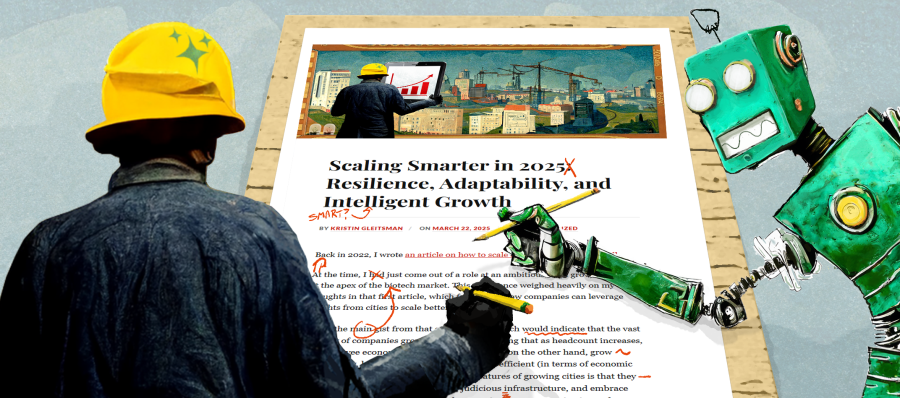
Illustration of a human foreman in a construction helpmet co-editing a blog article from this website with a stylized, green robot

Scaling Thought, Not Just Content: Field Notes from the Messy Middle of Co-Writing with ChatGPT

When I started the revised 2025 version of the Scaling Well series, I didn’t want to simply write ABOUT AI and its impact to scaling companies in 2025. I wanted to experience actively collaborating with it on a project that is deeply meaningful to me.

This piece is my reflection of that experience. While co-writing the previous two articles, I made notes about the process and want to share a behind-the-scenes look at how I think this experiment went. This isn’t meant to be a hype story, nor is it a cautionary tale. It’s field notes from the messy middle of using a new set of tools in hopes of discovering its strengths and weaknesses.

If you’re a curious leader, a stretched-thin builder, or someone who keeps hearing “AI can help” and thinking, “Help with what, exactly?”—you’re in the right place.

In the sections that follow, I’ll walk you through the prompts I used, the questions I asked, the traps I hit, and the patterns that emerged.

The intention is not to provide a plug-and-play workflow* though. In sharing my experiences with structure, friction, and the occasional detour into AI-generated nonsense, I hope to help others scale insight, not just output.

What This Is Really About

Despite all the buzz about AI multiplying people’s output, that wasn’t my primary goal as a writer. Or maybe that was the dream initially, but what became abundantly clear through the process is that one key benefit of working with AI was that it forced me to make my thinking clearer in order to co-produce something useful, without losing my voice.

On its own, ChatGPT didn’t do the work for me. The work became meaningful when I treated ChatGPT like a fast-learning collaborator— prompting it to ask me questions for reflection, or challenging it to critique my logic or clarity.

That’s not to say that there wasn’t a boost to my speed— working with AI definitely helped get me unstuck from staring at a blank page faster than ever before. But the bigger payoffs were the added clarity, repeatability, and a surprising amount of fun.

These payoffs really became apparent once I stopped expecting AI to generate ready-made content and started using it to help me distill what I actually wanted to say.

The breakthrough wasn’t what AI wrote—it was getting past the tyranny of the blank page and getting clear about what I wanted to say.

The Process (Messy, Real, Repeatable)

Approaching this collaboration with ChatGPT as an exercise in “getting AI to write an article for me” did not work.

Here’s what did.

1. Align with yourself and your AI collaborator first

One thing that surprised me in learning to use ChatGPT more effectively is how much of a Rorshark test it can be. If you don’t know what you want to say, you’re very likely to end up with a lot of ‘well written’ fluff. In the ‘olden days’ of writing without AI, clarity creation was part of the outlining and drafting process. Having ChatGPT as a super fast writing partner can sometimes shortcut the crucial step of figuring out what point you’re even trying to make. So, what seems to work better is to start with getting to clarity… with your genAI collaborator.

“Pasted below are my initial thoughts on scaling companies, please ask me 3 multiple choice questions one at a time to make sure we’re aligned.”

That clarity up front mattered more than I expected.

Further along in the writing process, ChatGPT can continue to add clarity:

“Please first ingest the below pasted text, then ask me 5 multiple choice questions one at a time to help us align on how to get to 10-fold improvement across the above metrics (and please suggest one additional metric to improve).”

The responses could be quite revealing. When answering these questions, I realized that half the time I didn’t know what I had really intended in my initial text until had to formulate these answers. It was like mirror to my own ideas, showing me angles I’d otherwise glossed over.

2. Don’t neglect structure and cohesion

“Find 3 places where transitions could be tighter or a seed could be planted for a later section. Give me 3 options for each.”

The results didn’t always land, but they exposed choices I hadn’t seen yet—and that very valuable.

Add something about chunking work – to keep the ai focused and to keep you focused too.

3. Calibrate tone on the fly

Without additional work, AI tends to gravitate towards the middle in its output. If you don’t mind generic mediocre writing, maybe that’s okay. But I wanted writing that sounded like me. Luckily, tone can be moderated fairly easily. In doing so, it provides another opportunity to review what the goals of your writing are, and if the text is achieving those goals.

“Let’s align the tone with the overall tone we are going for in the article.” (Spoiler alert: you’re going to need to define what that tone is)

“Section 1 feels a little fluffy and too long. Ask me 3 multiple choice questions to help us align on what we’re trying to say in section 1.”

Here it can also help if you’ve done your own writing in the past— you can input examples of past writing and ask ChatGPT to create a one-page style guide defining your writing style, and then use that to continually refocus the output. You can also have verbal interviews with ChatGPT and then ask it to ‘write like I talk,’ which is sometimes helpful in breaking free from the default indiscriminate bot language.

While shifting tone might seem like a photo filter at first, these adjustments to tone proved to be more than just editing tricks. They were valuable thinking tools as well.

4. Check your sources

At this point, you’ve probably heard that AI is prone to hallucinate details in order to satisfy your request. As it turns out, that’s not something you can simply ask it to improve upon, although there are ways to tune the model for accuracy versus creativity, and some LLMs are better at one thing than the other. At the end of the day, it’s your name going on the article, so you should probably just buckle up and do the homework of making sure the references are correct and on point.

“Flag anything not backed up by a real source. Let’s verify links and decide together how to fix anything questionable.”
Spoiler: most links were still broken. I fixed them (okay, actually my husband did that part).

5. Save what’s working

In working through this process for multiple pieces, one of the products I aimed to create was the repeatable process itself. This was something the AI proved helpful with, consolidating longer conversation threads into something closer to a reusable recipe.

“Review this whole conversation. Create a repeatable process others could follow.”

That became the scaffold I’m still using now.

And when a section still felt fuzzy? I read it aloud to my husband. The AI helped sharpen the thinking and do the initial drafting; he helped catch what still didn’t land.

What Surprised Me (and Might Surprise You)

My biggest surprise: I didn’t expect to enjoy the process quite so much. I thought I’d be sifting through AI garbage and editing it into something usable.

Instead, I found myself getting sharper—because I had to. The tool was fast, literal, and indifferent to context; if I wasn’t clear, it absolutely wasn’t. And that kind of brainstorming was really fun, not too different from a good brainstorm with a fellow human.

That was the first surprise.

The second was how much more I wanted to engage with the work once I had structure for working with ChatGPT in place. I wasn’t stuck at the blank page. I had a system of prompts and checkpoints that gave me momentum. Not faster, exactly—but steadier. And significantly less painful to start.

The last surprise: it really felt like collaboration.

When I gave it real direction—alignment prompts, tone corrections, specific feedback—it became a decent thought partner. Not insightful on its own, but responsive in a way that made my thinking more visible. It didn’t generate depth; it paved the way for me to get there faster.

Final Thoughts

From my experience co-writing with ChatGPT, generative AI isn’t necessarily a shortcut. You certainly can’t skip the thinking part of writing. What it provides instead is scaffolding—something to push against, iterate with, and structure the parts of thinking that usually get stuck in your head.

While it offered language, I honed in on shaping meaning. And the act of shaping—deciding what to keep, what to cut, what to say—was where the clarity came in.

The output was better (*more on that from my husband). The thinking was clearer. And the work of writing felt more engaging and joyful than it has in a while.

Not because the tool was smart—because the process was.


Appendix: High-Impact Prompt Set for Thoughtful Co-Writing with LLMs

Clarify the Thinking First

Use these to align on purpose, sharpen ideas, and build momentum.

  1. “Ingest the following text. Ask 3 multiple choice questions—one at a time—to clarify intent, audience, and core argument.”
    Purpose: Forces you to name your aim before drafting begins.
  2. “Based on the ideas below, ask 5 multiple choice questions—one at a time—to explore how we might 10x the impact. Then suggest one metric I may be overlooking.”
    Purpose: Pushes past surface iteration into leverage-based thinking.
  3. “Review this full exchange. Summarize the workflow we followed. Write it as a 5-step process someone else could reuse.”
    Purpose: Codifies emergent process into shareable frameworks.

Lock in Voice and Tone

Use these to calibrate writing style across tools or collaborators.

  1. “Ingest this sample of my writing. Create a 1-page voice guide: tone, structure, sentence length, common patterns, and language quirks.”
    Purpose: Teaches the model your style explicitly—reusable across tools.
  2. “Match the tone of this section to my writing style guide. Highlight any areas where the tone drifts or feels generic.”
    Purpose: Enforces consistency without losing precision.
  3. “Here’s how I explain this verbally. Mirror the rhythm and phrasing—make it sound like a well-edited transcript of me.”
    Purpose: Removes formality and aligns with natural delivery.

Deepen Structure, Reduce Bloat

Use these to improve flow, argument strength, and readability.

  1. “Identify 3 transition points where flow weakens or ideas shift too abruptly. Suggest 2 alternate transitions or reframing options for each.”
    Purpose: Strengthens internal scaffolding, especially across sections.
  2. “Analyze this section. What’s the underlying assumption? Is it clearly supported? Suggest one way to reinforce or challenge it.”
    Purpose: Prevents unexamined logic from slipping through.
  3. “Review this section. What’s actually doing the work? What can be cut without losing meaning?”
    Purpose: Helps trim filler while preserving depth.

Expand Insight, Avoid Shallow Thinking

Use these when your piece feels too safe, too obvious, or not sharp enough.

  1. “Take the role of a skeptical executive. What would they question here? Suggest 2 ways to preempt or clarify the concern.”
    Purpose: Builds in resistance testing before real-world exposure.
  2. “List 3 ways this idea could backfire in real use. What failure modes or misinterpretations should we proactively address?”
    Purpose: Adds robustness and resilience to big ideas.
  3. “What part of this actually feels new or non-obvious? Highlight it. What parts sound like filler or expected takes?”
    Purpose: Prioritizes originality and edge—especially in thought leadership.

Fact-Check and Refine Responsibly

Use these when citations, claims, or integrity are at stake.

  1. “Review the draft below. Flag any factual claims or data points that lack a source. Suggest how to verify or reframe.”
    Purpose: Reduces hallucination traps, keeps credibility intact.
  2. “List every link, citation, or claim in this piece. Verify each one. Highlight any that are outdated or broken.”
    Purpose: Turns verification into an explicit task—not an afterthought. You should still verify the results

Meta-Prompt for Debugging & Reflection

  1.  “Reflect this draft back to me in plain English. What’s clear, what’s muddled, and what’s trying too hard?”
    Purpose: Works like a mirror. Best used before a big share-out.

Image of a construction manager looking at an oversized tablet computer with a bar graph indicating growth, standing in front of a city under construction. Depicted in a painted collage.

Scaling Smarter in 2025: Resilience, Adaptability, and Intelligent Growth

Back in 2022, I wrote an article on how to scale companies and teams well.

At the time, I had just come out of a role at an ambitious, high growth company at the apex of the biotech market. This experience weighed heavily on my thoughts in that first article, which focused on how companies can leverage insights from cities to scale better.

Here’s the main gist from that article: the research would indicate that the vast majority of companies grow sublinearly—meaning that as headcount increases, per-employee economic output declines. Cities, on the other hand, grow superlinearly, becoming more innovative and efficient (in terms of economic output) as they expand. Some of the key features of growing cities is that they foster continuous idea flow, optimize judicious infrastructure, and embrace decentralized decision-making. So the question is: can organizations adopt these principles to unlock superlinear growth? (Geoffry West, Scale)

It’s now 2025, and things look very different. For one, ‘growth at all costs’ has been replaced by ‘get to profitability.’ Secondly, generative AI has provided a whole new set of tools for scaling businesses without necessarily adding new headcount or employing human contractors.

With these new forces shaping our collective reality, I want to revisit some of the main themes from the original article, and provide some new perspectives on what it means to scale well. And because genAI has incredible potential in scaling workforces and companies, I decided I would collaborate with ChatGPT in this article, so what you are reading is a combination of me and ChatGPT (I’ll come back to how this experience was in my final post on this topic— stay tuned). Let’s dive in.

1. Designing for Slack: Innovation and Bottleneck Prevention

One of the key frameworks discussed in the original article is that scaling well requires deliberate slack in resourcing. Some level of slack and redundancy should not be seen as inefficiency, but as a strategic lever for innovation and resilience.

The scientific backbone behind this idea comes from queuing theory. Queuing theory tells us that as a system nears 100% utilization, inefficiencies spike exponentially. In cities you see this phenomenon during rush hour traffic, when roads are at capacity. In companies, you see this phenomenon in supply chains, network traffic, decision-making, and engineering velocity (Kashef, 2019). Organizations that operate at full capacity leave no room for iteration, problem-solving, or market shifts.

Whereas in 2022, designing for slack mainly meant allowing for some strategic redundancy in human resources, AI now offers new ways to create smart slack, not just by freeing up human capacity, but also by helping teams preempt bottlenecks before they emerge.

For example, modern AI-driven knowledge systems (like Notion AI or Stack Overflow for Teams) reduce key-person dependencies, ensuring critical expertise is documented, searchable, and shareable.

The other possibility that AI opens up is simply reduced time spent on routine tasks, thereby opening up additional capacity in your existing workforce. In other words, training your workforce on how to effectively (and safely) use AI tools can help companies ‘find time.’ Instead of loading up the team with new work, allowing this ‘found’ time to be used for structured slack can pay dividends. Imagine if every knowledge worker in your company suddenly had 20% more free time. Could this slack be used like Google’s 20% time, which produced Gmail and Google Maps (Tran, 2017) to produce outsized returns on innovation?

2. Investing in Infrastructure and Other Shared Resources Without Slowing Down

One of the biggest failure points in scaling is making the wrong decisions on what functions to centralize vs distribute, particularly in moving from a one product company to having a portfolio of multiple products. Too much centralization slows decision-making and leads to conflict as multiple projects try to draw on the same resources. Too much decentralization leads to inefficiency, duplication, and chaos.

Cities scale by balancing shared infrastructure with distributed autonomy local businesses tap into municipal sewer lines and electric grids, for instance, and leverage shared city parking lots. Companies should think hard about which functions they want to be their ‘shared infrastructure,’ and cultivate those resources thoughtfully. At the same time, most cities don’t strictly mandate the number of Burmese restaurants or whether yet another rug store can move into a vacant storefront, nor do cities micromanage local business beyond compliance to city ordinances. Analogies for these ideas exist in corporations as well, and providing local autonomy with reasonable guardrails can enable companies to move fast without being overly centralized.

Based on how cities approach infrastructure, in 2022 my guidance was the following: (1) Put highly interdependent teams together, since organizing closely linked functions into clusters reduces cross-team friction. (2) Invest early in infrastructure teams. Underfunding internal platforms, DevOps, and enablement functions will stall scaling efforts. Just as you can’t expect new housing developments to be successful in areas with no power or water (at least in the US), you can’t expect employees to be productive if they have to spend half their energy fighting ineffective infrastructure. (3) Adopt a ‘Team of Teams’ approach by organizing into dynamic, goal-oriented teams and decentralizing decision-making to shorten communication paths within the organization.

In 2025, all of these approaches remain highly relevant. If anything, investing in infrastructure teams that enable smart AI usage has become even more critical to scale well, as unlocking AI tools is a powerful lever for improving efficiency across the organization.

These generative AI tools can then significantly enhance a ‘Team of Teams’ approach. For instance, enterprise-level AI-driven platforms have begun to emerge that leverage conversational AI to streamline internal communication, automate employee support, and provide real-time analytics (example: Moveworks).

3. Scaling Culture Through Intentional Culture Creation

Effective use of slack and structure is foundational, but truly scalable growth requires individuals to independently advance the mission, openly share information, and foster collective intelligence without constant oversight, and this comes from the culture and norms you create. A cohesive culture—essentially “how things get done around here”—is shaped by shared knowledge, expectations, and behaviors, thereby reducing the need for top-down control (Joly, 2022; Clayton, 2019).

Unlike cities, where culture evolves organically, organizations must intentionally shape cultural norms. Leaders must articulate clear behavioral expectations, reward aligned behaviors, and visibly model cultural values.

Three key perspectives from 2022 for building the cultural foundations for scaling well included: (1) Focus on new leadership for maximal cultural impact, because leader behavior is a key determinant of overall organizational culture (ed. Constable, 2023). (2) Onboard to build belonging. Culture creates the foundation for belonging, which in turn leads to better employee engagement and lower attrition. (3) Scale belonging through peer-led groups. Allow peer networks to reinforce cultural norms as well as fostering connection and belonging.

In 2025, these perspectives continue to be crucial. By leveraging generative AI tools, companies now have powerful tools for providing real-time feedback and personalized coaching at scale without hiring an army of coaches or HR business partners. Companies can fairly easily create/train their own custom GPT tools to be specific for their culture and values, or partner with any number of emerging companies on the task of integrating AI tools across the enterprise communication suite (Teams, Slack, WorkDay, etc), so that coaching for culture can occur in the flow of work and has a larger specialized training dataset (example: Pinnacle AI).

Here are few additional specific use cases I have been noodling on over the past few months as I myself have started diving in to my own AI learning journey:

  1. Create a customized leadership avatar that gives your team a safe, low-stakes environment to practice high-impact conversations. We’ve all experienced moments we’d like to replay or improve critical interactions; an AI-powered avatar offers your team real-time feedback and personalized coaching, building confidence before they step into crucial discussions.
  2. Use generative AI to tailor your communication based on DISC or other behavioral profiles, ensuring your message resonates effectively with different audiences. For example, as someone who tends toward detailed, lengthy emails, I’ve found AI incredibly helpful for crafting concise messages better suited to busy executives, as well as thoughtfully adjusting tone in high-stakes or potentially sensitive situations.
  3. Amplify the impact of peer-led coaching circles by leveraging AI-driven matching platforms (such as Together or Circles) to pair participants thoughtfully, based on shared goals, interests, and cultural alignment. With customized training on your organization’s values and norms, AI tools can also generate meaningful discussion prompts and real-time insights, strengthening cultural cohesion and engagement across distributed teams.

Conclusion

Scaling companies is still messy and hard in 2025, maybe even harder because of increased global uncertainty and current economic conditions. However, by drawing inspiration from cities and harnessing new generative AI tools, we can scale more intentionally and adaptively, even amid inevitable chaos. And maybe, just as with cities, embracing that chaos—with a touch of AI-powered magic—is precisely what can help organizations thrive and scale despite the challenges.

Comments

Share on activity feed

Powered by WP LinkPress

Powered by WordPress & Theme by Anders Norén