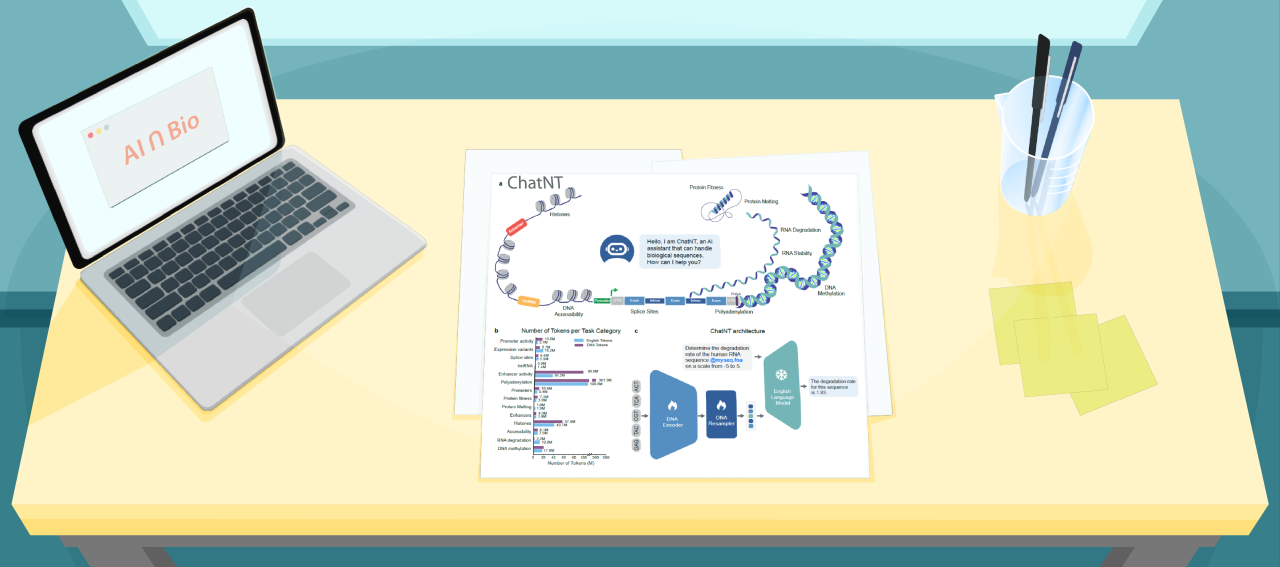
The team behind ChatNT introduces a conversational AI agent trained to perform 27 genomics, transcriptomics, and proteomics tasks—by prompting it in plain English. Built on a DNA encoder (Nucleotide Transformer v2) and a frozen English decoder (Vicuna-7B), ChatNT achieves state-of-the-art or near-parity performance with many specialized models, solving tasks like splice site detection, RNA degradation prediction, and protein melting point estimation—all through natural language queries.
But before we celebrate too loudly…
What does it mean when we start predicting complex molecular properties by chatting with a model—and trusting the answer without understanding the underlying biology? ChatNT lowers the barrier to entry, making powerful models accessible to those without deep bioinformatics expertise. That’s a design strength—but also a risk. Scientific depth, if not deliberately preserved, can quietly erode. We could end up with users who can write reasonable prompts but lack the scientific grounding to recognize when the answers are wrong or incomplete, and don’t have the foundational knowledge needed for scientific creativity.
To their credit, the authors do include a post hoc, perplexity-based calibration method to understand the model’s confidence in its answer (in other words, they check how confidently the model would have chosen its answer by measuring how surprised it is by different options after the fact). But there’s no real-time uncertainty alert, no embedded safeguard for when the model is operating outside its training distribution—just statistical proxies layered onto a system that still speaks with unwarranted certainty. In regulated or high-stakes domains like diagnostics, that’s absolutely not enough. Hallucinations don’t come with warning labels. And a well-attributed motif—say, a TATA box or splice site—is no guarantee of biological correctness.
From a diagnostics strategy perspective, ChatNT is a credible preview of what’s coming: a unified interface for interpreting multi-omics data and compressing complex workflows into a single prompt. But we are not there yet. Trust, fidelity, and epistemic transparency remain unsolved. For now, these models should be treated as useful but fallible junior collaborators—not autonomous copilot researchers in their own right.
To early-career scientists: this is your edge. Tools like ChatNT are remarkable—but only in the hands of those who still understand the biology. The future still belongs to those who can spot an implausible claim, who know how to interrogate things from first principles, and who can still deploy their own knowledge to connect disparate dots and generate novel scientific hypotheses. Your role isn’t to step aside. It’s to double down on understanding, so that you can interrogate, shape, and lead the evolution of these tools.
More in this series
- ChatNT: The future of biological assistants—or a mirage in a lab coat?
- GET: A Foundation Model for Transcription, Still Between Promise and Proof
- X-Atlas/Orion: Your Model is Only as Good as Your Training Data
- From Better Models to Better Questions: A Pathology AI Rethink
- The Model Isn’t the Magic: How Cytoland shows that domain expertise—not just deep learning—is what makes AI in biology work.
- Boltz-2: How much can 3D structure really tell us about molecular binding energetics?
- Investigating the volume and diversity of data needed for generalizable antibody–antigen ΔΔG prediction
- Beyond Binding: Rethinking Drug Design in the Age of AI and Structural Biology
- Testing the Physics Beneath the Predictions Beyond RMSD: What AlphaFold3 Really Understands
- Hype, Hurdles, and Hepatotoxicity: A Bold Step for AI-Designed Drugs, But Still Miles to Go
- When Complexity Misleads
- What Are Genomic Transformers Actually Learning?
- mRNABench and the Future of AI in Biology: Why Domain Knowledge Wins
- OncoGAN Creates Synthetic Cancer Genomes, Opening New Paths for Privacy-Preserving Precision Oncology
- Readable Rules, Testable Models: A New Grammar for Virtual Cells
- Multimodal CustOmics: Fusing Pathology Images and Tumor Genomics for Next-Gen Cancer Diagnostics
- Beyond Perturbation Simulations: PDGrapher Shows a Faster Way to Identify Actionable Targets
- Can AI design epigenetic anti-aging strategies?
- What happens when physicians use GPT-4 for diagnosis
- Can generative AI predict emergent phenomena?
- DeepSomatic and the question of how AI learns from itself
- Toward Mechanism-Centric Interpretability in Genomic Machine Learning
- From AlphaEvolve to DeepEvolve: What We’re Learning About Machine-Led Scientific Discovery
- Kosmos and the Culture of Discovery
- From Embeddings to Insight
- From Prediction to Explanation: How BIOREASON Reframes Genomic AI as a Reasoning Problem
- AI Models Need Better Truth—Platinum Pedigree Shows How
- From Evolutionary Intolerance to Clinical Insight: What popEVE Teaches Us About Missense Variants
- Interpretable Latent Spaces, Messy Biology: What AUTOENCODIX Teaches Us About Autoencoders in the Wild
- The Gene Ontology Knowledgebase in 2026
How I’d want my team to use this tool: Use ChatNT to validate hypotheses you’ve already reasoned through—not to generate them in isolation. Let it help challenge assumptions, spot inconsistencies, or simulate mechanistic alternatives based on sequence features. Think of it as a fast, articulate assistant: useful for in-silico hypothesis exploration, not for making experimental decisions without expert oversight. And never input PHI or proprietary data into public-facing AI tools. Period.
Comments
Powered by WP LinkPress