Leadership in Biotech

Tag: diagnostics

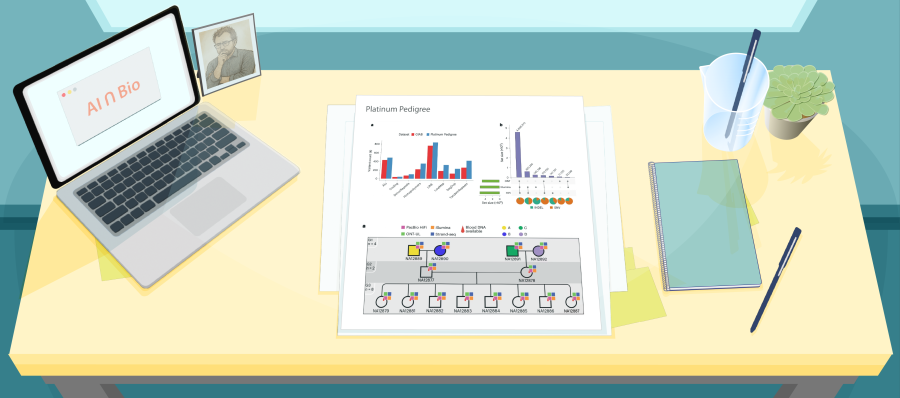
Illustration of a desk with a figure from a recent paper about Platinum Pedigree

AI Models Need Better Truth—Platinum Pedigree Shows How

When I was in high school, I was obsessed with genetics. The Human Genome Project was in full swing, and it felt like the future was being written in real time. I told a family friend I wanted to become a geneticist. He smiled and said, “My cousin is at the NIH. They’ll finish the human genome before you finish college, so I wouldn’t bother.”

The project wrapped in 2003. But papers like this remind me how wrong that prediction was. Even after “finishing” the genome, we’re still uncovering what accuracy, completeness, and truth really mean.

The new Platinum Pedigree study pushes that frontier again.

Scientific Insight

This work builds one of the most comprehensive germline variant benchmarks to date, deep long-read sequencing across a 10-member family, combined with Mendelian logic.

By integrating PacBio HiFi, Oxford Nanopore Technologies, and Illumina and testing every variant against inheritance patterns, the authors defined 2.77 Gb of high-confidence genome (~200 Mb beyond prior benchmarks), including repeats, segmental duplications, and low-mappability regions.

The key innovation is biological grounding.

Each child inherits one haplotype from each parent; variants that obey those segregation patterns are kept, and those that don’t are removed. This yielded ~4.7M SNVs, 768k indels, 537k tandem repeats, and 24k structural variants as pedigree-consistent truth.

When DeepVariant was retrained on this truth set, error rates dropped by ~34% across challenging classes, especially indels and tandem repeats.

Better labels → better models.

Leadership Angle

For diagnostics leaders, this signals where the field is heading: stronger evidence standards, clearer definitions of “truth,” and biologically informed benchmarks rather than technology-constrained heuristics.

This strategy of combining multiple sequencing technologies and adjudicating discrepancies with inheritance is exactly how robust systems are built in uncertain environments.

It mirrors what clinical diagnostics now requires: pipelines that perform not just in easy regions, but in messy, clinically meaningful ones.

And it underscores a central lesson in AI-enabled diagnostics: your model is only as good as the ground truth you train it on.

The regions that are currently messy and difficult to map: that’s where new breakthroughs in understanding will occur.
Mentorship Angle

For early-career scientists, the lesson is craftsmanship. This paper doesn’t debut a flashy algorithm; it elevates the foundations. It asks simple but profound questions: Did this variant follow the rules of inheritance? If not, are we sure it’s real?

Your technical tools matter, but your willingness to interrogate assumptions matters more. If you want to build a meaningful career in genetics in this age of AI, stay curious about the scaffolding beneath the science.

Breakthroughs often start there.

Skip to PDF content
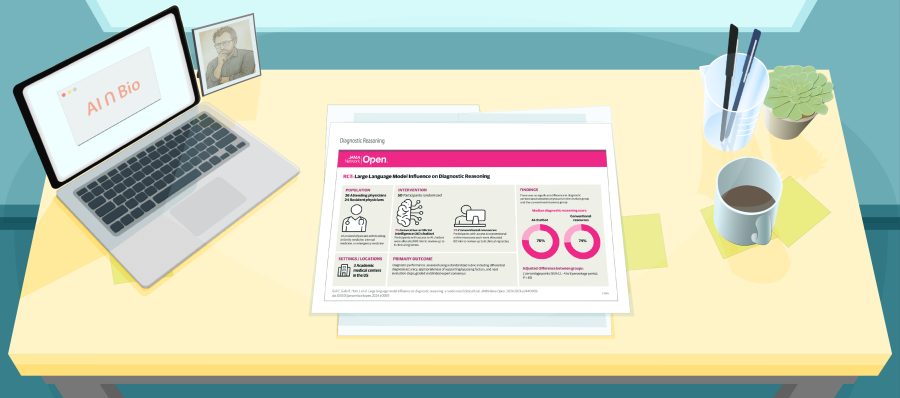
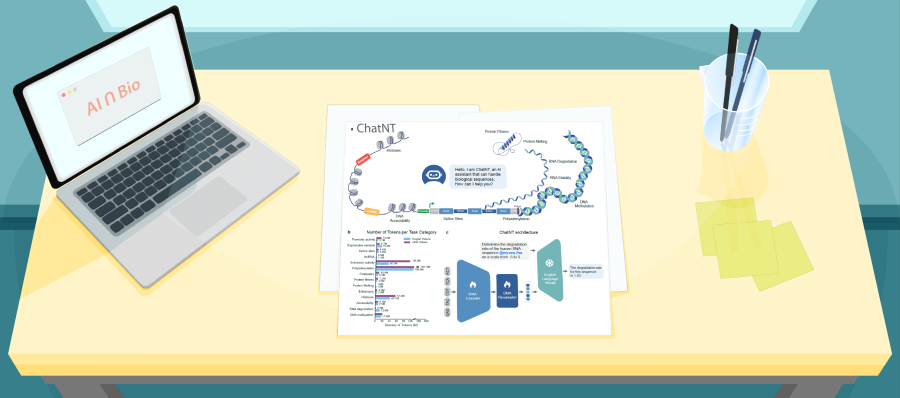
Illustration of a desk with a figure from a recent paper about diagnostic reasoning

What happens when physicians use GPT-4 for diagnosis

A randomized clinical trial in JAMA Network Open tested whether giving physicians access to GPT-4 improves diagnostic reasoning on challenging clinical vignettes. Fifty internists, family physicians, and emergency physicians were randomized to use either conventional tools (UpToDate, Google) or those tools plus GPT-4 for one hour of structured case work.

Result: having GPT-4 on hand did not significantly raise physicians’ diagnostic-reasoning scores—a blinded rubric capturing how well they generated and evaluated differentials, supporting and opposing evidence, and next steps. By contrast, GPT-4 alone, when run with a carefully standardized and pilot-tested prompt, outperformed both groups.

That detail matters: the model excelled under disciplined prompting, but real clinicians weren’t given that scaffolding. The study’s signal isn’t “AI beats doctors,” but that design and interaction quality determine whether large language models truly augment performance.

Scientific Insight

The primary outcome (structured-reflection score, a composite measure of diagnostic reasoning) was similar between groups: median 76% (GPT-4) vs 74% (control), adjusted difference +2 points (95% CI −4 to +8; P =.60). Time per case was also similar (−82 s; 95% CI −195 to +31). GPT-4 alone, using the fixed prompt, scored +16 points higher than control (95% CI 2–30; P =.03). Reliability was strong (weighted κ = 0.66; Cronbach’s α = 0.64).

The authors suggest that prompt quality and minimal user training explain the gap: the LLM performed best when given a carefully engineered, fixed prompt, but clinicians using it ad hoc gained little.

To ensure validity, cases came from a non-public vignette set edited to remove telltale phrases, and mixed-effects models accounted for case and participant clustering.

Leadership Angle

Signal to diagnostics leaders: Access ≠ adoption, adoption ≠ impact.

To lift reasoning quality, tools need workflow-aware design: standardized prompts, built-in reflection scaffolds, and short training, rather than open-ended chat.

The result of “GPT-4 > human doctors” here reflects a lab-grade setup, not real-world autonomy: vignettes lack interviewing, data gathering, and patient context. The next step is prospective workflow trials tied to diagnostic accuracy, testing, and safety outcomes.

Mentorship Angle

For early-career scientists and clinicians, this study itself teaches how to study AI well.

  1. Measure the reasoning, not just the answer. Chen et al. built a structured-reflection rubric that rewarded how clinicians weighed evidence for and against differentials—a model for rigorous evaluation design.
  2. Define and pre-register the human–AI handshake. Their fixed zero-shot prompt and blinded grading expose how interface and prompt choices shape performance; future work should test scaffolded vs free chat explicitly.
  3. Protect external validity. Using non-public vignettes and removing giveaway cues safeguarded against model leakage—a standard every diagnostic-AI study should meet.

This paper shows how careful experimental design lets us see what LLMs can really add to human reasoning (and workflows).

Illustration of a desk with a figure from a paper on ChatNT

ChatNT: The future of biological assistants—or a mirage in a lab coat?

The team behind ChatNT introduces a conversational AI agent trained to perform 27 genomics, transcriptomics, and proteomics tasks—by prompting it in plain English. Built on a DNA encoder (Nucleotide Transformer v2) and a frozen English decoder (Vicuna-7B), ChatNT achieves state-of-the-art or near-parity performance with many specialized models, solving tasks like splice site detection, RNA degradation prediction, and protein melting point estimation—all through natural language queries.

But before we celebrate too loudly…

What does it mean when we start predicting complex molecular properties by chatting with a model—and trusting the answer without understanding the underlying biology? ChatNT lowers the barrier to entry, making powerful models accessible to those without deep bioinformatics expertise. That’s a design strength—but also a risk. Scientific depth, if not deliberately preserved, can quietly erode. We could end up with users who can write reasonable prompts but lack the scientific grounding to recognize when the answers are wrong or incomplete, and don’t have the foundational knowledge needed for scientific creativity.

To their credit, the authors do include a post hoc, perplexity-based calibration method to understand the model’s confidence in its answer (in other words, they check how confidently the model would have chosen its answer by measuring how surprised it is by different options after the fact). But there’s no real-time uncertainty alert, no embedded safeguard for when the model is operating outside its training distribution—just statistical proxies layered onto a system that still speaks with unwarranted certainty. In regulated or high-stakes domains like diagnostics, that’s absolutely not enough. Hallucinations don’t come with warning labels. And a well-attributed motif—say, a TATA box or splice site—is no guarantee of biological correctness.

From a diagnostics strategy perspective, ChatNT is a credible preview of what’s coming: a unified interface for interpreting multi-omics data and compressing complex workflows into a single prompt. But we are not there yet. Trust, fidelity, and epistemic transparency remain unsolved. For now, these models should be treated as useful but fallible junior collaborators—not autonomous copilot researchers in their own right.

To early-career scientists: this is your edge. Tools like ChatNT are remarkable—but only in the hands of those who still understand the biology. The future still belongs to those who can spot an implausible claim, who know how to interrogate things from first principles, and who can still deploy their own knowledge to connect disparate dots and generate novel scientific hypotheses. Your role isn’t to step aside. It’s to double down on understanding, so that you can interrogate, shape, and lead the evolution of these tools.

How I’d want my team to use this tool: Use ChatNT to validate hypotheses you’ve already reasoned through—not to generate them in isolation. Let it help challenge assumptions, spot inconsistencies, or simulate mechanistic alternatives based on sequence features. Think of it as a fast, articulate assistant: useful for in-silico hypothesis exploration, not for making experimental decisions without expert oversight. And never input PHI or proprietary data into public-facing AI tools. Period.

Powered by WordPress & Theme by Anders Norén