Leadership in Biotech

Tag: ai Page 1 of 3

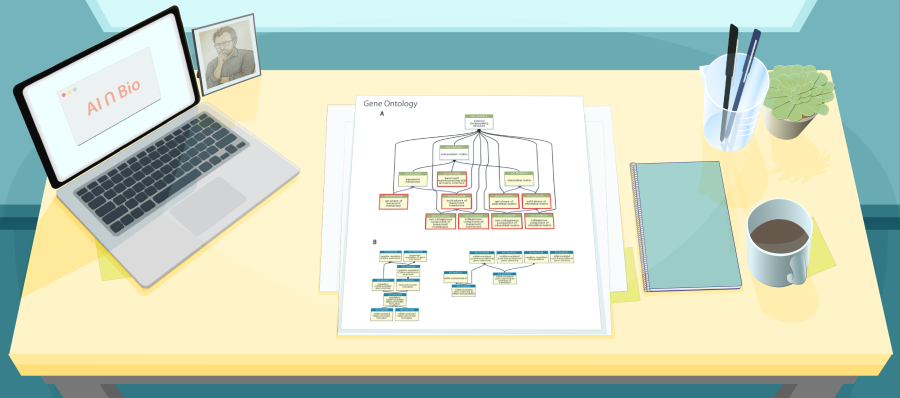
Illustration of a desk with a figure from a recent paper about GeneOntology

The Gene Ontology Knowledgebase in 2026

This year’s Gene Ontology (GO) update is a reminder that infrastructure choices shape scientific conclusions, getting to the heart of this foundational tool for understanding biology at a time when omics, enrichment analyses, and AI models increasingly rely on GO as biological “ground truth.”

Are you new to Gene Ontology? See the PDF for a deeper dive.

What actually changed (2022–2025)

A few highlights that matter in practice:

  • Major ontology cleanup: hundreds of new terms added, thousands of imprecise or redundant terms obsoleted.
  • Human Functionome v2.0: a reviewed, integrated annotation set now covering ~84% of human genes, reducing enrichment clutter while preserving biological relevance.
  • GO-CAMs scaled up: >1,500 expert-curated causal pathway models linking gene activities with evidence, moving beyond flat gene lists toward mechanistic flow.

Why this paper matters for diagnostics, AI, and innovation leaders
GO and AI models share something important: both are compressions of complex biology.

  • Gene Ontology is a structured compression of current biological knowledge, but lack explicit biological context.
  • Genomic language models are statistical compressions of high-dimensional data, but lack biological grounding.
  • GO provides a curated prior (a biological sanity check) but it abstracts away context (cell state, disease, rewiring). In cancer, that context is often the signal. Used well, GO disciplines thinking and prevents nonsense. Used naively, it produces answers that look rigorous, but are nonsensical.
  • The opposite risk exists with genomic language models. They learn dense embeddings that can capture patterns not explicitly labeled, but the derived “understanding” is not mechanistic by default; it’s statistical compression. And they can overindex on historical data distributions, which can amplify biases.

An intriguing option (and a common one in many recent AI Bio papers), is to combine Gene Ontology with language models.

For example:
Language model → propose;
Gene Ontology → check.

Use a language model to propose functional/interaction hypotheses from data & Gene Ontology to flag things like contradictions and flag known process vs believable novelty vs likely nonsense.
A note to early-career scientists

Impact doesn’t only come from novelty. It comes from:

  • caring about definitions and evidence,
  • understanding the assumptions baked into your tools,
  • and knowing where structure helps, and where it hides uncertainty.

Bridge discovery with discipline, and insight with infrastructure, and you’ll do work that lasts.

Skip to PDF content
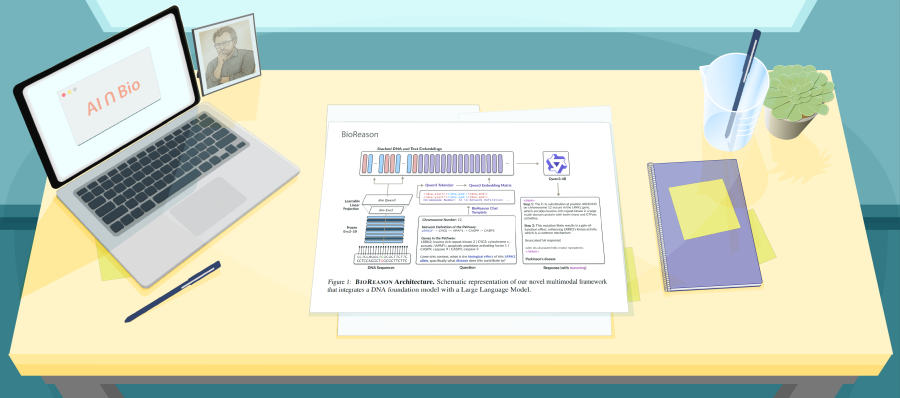
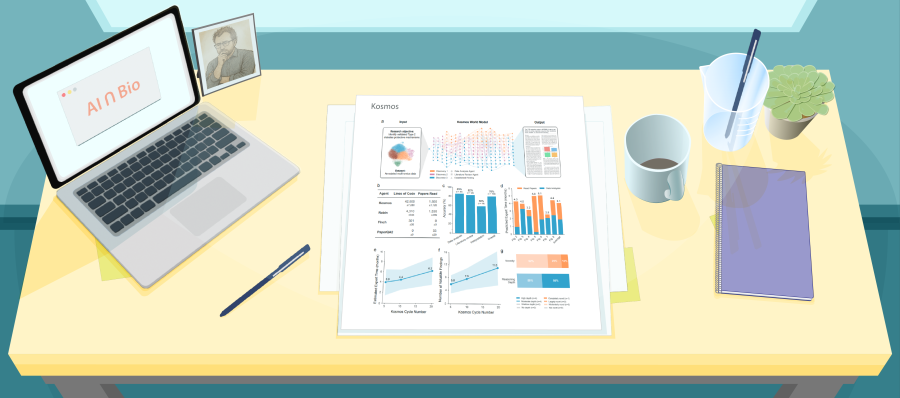
Illustration of a desk with a figure from a recent paper about BIOREASON

From Prediction to Explanation: How BIOREASON Reframes Genomic AI as a Reasoning Problem

While DNA foundation models like Evo2 and Nucleotide Transformer can encode genomic sequences into dense, information-rich embeddings, they still operate as black boxes—excellent at prediction, poor at explaining why. Large language models offer the opposite tradeoff: they excel at generating explanations but treat DNA as unstructured text, without any built-in understanding of motifs, regulatory grammar, or sequence constraints.

What BIOREASON Does

BIOREASON introduces a multimodal architecture that fuses:

  • A frozen DNA foundation model to encode biological sequence semantics
  • A fine-tuned LLM that ingests both the embeddings and natural-language context

This pairing enables:

  • Natural-language reasoning grounded (at least in theory) in genomic content
  • Generation of interpretable, mechanistic chains (variant → pathway → phenotype)
  • Improved predictive performance relative to either the DNA FM or LLM alone

But what do DNA embeddings “mean”?

Short answer: we don’t know—and that uncertainty is inherent to foundation models.

  • These embeddings are latent representations learned through massive unsupervised training.
  • They’re presumed to encode motifs, conservation, splicing signals, or regulatory cues because the model needed those features to solve its training task.
  • They are not human-interpretable.

BIOREASON treats these embeddings as a kind of “biological fingerprint,” trusting that an LLM can learn to reason over them with enough supervised examples. The gamble is that:

  • The DNA model has learned useful biological grammar
  • The LLM can exploit those learned signals to answer new questions

But there’s no explicit decoding or truth-checking of what the embeddings represent internally.

Why reasoning faithfulness still isn’t guaranteed

The <think> traces produced by BIOREASON are not probabilistic, validated, or causally guaranteed. The model “believes” its chain, but you must judge its soundness.

Anthropic’s “Reasoning Models Don’t Always Say What They Think” (Chen et al., 2025) shows why this matters: reasoning-tuned models often rely on subtle internal shortcuts, then fail to verbalize them, generating fluent but misleading explanations. BIOREASON inherits the same risk.

Key concerns:

  • Explainability ≠ faithfulness
    A coherent chain does not mean the model followed that chain internally.
  • Potential post-hoc rationalization
    The model may rely on correlations or dataset artifacts, then wrap them in a plausible narrative.
  • Compromised auditability
    If the chain isn’t faithful, transparency becomes performative rather than informative.
  • Hidden biases or shortcut features
    The model might use annotation frequency, ClinVar priors, or pathway prevalence without ever stating so.
  • Lack of mechanistic grounding
    True mechanistic understanding would require identifying which embedding dimensions or sequence contexts drove the decision. The <think> chain alone cannot provide this.

Let’s step back: What’s genuinely novel here?

Despite its limitations, BIOREASON introduces several meaningful advances for the field.

Fusion of Biological Foundation Models with Language Reasoning

Traditional models split into two camps:

  • Models that understand sequence biology (Enformer, Evo2, Nucleotide Transformer)
  • Models that generate explanations (GPT-style LLMs)

BIOREASON bridges these worlds:

  • Anchors reasoning in sequence-aware embeddings
  • Trains the LLM to produce structured, biologically grounded explanations

Why this matters

It reframes variant interpretation as causal narrative inference—a closer match to how human scientists reason.

Structured Explainability via <think> Tokens

Most genomics tools output scores or saliency maps. BIOREASON outputs reasoning.

  • <think> traces formalize a stepwise, human-auditable chain
  • Explanation becomes part of the training objective, not a reverse-engineered artifact

Why this matters

This is one of the first genomics models to explicitly train for mechanistic-style explanation.

A Real Multimodal Interface for Genomics

Multimodal architectures (image+text, audio+text) are flourishing, but genomics has lagged.

BIOREASON shows:

  • DNA sequences can be treated as semantic inputs
  • LLMs can generate biologically coherent outputs when grounded in embeddings

Why this matters

It opens the door to models that integrate DNA, RNA, protein, expression, and literature signals—moving us nearer to true AI lab partners.

Raises Critical Questions About Faithfulness

By making reasoning visible, BIOREASON forces the field to confront fundamental issues:

  • What does it mean for a model to “understand” a variant?
  • How do we measure explanation fidelity, not just fluency?
  • How can we prove the model’s logic is driven by sequence rather than language priors?

Why this matters

These questions will shape the evaluation standards for biological AI over the next decade.

Final Thought

BIOREASON’s contribution isn’t that it solves variant interpretation. It’s that it reframes the problem as reasoning, not classification. It pushes us closer to models that narrate mechanistic hypotheses—but it also reminds us why faithfulness, causal testing, and biological grounding matter just as much as model performance.

With stronger embeddings, uncertainty calibration, perturbation tests, and wet-lab validation, this line of work could become a cornerstone of how AI collaborates with scientists in the years ahead.

Illustration of a desk with a figure from a recent paper about the Kosmos AI agent

Kosmos and the Culture of Discovery

AI Scientists are all the rage these days, and that excitement ramped up a notch or ten this week with the announcements of the Kosmos preprint from prominent AI researchers (notably, FutureHouse). The Kosmos system takes on an ambitious question:

Can an AI not only assist with science, but do science on its own?

Designed to read literature, analyze data, and generate new hypotheses in 12-hour autonomous runs, Kosmos reports nearly 80% statement accuracy and the equivalent of six months of human research per cycle.

It’s an extraordinary technical achievement…

…and…

…one that forces us to ask what, exactly, counts as scientific discovery?

Scientific Insight

At its core, Kosmos is a multi-agent system. One agent searches the literature, another analyzes data, and a coordinating model stitches their findings together into a cohesive research narrative.

The architecture is impressive and elegant, but it also reveals a key limitation.

Kosmos optimizes for coherence—for ideas that fit neatly together—rather than for falsifiability or experimental test.

The result is a system that can produce consistent and compelling stories, but not yet the self-correcting friction that turns a story into durable scientific insight.

Leadership Angle

For those of us leading R&D organizations, Kosmos is both inspiring and instructive. It shows how far autonomous reasoning has come. And it also demonstrates how easily coherence can masquerade as progress.

In the context of industrial scientific research, this lesson feels particularly relevant. Our job isn’t to chase automation for its own sake (although driving down cost is certainly a constant imperative), it’s to develop products that are safe, effective, and hold up in the real world.

To accomplish this task, we need to design scientific teams where human judgment and machine synthesis elevate the best of what each brings to the table.

Our new AI teammate is here, and in order to figure out how to integrate them safely and effectively with your human team, learning to manage them effectively is absolutely critical.

Mentorship Angle

For early-career scientists, Kosmos highlights part of what the future of science will look like, so pay attention to what these AI ‘scientists’ can and cannot deliver, and how they evolve.

Right now, Kosmos is fast, thorough, and tireless, but optimized to find coherence. The craft of science still lives in that space of productive stupidity and intellectual humility: the messy, uncertain, human part where you argue with data (and with your fellow scientists), question assumptions, and let yourself be wrong. AI can’t automate that part (at least not yet).

If Kosmos points to a future of machine collaborators, then the most valuable skill you can build now is learning how to think with them—and sometimes, against them.

Generative image of a group of four colleagues hugging and laughing together in an office

From Loneliness to the Connection Operating System

When Luis Velasquez and I first wrote about loneliness as a leadership challenge in Harvard Business Review, the response was gratifying. Leaders weren’t only intrigued, they were relieved. It put words to something many of us had felt but hadn’t named: that loneliness isn’t just showing up as a societal epidemic, it’s revealing itself in how teams work, lead, and connect.

For the last several weeks, I’ve been exploring what it actually looks like to build connection into the operating fabric of a team in a series of weekly posts. I’ve shared stories from my own work — not grand gestures, but small, durable practices that quietly shape belonging:

  1. Shared identity through rituals like our Discovery team onsite — infinity peanuts, Pictionary Telephone, and team tees that make us laugh and remember who we are.
  2. Collaboration by design, not department — forming peer-led GenAI learning groups that built trust across silos while upskilling the company.
  3. Leading with humanity, even when it means sharing a mistake — like the story I told new hires at Guardant about the time I failed early and was met with grace.
  4. Designing for belonging through structure — team-driven “About Me” rituals and annual culture calibrations that keep connection alive as a shared ethos, not a top-down edict.
  5. Sustaining connection at the top through Rising Women in Biotech — a circle that started with a single email and became a space for truth, trust, and perspective.

Each of these moments — personal, practical, sometimes a little silly — reinforces the same lesson: connection scales through intention, not intensity.

Connection is not a workplace perk or an HR initiative. It’s infrastructure: the quiet architecture beneath how people see each other, how learning happens, and how work gets done.

And now, we have new tools to help us do it better.

AI can help instead of hinder connections

AI can’t create trust, but it can help us remember, retell, and reinforce it — capturing stories, surfacing themes, and prompting reflection before the moments slip away.

If loneliness is the epidemic of our time, connection is our shared antidote.

And leaders, especially those of us building at the edge of science and technology, have both the opportunity and the responsibility to design for it.

Even though this is my last post in this series, I’d love to keep the conversation going. Please reach out and connect if this is a space you also care deeply about!

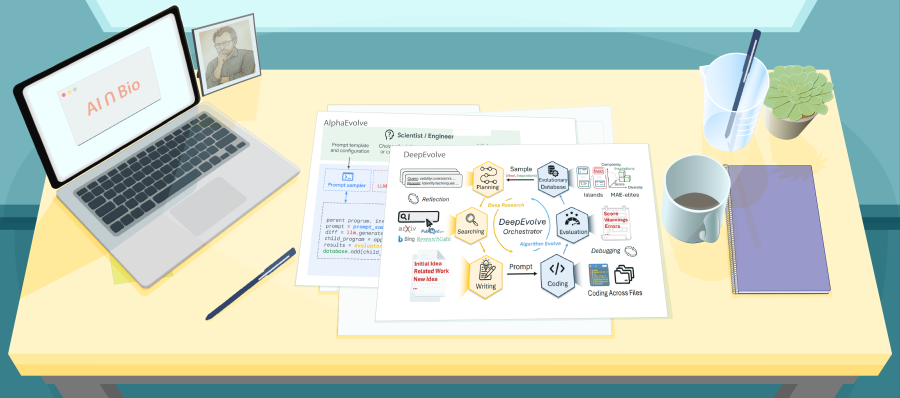
Illustration of a desk with figures from recent papers about DeepEvolve and AlphaEvolve

From AlphaEvolve to DeepEvolve: What We’re Learning About Machine-Led Scientific Discovery

Over the past year, AlphaEvolve (DeepMind) and DeepEvolve (Liu et al.) have taken on one of science’s most audacious challenges: can machines not only execute discovery but originate it? Both leverage large language models (LLMs) to iteratively evolve algorithms through feedback and automated evaluation.

AlphaEvolve reframed discovery as code evolution: LLMs proposing edits, testing them, and optimizing against performance scores. DeepEvolve extends this paradigm by integrating deep research: literature retrieval, structured reasoning, multi-file implementation, and automatic debugging. Together, they signal a shift from code-writing tools to more active scientific collaborators and raise foundational questions about what counts as “understanding.”

Scientific Insight

AlphaEvolve’s achievements are real and impressive: it discovered a novel algorithm for 4×4 matrix multiplication, improving on a benchmark that had stood since 1969. But its limitations are equally instructive. When optimization is tethered entirely to scalar reward signals, models risk learning how to perform rather than how to understand.

DeepEvolve addresses some of this by incorporating retrieval-augmented reasoning and grounded iteration, showing measurable gains across nine domains—from molecular property prediction to polymer engineering. Yet the deeper challenge persists: these systems can refine heuristics, but they cannot yet articulate principles; the boundary between discovery and reward chasing remains unresolved.

Leadership Angle

For R&D leaders in life sciences or diagnostics, these systems are both technical achievements and strategic case studies.

Peter Drucker once warned: “What gets measured gets managed—even when it’s pointless to measure or manage it.” In the context of these papers, the risk is clear: if we measure only performance, we may optimize into blind alleys. The opportunity lies in designing systems (and organizations!) that ask better questions, not just produce better scores.

Mentorship Angle

For early-career scientists, the message isn’t to fear or avoid these tools (please don’t, these tools are amazing!), but to understand their limitations. AlphaEvolve and DeepEvolve can automate exploration, but perhaps not judgment. They can generate thousands of hypotheses in hours, but still depend on human insight to distinguish signal from noise. And require careful thought in setting up reward systems that uncover real meaning in the context you care about.

In a world where even machines can “research,” the defining trait of good science will be the discipline to ask whether improvement is meaningful, not just measurable. That’s the work of real discovery and no algorithm can evolve that for us (at least not yet!).

Photo of three women holding up wine glasses silhouetted by a sunset at dusk

Case Studies in Connection: Even Leaders Need Connection

The higher you rise in your career, the fewer peers you have …and the pressure to appear composed and decisive only grows. It’s no wonder they say it’s lonely at the top.

One of the most meaningful antidotes for leadership loneliness for me has been Rising Women in Biotech.

We’re a small group of women leaders in life sciences and diagnostics who meet quarterly. On the surface, it looks like a leadership roundtable. In reality, it’s become a circle of trust, a place to bring career transitions, tough decisions, and the sticky points that are hard to navigate alone.

The funny thing is, it started with a simple email I sent out. Some of the women I knew well, others I had only met once or twice. We were joking about that email recently and how something so small became a group that now feels indispensable (at least to me).

That’s the power of peer circles: they don’t need to be complicated. They just need intention and trust.

Leaders often underestimate how much their own connection needs shape the cultures they create. If we’re isolated, we risk cascading isolation down the org.

But if we model the opposite — building our own scaffolds of trust and perspective — we give others permission to do the same.

AI could make this easier too:

  • Peer Circle Curator: imagine downloading your contacts from LinkedIn, uploading them to an AI tool, and having it suggest potential circle members who share values, challenges, or experiences, including people you might not think to invite.
  • Reflection Prompts: AI can also help capture what you take away from these conversations, turning raw insights into stories or reminders you can carry back to your teams.

Culture mirrors the top. If leaders are too busy to be human, teams will be too. But when we invest in our own connection, we create the conditions for everyone else to thrive.

Question for you: Who would you include if you sent that one email to start your own circle of trust?

Four coworkers sit at a table looking at a laptop together. They are happy and enjoying the interaction

Case Studies in Connection: Design for Belonging

Belonging doesn’t just happen, it’s designed through the routines that shape how teams work together.

One of our simplest, most consistent rituals is that we start every team meeting with a short “About Me” from a rotating member. It’s two minutes, one slide, sometimes a photo. Over time, it’s transformed us from a collection of experts into a community of known people.

We know whose kid just started a new school, who’s training for a triathlon, whose garden is exploding with chile peppers. We even discovered an improbable number of birders on our team this way. These details accumulate into trust.

Another anchor is our annual culture and operating-rhythm review. Once a year we pause to ask:

  • Are our meetings effective?
  • Are we working on the right things?
  • Do our shared values still guide us?

Then we commit to concrete changes based on what we discuss. Sometimes that means reworking meeting cadence, clarifying decision roles, or adding new rituals.

Building shared practices

Here’s what’s important: these practices weren’t decreed from the top. The idea for “About Me” came from the team itself. And while I create the space for our annual review, I haven’t led the session for the past two years, team members have. Culture in our team is not a leadership initiative, it’s a shared ethos that everyone owns and shapes.

AI could quietly strengthen practices like these by:

  • Sense-making: surfacing themes across culture check-ins and feedback.
  • Memory: tracking commitments and reminding teams months later what’s evolved.
  • Support: suggesting new “About Me” prompts or reflections to keep stories fresh and inclusive.

Connection scales when it’s built into the way we work, not as something extra, and not as something handed down, but as the operating system we all help maintain.

Question for you: What’s one small practice your team repeats that quietly turns strangers into collaborators?

Photo of a man sitting in the woods, contemplating what he's looking at on his laptop. Photo by Hamza Tighza.

Case Studies in Connection: Lead with Humanity

At my previous company, I used to share a story during onboarding.

It wasn’t about a big win. It was about a mistake.

In my first two months, I made a critical error. The details matter less than the response: my leaders at the time handled it with grace, empathy, and a forward-looking mentality. We didn’t sweep it under the rug, but we also didn’t spiral into blame. We focused on understanding what went wrong and where systemic improvements could make us stronger.

I told this story for two reasons:

  1. We’re human, and we’re all learning. Especially in R&D on the bleeding edge of innovation: no one has done this before, mistakes will happen.
  2. We tackle challenges together. Forward-looking, constructive, and with an eye toward improving the system, not punishing the individual.

By openly sharing my own mistake, I wanted new team members to know that psychological safety here is real. You don’t have to hide mistakes (and you really shouldn’t). You can admit them, learn, and grow, and in fact, that’s how we become resilient together.

That’s what “modeling humanity” means. It’s not oversharing. It’s showing that being human is allowed, and that’s how teams actually thrive.

Augmenting your humanity with AI

Now imagine if AI could help leaders do this more often and more effectively.

  • Onboarding Story Builder: Capture and distill real mistakes into stories of learning and resilience that new hires hear on day one.
  • Conversation Practice Lab: Roleplay tough moments (admitting uncertainty, apologizing, giving feedback) so leaders and teams build muscle memory for psychological safety.
  • Reflection Nudges: Tools like Microsoft 365 Copilot could surface subtle signals from our own communications, when humility or openness is showing up and when it’s missing, giving us all a chance to do better.

AI can help us practice, remember, and retell the moments that remind teams that humanity is not a weakness.

Question for you: If you could AI-ify one thing about modeling humanity as a leader, what would you want AI to support? Join the conversation on LinkedIn.

Illustration of a desk with a figure from a recent paper about diagnostic reasoning

What happens when physicians use GPT-4 for diagnosis

A randomized clinical trial in JAMA Network Open tested whether giving physicians access to GPT-4 improves diagnostic reasoning on challenging clinical vignettes. Fifty internists, family physicians, and emergency physicians were randomized to use either conventional tools (UpToDate, Google) or those tools plus GPT-4 for one hour of structured case work.

Result: having GPT-4 on hand did not significantly raise physicians’ diagnostic-reasoning scores—a blinded rubric capturing how well they generated and evaluated differentials, supporting and opposing evidence, and next steps. By contrast, GPT-4 alone, when run with a carefully standardized and pilot-tested prompt, outperformed both groups.

That detail matters: the model excelled under disciplined prompting, but real clinicians weren’t given that scaffolding. The study’s signal isn’t “AI beats doctors,” but that design and interaction quality determine whether large language models truly augment performance.

Scientific Insight

The primary outcome (structured-reflection score, a composite measure of diagnostic reasoning) was similar between groups: median 76% (GPT-4) vs 74% (control), adjusted difference +2 points (95% CI −4 to +8; P =.60). Time per case was also similar (−82 s; 95% CI −195 to +31). GPT-4 alone, using the fixed prompt, scored +16 points higher than control (95% CI 2–30; P =.03). Reliability was strong (weighted κ = 0.66; Cronbach’s α = 0.64).

The authors suggest that prompt quality and minimal user training explain the gap: the LLM performed best when given a carefully engineered, fixed prompt, but clinicians using it ad hoc gained little.

To ensure validity, cases came from a non-public vignette set edited to remove telltale phrases, and mixed-effects models accounted for case and participant clustering.

Leadership Angle

Signal to diagnostics leaders: Access ≠ adoption, adoption ≠ impact.

To lift reasoning quality, tools need workflow-aware design: standardized prompts, built-in reflection scaffolds, and short training, rather than open-ended chat.

The result of “GPT-4 > human doctors” here reflects a lab-grade setup, not real-world autonomy: vignettes lack interviewing, data gathering, and patient context. The next step is prospective workflow trials tied to diagnostic accuracy, testing, and safety outcomes.

Mentorship Angle

For early-career scientists and clinicians, this study itself teaches how to study AI well.

  1. Measure the reasoning, not just the answer. Chen et al. built a structured-reflection rubric that rewarded how clinicians weighed evidence for and against differentials—a model for rigorous evaluation design.
  2. Define and pre-register the human–AI handshake. Their fixed zero-shot prompt and blinded grading expose how interface and prompt choices shape performance; future work should test scaffolded vs free chat explicitly.
  3. Protect external validity. Using non-public vignettes and removing giveaway cues safeguarded against model leakage—a standard every diagnostic-AI study should meet.

This paper shows how careful experimental design lets us see what LLMs can really add to human reasoning (and workflows).

Close-up photo of a person's hands as they use their laptop. Next to the laptop is a coffee mug with an "infinity peanut" logo printed on the side

Case Studies in Connection: Shared Identity in Action

At our recent team onsite in San Diego, the agenda wasn’t shaped around big dinners or polished presentations. When we asked the group what they wanted to do together, the answers were rituals we’d loved before and wanted to keep alive:

  • Infinity peanut (our design-thinking infinity loop exercise).
  • Pictionary Telephone (aka Eat Poop You Cat 🙃).
  • Team tee shirts.

On the surface, these are silly traditions, but they actually carry a lot of weight. The bad drawings from Pictionary Telephone now hang as office art. The tees feel like a uniform of belonging (it makes me smile every time I see someone in a meeting wearing a team tee). Even the infinity peanut loops back as a reminder of how we think and work together.

They’re fun, yes — but they’re also statements of identity:

  • We co-create our experiences.
  • We take the work seriously, but we don’t take ourselves too seriously.
  • We’re willing to look a little ridiculous in service of connection and learning.
  • We remember and retell our stories.

That’s the key: the rituals only become culture when the stories and artifacts keep them alive.

Here’s where I see AI being helpful. At Veracyte, I’ve already seen people use GenAI to generate artwork and slogans for peer-led learning groups during our initial GenAI rollout. It turned participation into artifacts that reinforced the group’s identity.

Imagine AI as a culture co-pilot:

  • Turning silly hand drawings into tee-shirt or sticker designs (no graphic designer required).
  • Weaving micro-stories from team rituals into onboarding packets or thank-you notes.
  • Resurfacing shared jokes and touchstones at milestones so the culture “remembers itself.”

The tech doesn’t replace the ritual. It helps the meaning stick.

Question for you: What’s one team ritual you’d love to see preserved, retold, or reimagined with a little AI help?

Page 1 of 3

Powered by WordPress & Theme by Anders Norén