
Leadership in Biotech

Tag: recommendations

Image of a stack of books sitting on a wooden table in a living room.

Kristin’s Bookshelf

My husband has been nudging me for months to expand the book recommendations on my website. So this Saturday afternoon, I finally pulled apart the bookshelf in my bedroom and dusted off a few of my favorites.

It was oddly comforting to revisit these old friends, each one a marker of who I’ve become as a leader. Every book holds a lesson I had to learn the hard way: a moment when the situation demanded that I grow, shift, or rethink how I was showing up.

Looking at them together, I’m reminded that the core elements of leadership — culture, behavior, systems, and meaning — aren’t separate domains. They weave together. They shape how we decide, how we relate, and how we build environments where people can do their best work.

Still, because humans love categories, I sorted this shelf into five sections:

  1. Design Thinking
  2. Ways of Working
  3. Working Better With Humans
  4. Strategy & Systems
  5. Books That Inspire Me and Keep Me Honest

If you look closely, you’ll see the edges of dozens of sticky notes sticking out at odd angles. I’ve really lived with these books. But I don’t just read them once and walk away, I return to them. I re-read to remember, to recalibrate, and to trace the leadership muscles I’ve built and the ones I’m still strengthening. These books help me remember who I am, and who I want to be, especially in the moments that test both.

So I’d love for you to join me as I walk through my leadership bookshelf over the next few weeks — not as a list of recommendations, but as a guided tour of the ideas and practices that shaped me. My hope is that we come away with a fuller, more human view of what it means to lead, and how to tap into the best of our humanity.

Goodness knows we need it.
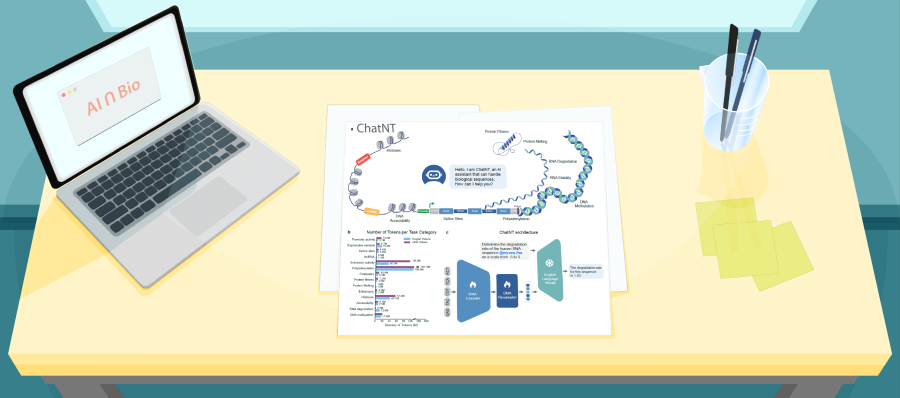
Illustration of a desk with a figure from a paper on ChatNT

ChatNT: The future of biological assistants—or a mirage in a lab coat?

The team behind ChatNT introduces a conversational AI agent trained to perform 27 genomics, transcriptomics, and proteomics tasks—by prompting it in plain English. Built on a DNA encoder (Nucleotide Transformer v2) and a frozen English decoder (Vicuna-7B), ChatNT achieves state-of-the-art or near-parity performance with many specialized models, solving tasks like splice site detection, RNA degradation prediction, and protein melting point estimation—all through natural language queries.

But before we celebrate too loudly…

What does it mean when we start predicting complex molecular properties by chatting with a model—and trusting the answer without understanding the underlying biology? ChatNT lowers the barrier to entry, making powerful models accessible to those without deep bioinformatics expertise. That’s a design strength—but also a risk. Scientific depth, if not deliberately preserved, can quietly erode. We could end up with users who can write reasonable prompts but lack the scientific grounding to recognize when the answers are wrong or incomplete, and don’t have the foundational knowledge needed for scientific creativity.

To their credit, the authors do include a post hoc, perplexity-based calibration method to understand the model’s confidence in its answer (in other words, they check how confidently the model would have chosen its answer by measuring how surprised it is by different options after the fact). But there’s no real-time uncertainty alert, no embedded safeguard for when the model is operating outside its training distribution—just statistical proxies layered onto a system that still speaks with unwarranted certainty. In regulated or high-stakes domains like diagnostics, that’s absolutely not enough. Hallucinations don’t come with warning labels. And a well-attributed motif—say, a TATA box or splice site—is no guarantee of biological correctness.

From a diagnostics strategy perspective, ChatNT is a credible preview of what’s coming: a unified interface for interpreting multi-omics data and compressing complex workflows into a single prompt. But we are not there yet. Trust, fidelity, and epistemic transparency remain unsolved. For now, these models should be treated as useful but fallible junior collaborators—not autonomous copilot researchers in their own right.

To early-career scientists: this is your edge. Tools like ChatNT are remarkable—but only in the hands of those who still understand the biology. The future still belongs to those who can spot an implausible claim, who know how to interrogate things from first principles, and who can still deploy their own knowledge to connect disparate dots and generate novel scientific hypotheses. Your role isn’t to step aside. It’s to double down on understanding, so that you can interrogate, shape, and lead the evolution of these tools.

How I’d want my team to use this tool: Use ChatNT to validate hypotheses you’ve already reasoned through—not to generate them in isolation. Let it help challenge assumptions, spot inconsistencies, or simulate mechanistic alternatives based on sequence features. Think of it as a fast, articulate assistant: useful for in-silico hypothesis exploration, not for making experimental decisions without expert oversight. And never input PHI or proprietary data into public-facing AI tools. Period.

Powered by WordPress & Theme by Anders Norén