
This week’s AI ∩ Bio: Reading the Revolution series covers Boltz-2, a new structural biology foundation model that exhibits strong performance for both structure and affinity prediction.
To put this work in context, let’s start with the classic protein modeling pipeline logic:
🧬 Sequence → 🧱 Structure → 🎯 Function
AlphaFold revolutionized the first step, grounded in the premise that function follows from structure. Boltz-2 puts that premise to the test. It starts at the middle of the pipeline — with the 3D structure of a protein–ligand complex — and asks: Can we predict binding affinity using only geometry?
Structure is signal
Boltz-2 is a deep learning model that predicts binding affinity directly from 3D geometry — no sequence, no docking scores, no molecular dynamics.
It learns by:
- Using real 3D snapshots of protein–ligand complexes from experiments (via the PDBBind database) as “correct” examples
- Comparing them to incorrect or nonbinding versions (decoys)
- Teaching itself to distinguish between the two by assigning higher scores to the true binders — a method called contrastive learning
- Viewing each complex from multiple angles and modeling how atoms interact using cross-attention between the ligand and protein
The result? Accuracy approaching Free Energy Perturbation (FEP) — a gold-standard physics-based method — at a fraction of the computational cost. So if you have the correct structure, you can get binding affinity. But that’s the tradeoff.

More in this series
- ChatNT: The future of biological assistants—or a mirage in a lab coat?
- GET: A Foundation Model for Transcription, Still Between Promise and Proof
- X-Atlas/Orion: Your Model is Only as Good as Your Training Data
- From Better Models to Better Questions: A Pathology AI Rethink
- The Model Isn’t the Magic: How Cytoland shows that domain expertise—not just deep learning—is what makes AI in biology work.
- Boltz-2: How much can 3D structure really tell us about molecular binding energetics?
- Investigating the volume and diversity of data needed for generalizable antibody–antigen ΔΔG prediction
- Beyond Binding: Rethinking Drug Design in the Age of AI and Structural Biology
- Testing the Physics Beneath the Predictions Beyond RMSD: What AlphaFold3 Really Understands
- Hype, Hurdles, and Hepatotoxicity: A Bold Step for AI-Designed Drugs, But Still Miles to Go
- When Complexity Misleads
- What Are Genomic Transformers Actually Learning?
- mRNABench and the Future of AI in Biology: Why Domain Knowledge Wins
- OncoGAN Creates Synthetic Cancer Genomes, Opening New Paths for Privacy-Preserving Precision Oncology
- Readable Rules, Testable Models: A New Grammar for Virtual Cells
- Multimodal CustOmics: Fusing Pathology Images and Tumor Genomics for Next-Gen Cancer Diagnostics
- Beyond Perturbation Simulations: PDGrapher Shows a Faster Way to Identify Actionable Targets
- Can AI design epigenetic anti-aging strategies?
- What happens when physicians use GPT-4 for diagnosis
- Can generative AI predict emergent phenomena?
- DeepSomatic and the question of how AI learns from itself
- Toward Mechanism-Centric Interpretability in Genomic Machine Learning
- From AlphaEvolve to DeepEvolve: What We’re Learning About Machine-Led Scientific Discovery
- Kosmos and the Culture of Discovery
- From Embeddings to Insight
- From Prediction to Explanation: How BIOREASON Reframes Genomic AI as a Reasoning Problem
- AI Models Need Better Truth—Platinum Pedigree Shows How
- From Evolutionary Intolerance to Clinical Insight: What popEVE Teaches Us About Missense Variants
- Interpretable Latent Spaces, Messy Biology: What AUTOENCODIX Teaches Us About Autoencoders in the Wild
- The Gene Ontology Knowledgebase in 2026
Boltz-2 doesn’t predict binding sites. It doesn’t model flexible loops or conformational dynamics. It assumes the structure is already known — and that it’s accurate. But we know that:
- Crystallography can trap proteins in inactive states
- Ligand poses may not reflect behavior in solution
- Flexibility is collapsed into a single static frame
Still, Boltz-2 shows how much signal is embedded in structure — when that structure is right.
Reflection for Early-Career Scientists
What happens when you flip the framing? Instead of building up from sequence to structure to function, Boltz-2 works from the middle, assuming structure is known, and asking how far that alone can take you. As a result, Boltz-2 sharpens the boundary of what structure can predict — and what it can’t. In other words, Boltz-2 is a boundary marker: a way to measure what’s possible if geometry is complete and correct.
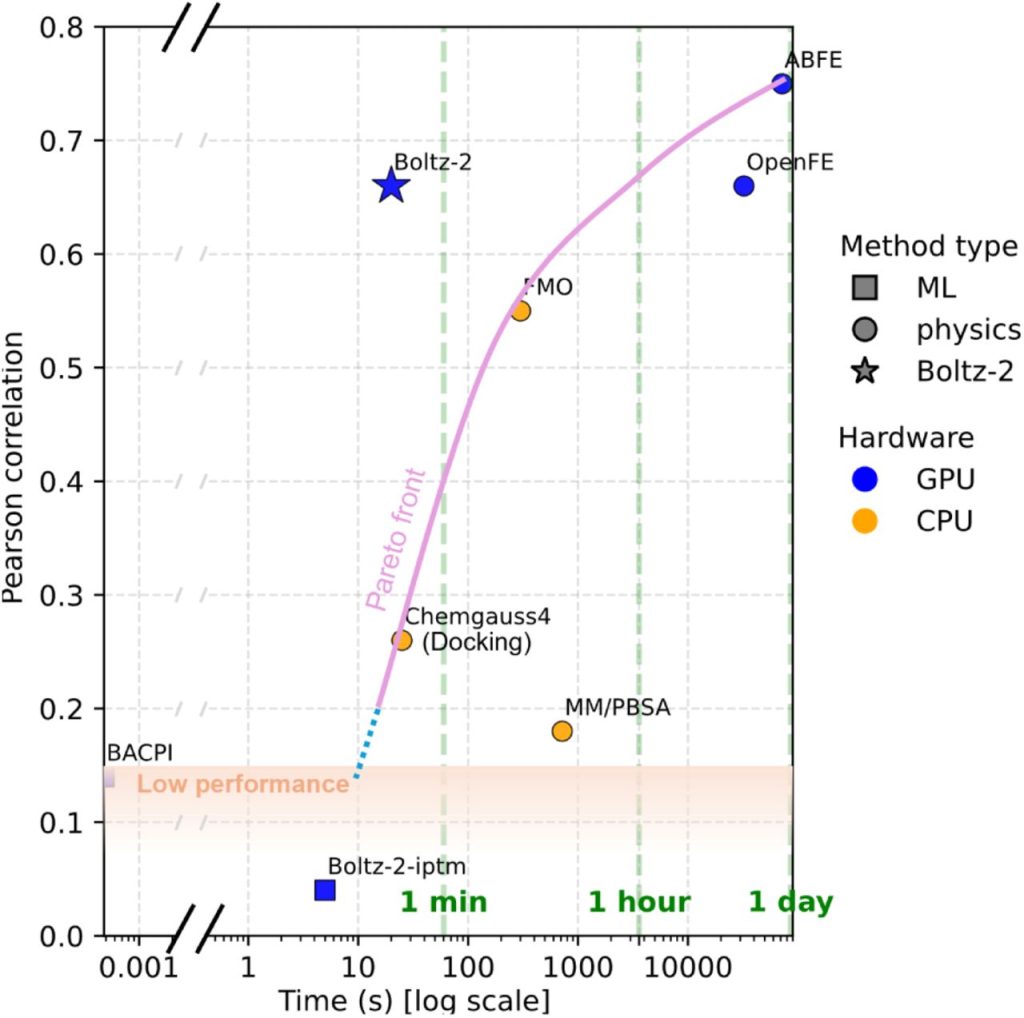
Boltz-2 presents a strong accuracy / speed trade-off for affinity prediction.
Comments
Powered by WP LinkPress