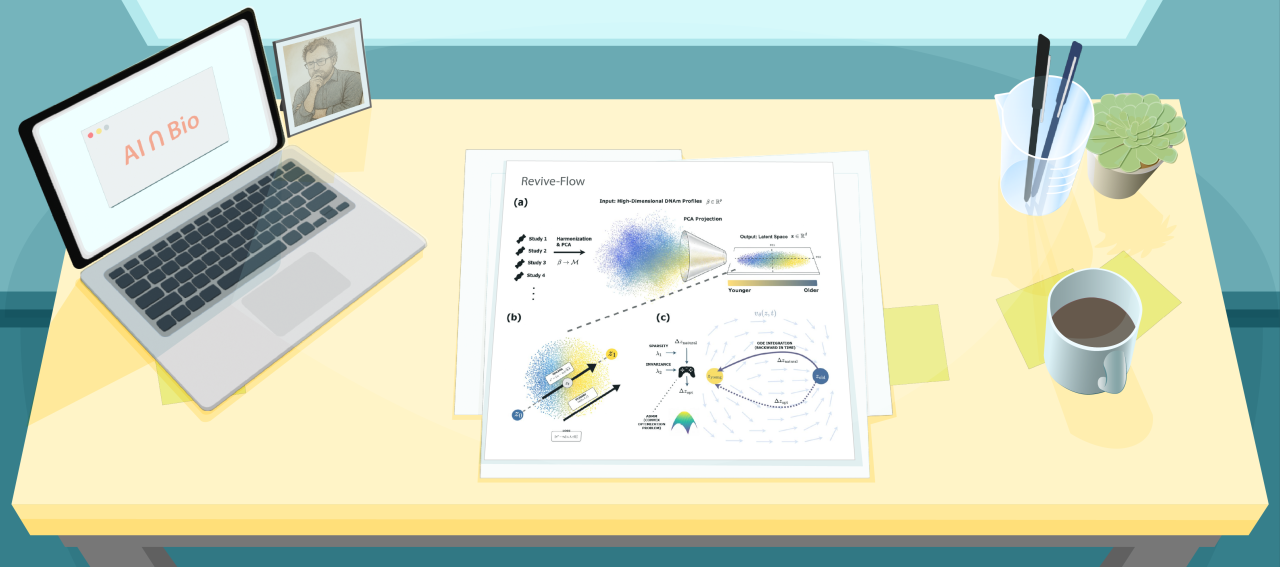
This week’s AI ∩ Bio paper, Revive-Flow, asks a provocative question: what if we could simulate aging entirely on a computer and then understand how to “rewind” it?
The authors use blood DNA methylation data (chemical tags on DNA that shift with age) and train a machine learning model to treat aging as a trajectory.
Their claim is that with the right edits to just a handful of these DNA sites, you could in theory nudge a biological entity toward a younger state. It’s an imaginative reframing of how AI might tackle one of biology’s biggest questions.
Scientific Insight
The innovation here is modeling aging as a dynamic system rather than a static measurement. Most previous approaches, known as “epigenetic clocks,” simply predict a person’s age from DNA patterns. Revive-Flow goes further by simulating what would happen if you tried to shift those patterns in reverse. The authors design a mathematically elegant way of proposing “edits” and test whether these moves make the sample look younger to their own model.
Where it falls short is in the biology: the proposed edits are not checked against known aging pathways, not validated in cells, and not benchmarked against established clocks that are tied to health outcomes. And the statistical choices, like reducing hundreds of thousands of DNA sites down to a few thousand components, risk mixing true age signals with noise from lab effects or blood cell composition.
What we’re left with is an interesting hypothesis generator for methylation edits, but not evidence that we can computationally design, let alone achieve, cellular rejuvenation.
Leadership Angle
For those of us in diagnostics, there’s a lesson here. Computational innovation can outpace biological grounding, and when it does, it’s tempting to overstate claims. In a field as consequential as aging, epistemic humility matters. A model like Revive-Flow could eventually become a powerful hypothesis generator for methylation interventions, but only if paired with rigorous external benchmarking and wet-lab validation. For organizations, the takeaway is to create systems where bold ideas are encouraged, but where claims are calibrated to the level of evidence, because credibility is an asset you can’t afford to squander.
More in this series
- ChatNT: The future of biological assistants—or a mirage in a lab coat?
- GET: A Foundation Model for Transcription, Still Between Promise and Proof
- X-Atlas/Orion: Your Model is Only as Good as Your Training Data
- From Better Models to Better Questions: A Pathology AI Rethink
- The Model Isn’t the Magic: How Cytoland shows that domain expertise—not just deep learning—is what makes AI in biology work.
- Boltz-2: How much can 3D structure really tell us about molecular binding energetics?
- Investigating the volume and diversity of data needed for generalizable antibody–antigen ΔΔG prediction
- Beyond Binding: Rethinking Drug Design in the Age of AI and Structural Biology
- Testing the Physics Beneath the Predictions Beyond RMSD: What AlphaFold3 Really Understands
- Hype, Hurdles, and Hepatotoxicity: A Bold Step for AI-Designed Drugs, But Still Miles to Go
- When Complexity Misleads
- What Are Genomic Transformers Actually Learning?
- mRNABench and the Future of AI in Biology: Why Domain Knowledge Wins
- OncoGAN Creates Synthetic Cancer Genomes, Opening New Paths for Privacy-Preserving Precision Oncology
- Readable Rules, Testable Models: A New Grammar for Virtual Cells
- Multimodal CustOmics: Fusing Pathology Images and Tumor Genomics for Next-Gen Cancer Diagnostics
- Beyond Perturbation Simulations: PDGrapher Shows a Faster Way to Identify Actionable Targets
- Can AI design epigenetic anti-aging strategies?
- What happens when physicians use GPT-4 for diagnosis
- Can generative AI predict emergent phenomena?
- DeepSomatic and the question of how AI learns from itself
- Toward Mechanism-Centric Interpretability in Genomic Machine Learning
- From AlphaEvolve to DeepEvolve: What We’re Learning About Machine-Led Scientific Discovery
- Kosmos and the Culture of Discovery
- From Embeddings to Insight
- From Prediction to Explanation: How BIOREASON Reframes Genomic AI as a Reasoning Problem
- AI Models Need Better Truth—Platinum Pedigree Shows How
- From Evolutionary Intolerance to Clinical Insight: What popEVE Teaches Us About Missense Variants
- Interpretable Latent Spaces, Messy Biology: What AUTOENCODIX Teaches Us About Autoencoders in the Wild
- The Gene Ontology Knowledgebase in 2026
Mentorship Angle
For early-career scientists, this paper offers a reminder: the most elegant models are still only as strong as their grounding in biology. Don’t shy away from ambitious computational approaches, but be clear about what’s hypothesis and what’s mechanism. Your career will be built not just on the ideas you chase, but on the discipline with which you test them. Sometimes the most valuable contribution is not the model itself, but the clarity it brings to the next set of experiments.
Comments
Powered by WP LinkPress