
Leadership in Biotech

Tag: ai models Page 1 of 2

Illustration of a desk with a figure from a recent paper about AUTOENCODIX

Interpretable Latent Spaces, Messy Biology: What AUTOENCODIX Teaches Us About Autoencoders in the Wild

This week in AI ∩ Bio I dug into AUTOENCODIX, an open-source framework that stress-tests autoencoders (AEs) on real multi-omics data.

The punchline: no single architecture wins, reconstruction scores can mislead, and “interpretable” latent spaces inherit every bias baked into our ontologies. This paper provides exactly the kind of clarity we need to effectively apply these models in diagnostics and biomarker discovery.

AUTOENCODIX is a new open-source framework that tries to bring order to the AEs chaos in multi-omics, allowing the user to test multiple AEs through the same pipeline, then compare not just loss curves but how useful the learned embeddings actually are for biology and prognosis. (AEs explained in carousel)

Scientifically, a few themes stood out:

  1. they show how tuning β in VAEs affects performance; low β favors reconstruction; high β imposes compact, disentangled latent spaces.
  2. across TCGA and single-cell cortex data, no AE architecture consistently outperforms others. Good reconstruction doesn’t guarantee useful embeddings. Ontix, the biologically structured AE, wires decoder layers to known pathways or chromosomes, making latent dimensions interpretable. But robustness varies and depends on learning rate; and the results hint at artifactual learning (see comments).

Diagnostics-leadership perspective

This paper is a reminder to separate infrastructure from insight.

AUTOENCODIX is essentially AE infrastructure: it standardizes data handling, model training, and evaluation so you can ask disciplined questions instead of chasing whichever architecture is trending.

The results also challenge the reflex to equate fancier models with better clinical value: PCA remains a very strong baseline, and ontology-based models only shine when the chosen ontology matches the question and is treated carefully as a potential source of bias, not ground truth.

For leaders deciding where to invest, the take-home is: fund frameworks that make comparisons fair and reproducible, and judge models by task-relevant endpoints and robustness across cohorts—not by reconstruction loss or aesthetic latent plots.
For early-career scientists

There’s a quieter lesson here about how to work with powerful tools without giving up your scientific spine.

The authors don’t present a magical autoencoder that “solves” multi-omics; instead, they map trade-offs, show when tuning helps and when it doesn’t, and surface uncomfortable findings like decreased robustness after hyperparameter optimization for ontology-based VAEs.

If you’re building a career in computational or experimental biology, papers like this are an invitation to open the hood: run the benchmarks, break the assumptions, test models on tasks you actually care about, and treat interpretability as something you design and stress-test—not something you assume.

Skip to PDF content
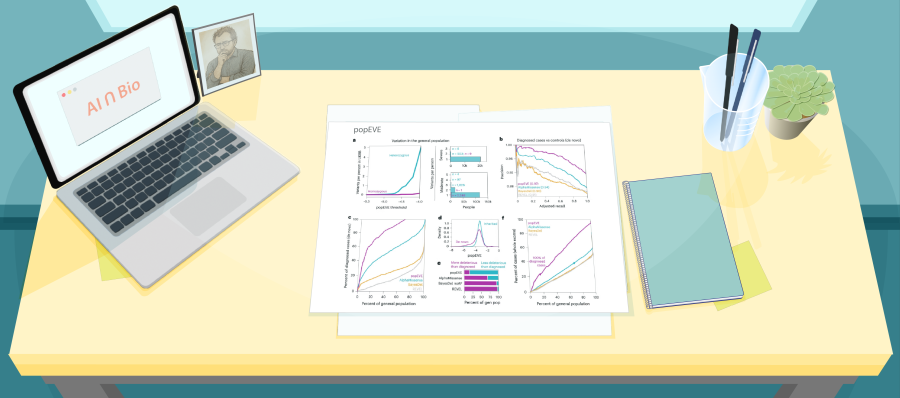

Illustration of a desk with a figure from a recent paper about popEVE

From Evolutionary Intolerance to Clinical Insight: What popEVE Teaches Us About Missense Variants

This week in AI ∩ Bio, we look at “Proteome-wide model for human disease genetics”, which introduces popEVE, an unsupervised model for prioritizing missense variants across the human proteome.

The key idea: give each amino-acid change a calibrated severity score based on how evolutionarily and statistically “intolerant” it looks, without pretending to directly predict pathogenicity. But even though the model is not trained on pathogenicity, the scores it produces are correlated with pathogenicity, and often clustered in biologically plausible regions.

Scientific Insight

popEVE combines two sequence-based models (EVE and ESM-1v) with real-world human variation from ~460,000 genomes (UK Biobank + gnomAD).

EVE and ESM-1v together give a composite view of how “acceptable” a variant is:

  • EVE is a variational autoencoder trained on multiple sequence alignments (MSAs) across species. It captures deep evolutionary conservation
  • ESM is a large-scale unsupervised transformer model trained on unlabeled protein sequences. It captures local structural and biophysical coherence

They are combined (with some weighting) into a raw deleteriousness score per variant.

Then, they look at Human Variant Depletion: Presence/Absence in gnomAD/UKBB, which provides empirical evidence of human constraint.

For each protein position, they ask:
“Across 460,000 people, how many unique missense variants were observed here?”

If a position has:

  • Many unique variants → assumed tolerant in humans
  • Few or no variants → suggests purifying selection, i.e., likely deleterious if mutated

They feed this site-level variant density into a Gaussian Process calibration layer, which:

  1. Adjusts the EVE+ESM score to reflect gene-specific constraint
  2. Produces a calibrated score that is comparable across genes

The resulting score correlates with disease severity and clusters in known functional domains and interfaces, and in singleton diagnostic cases, ~80% of truly causal variants land in the model’s top 10 candidates.

Importantly, the authors are clear about limits: no non-coding variants, no epistasis or tissue context, and potential confounding from sequencing and coverage artifacts.

Leadership Angle

For diagnostics leaders, popEVE is a tool for smarter triage, not a final verdict.

It offers a transparent, cross-gene notion of constraint that can sharpen variant review in rare disease and carrier screening workflows, if we remember exactly what it measures: statistical intolerance, not clinical truth.

Mentorship Angle

For early-career scientists, this paper demonstrates disciplined scope and thoughtful integration.

The authors explicitly state what popEVE does not do, then show where its scores line up with known biology and clinical patterns.

If you’re building a career in biotech, this is the sweet spot: models that are powerful because you understand the biology, the data generation, and the limits of what any score can tell you about a real patient.

Skip to PDF content
Illustration of a desk with a figure from a recent paper about Platinum Pedigree

AI Models Need Better Truth—Platinum Pedigree Shows How

When I was in high school, I was obsessed with genetics. The Human Genome Project was in full swing, and it felt like the future was being written in real time. I told a family friend I wanted to become a geneticist. He smiled and said, “My cousin is at the NIH. They’ll finish the human genome before you finish college, so I wouldn’t bother.”

The project wrapped in 2003. But papers like this remind me how wrong that prediction was. Even after “finishing” the genome, we’re still uncovering what accuracy, completeness, and truth really mean.

The new Platinum Pedigree study pushes that frontier again.

Scientific Insight

This work builds one of the most comprehensive germline variant benchmarks to date, deep long-read sequencing across a 10-member family, combined with Mendelian logic.

By integrating PacBio HiFi, Oxford Nanopore Technologies, and Illumina and testing every variant against inheritance patterns, the authors defined 2.77 Gb of high-confidence genome (~200 Mb beyond prior benchmarks), including repeats, segmental duplications, and low-mappability regions.

The key innovation is biological grounding.

Each child inherits one haplotype from each parent; variants that obey those segregation patterns are kept, and those that don’t are removed. This yielded ~4.7M SNVs, 768k indels, 537k tandem repeats, and 24k structural variants as pedigree-consistent truth.

When DeepVariant was retrained on this truth set, error rates dropped by ~34% across challenging classes, especially indels and tandem repeats.

Better labels → better models.

Leadership Angle

For diagnostics leaders, this signals where the field is heading: stronger evidence standards, clearer definitions of “truth,” and biologically informed benchmarks rather than technology-constrained heuristics.

This strategy of combining multiple sequencing technologies and adjudicating discrepancies with inheritance is exactly how robust systems are built in uncertain environments.

It mirrors what clinical diagnostics now requires: pipelines that perform not just in easy regions, but in messy, clinically meaningful ones.

And it underscores a central lesson in AI-enabled diagnostics: your model is only as good as the ground truth you train it on.

The regions that are currently messy and difficult to map: that’s where new breakthroughs in understanding will occur.

Mentorship Angle

For early-career scientists, the lesson is craftsmanship. This paper doesn’t debut a flashy algorithm; it elevates the foundations. It asks simple but profound questions: Did this variant follow the rules of inheritance? If not, are we sure it’s real?

Your technical tools matter, but your willingness to interrogate assumptions matters more. If you want to build a meaningful career in genetics in this age of AI, stay curious about the scaffolding beneath the science.

Breakthroughs often start there.

Skip to PDF content
Illustration of a desk with a figure from a recent paper about the pLM

From Embeddings to Insight

Protein language models (pLMs) learn from raw amino-acid sequences and turn each protein into a numerical “embedding.” Unlike AlphaFold (which is trained to predict 3D structure), pLMs are trained only on sequence patterns, then reused for tasks like fast homology search, function hinting, or variant triage.

The appeal of pLMs is that they might:

  • Identify remote homology
  • Assist in function annotation, especially for uncharacterized proteins
  • Predict mutation effects
  • Serve as general-purpose inputs for fold prediction, domain classification, etc.

This study benchmarks 14 pLMs to evaluate how well they capture biological similarity along three axes:

  • Sequence
  • Structure
  • Function

For each axis, the authors compare distances between embeddings to a “ground truth” similarity metric (see below). They test whether models reflect these similarities in two ways:

  • Inherent information: Does the raw embedding distance between two proteins correlate with their similarity?
  • Extractable information: Can a small model trained on the embeddings predict the similarity score?

Scientific Insight

This paper provides a systematic, well-designed benchmark for protein language models, useful for those developing or deploying these models computationally.

But it defines “success” in terms of alignment with thorny labels, which is a limitation of the field at the moment. See PDF below.

With that caveat, the results are compelling:

Out-of-the-box, small models often perform as well as large ones.

  • “Size-performance paradox”: model size doesn’t guarantee better embedding quality for biological similarity.

Larger models encode more information, but it’s hidden.

  • You need to train a model on the embeddings to “extract” biological signal.

Task-specific models don’t generalize.

  • Fine-tuning a model for one problem (e.g., enzyme function) distorts the embedding space and reduces general usefulness.

Leadership Angle

Bigger isn’t automatically better (we’re seeing this with genomic models as well). But also be mindful of what you are benchmarking to, and its relevance to what you care about.

Mentorship Angle

Let pLMs speed the front end of discovery, then make the science real.

  • Start with a testable claim in plain language—e.g., “Nearest neighbors in embedding space enrich for shared catalytic residues better than a sequence-identity cutoff at the same recall.”
  • Pre-register thresholds; include hard negatives (same fold, different function; low identity, same mechanism) & use controls (shuffle labels, etc)
  • Report where it fails—disordered regions, multi-domain proteins, complexes, and say why you think it failed
  • Document assumptions (databases, structure confidence, training leakage)

The win isn’t a pretty plot; the win is turning speed into better experiments that change what you do at the bench.

Skip to PDF content
Illustration of a desk with a figure from a recent paper about interpretable deep learning applications

Toward Mechanism-Centric Interpretability in Genomic Machine Learning

Rather than reviewing a paper, this week’s post takes a broader view on where we are at with respect to interpretability in genomics ML models.

As the field continues to rigorously interrogate the most recent ML genomics models, it has become clear that it’s incredibly easy to fool ourselves about what these models are learning, what they can predict, and how to do better.

One component of improving on the current state is to get more serious about interpretability. Most interpretability efforts remain retrospective—feature rankings, attention maps, or gradient plots that rationalize outputs but rarely reveal how, or whether, the model’s reasoning aligns with biology.

If we care about mechanism (and we should, because this is how models become more extensible and useful), we need a shift in stance. Interpretability should not be a gloss applied at the end of analysis, it should be part of how models are built, tested, and revised.

Here I posit that there are four questions worth asking of every architecture and dataset to help us move in that direction.

What are we interpreting: mechanisms, predictions, or confounds?

Each target demands a different standard of evidence. Mechanistic interpretability seeks causal structure; predictive interpretability seeks justification; artifact detection seeks bias. Without distinguishing them, we risk mistaking coherence for truth.

What biological hypotheses are encoded in the model architecture?

Every design choice carries an implicit worldview: MLPs flatten dependencies; GNNs canonize known graphs; transformers elevate context as signal. These are not neutral—they shape what the model is capable of discovering, and what it will systematically miss.

Can multimodal data be used to falsify interpretations?

Adding data layers isn’t just about increasing modeling power. Done correctly, an additional modality can act to challenge the others, serving as an independent test of whether the model’s inferences hold up under a different lens.

How can interpretability inform model iteration?

Used well, interpretability is diagnostic. It surfaces blind spots: missing biological priors, unrepresentable hierarchies, or architectural constraints that obscure mechanism. Those failures are invitations to refine both model and experiment.

Why it matters

Interpretability is not a transparency feature; it’s a scientific claim about correspondence between computation and biology.
And like any scientific claim, it must be testable, falsifiable, and revised in light of evidence.

Illustration of a desk with a figure from a recent paper about Revive-Flow

Can AI design epigenetic anti-aging strategies?

This week’s AI ∩ Bio paper, Revive-Flow, asks a provocative question: what if we could simulate aging entirely on a computer and then understand how to “rewind” it?

The authors use blood DNA methylation data (chemical tags on DNA that shift with age) and train a machine learning model to treat aging as a trajectory.

Their claim is that with the right edits to just a handful of these DNA sites, you could in theory nudge a biological entity toward a younger state. It’s an imaginative reframing of how AI might tackle one of biology’s biggest questions.

Scientific Insight

The innovation here is modeling aging as a dynamic system rather than a static measurement. Most previous approaches, known as “epigenetic clocks,” simply predict a person’s age from DNA patterns. Revive-Flow goes further by simulating what would happen if you tried to shift those patterns in reverse. The authors design a mathematically elegant way of proposing “edits” and test whether these moves make the sample look younger to their own model.

Where it falls short is in the biology: the proposed edits are not checked against known aging pathways, not validated in cells, and not benchmarked against established clocks that are tied to health outcomes. And the statistical choices, like reducing hundreds of thousands of DNA sites down to a few thousand components, risk mixing true age signals with noise from lab effects or blood cell composition.

What we’re left with is an interesting hypothesis generator for methylation edits, but not evidence that we can computationally design, let alone achieve, cellular rejuvenation.

Leadership Angle

For those of us in diagnostics, there’s a lesson here. Computational innovation can outpace biological grounding, and when it does, it’s tempting to overstate claims. In a field as consequential as aging, epistemic humility matters. A model like Revive-Flow could eventually become a powerful hypothesis generator for methylation interventions, but only if paired with rigorous external benchmarking and wet-lab validation. For organizations, the takeaway is to create systems where bold ideas are encouraged, but where claims are calibrated to the level of evidence, because credibility is an asset you can’t afford to squander.

Mentorship Angle

For early-career scientists, this paper offers a reminder: the most elegant models are still only as strong as their grounding in biology. Don’t shy away from ambitious computational approaches, but be clear about what’s hypothesis and what’s mechanism. Your career will be built not just on the ideas you chase, but on the discipline with which you test them. Sometimes the most valuable contribution is not the model itself, but the clarity it brings to the next set of experiments.

Illustration of a desk with a figure from a recent paper about PDGrapher

Beyond Perturbation Simulations: PDGrapher Shows a Faster Way to Identify Actionable Targets

In this week’s AI ∩ Bio series, we explore a paper that flips the script on traditional drug discovery. Instead of asking what happens if we perturb one target at a time, the authors ask a different question: given a diseased state and a healthy one, what interventions most directly shift a cell from here to there?

Summary

Our paper this week introduces PDGrapher, an AI model that flips the usual approach to drug discovery. Rather than simulating every possible perturbation, it asks the inverse question: given a diseased state and a desired healthy one, which interventions are most likely to get us there? Built on graph neural networks (GNNs) — machine learning models that learn from relationships in graphs, here representing genes and proteins — PDGrapher directly proposes potential target sets. In tests across 19 datasets spanning 11 cancers, it ranked known drug targets higher and ran up to 25× faster than comparable AI models.

Scientific Insight

PDGrapher works by embedding gene expression data onto biological networks and linking two modules: one that proposes targets to perturb, and another that predicts what the treated expression profile would look like. A cycle objective ties these together, keeping predictions consistent with biology.

  • On chemical perturbations, it consistently outperformed other models, recovering validated oncology targets like KDR (VEGFR2) and TOP2A.
  • On genetic knockouts, performance was more variable, reflecting the biological reality that cells often compensate when genes are missing.

The key advance is not raw accuracy alone but the problem formulation: shifting from simulating responses to directly identifying interventions that matter.

Leadership Angle

For diagnostics and translational leaders, PDGrapher is less a simulator than a decision aid. It offers three important signals for adoption:

  • Scalability — direct intervention discovery scales better as the number of possible combinations explodes.
  • Generalization — leave-cell-out results suggest some portability across related contexts, a must for preclinical triage.
  • Caveats — current evidence is from cell lines and LINCS/CMap profiles; real-world use will require prospective testing in primary cells, tissues, and in vivo systems.

Mentorship Angle

For early-career scientists, the lesson is about problem framing. PDGrapher didn’t succeed by adding more complexity but by asking a sharper question: from “what happens if I perturb everything?” to “which interventions directly solve the problem?” The discipline lies in defining the decision, making assumptions explicit, and stress-testing where models weaken. Carry that mindset forward — it’s what turns clever modeling into credible science.

Illustration of a desk with a figure from a recent paper about CustOmics

Multimodal CustOmics: Fusing Pathology Images and Tumor Genomics for Next-Gen Cancer Diagnostics

A new paper in PLOS Computational Biology introduces Multimodal CustOmics, a deep learning framework that fuses whole-slide pathology images with tumor molecular profiles (RNA expression, DNA copy changes, methylation, mutations). Why it matters: in oncology diagnostics we already generate both tissue images and sequencing data, but most models treat them separately. This study asks—what if we learn from them together?

Scientific Insight

The authors designed a model that groups molecular signals into gene programs (like “DNA repair” or “immune activation”) and clusters image patches into coherent tissue regions. A fusion layer then learns how programs and patterns align. Across multiple cancer types, the model outperformed existing approaches and even validated on an external lung cancer trial dataset—rare for this field. Interpretability scores trace importance from gene → pathway → tissue region → cell type. It’s compelling, but still correlational: no perturbation experiments to test causality.

Leadership Angle

For diagnostics leaders and investors, the signal is clear: multimodal by design is the next frontier. The advantage is not only higher accuracy but also resilience when some data are missing and structured rationales clinicians can interrogate. The translation challenge will be proving prospective impact—can such a model actually change a clinician’s decision in real time?

Mentorship Angle

For early-career scientists: the real craft is not just building complex models, but embedding discipline. Treat interpretability outputs as hypotheses to test, not truths to report. Build the control early—permutation checks, perturbation experiments, site validation. That’s how you transform attention maps into durable scientific insight.

The real test isn’t whether a model like CustOmics outperforms baselines on TCGA. It’s whether, in a prospective trial, it changes a clinician’s decision with confidence and transparency. That’s the bar diagnostics leaders should be watching.

Illustration of a desk with a figure from a recent paper about mRNABench

mRNABench and the Future of AI in Biology: Why Domain Knowledge Wins

This week’s paper, “MRNABENCH: A curated benchmark for mature mRNA property and function prediction,” introduces a benchmarking framework for evaluating whether foundation models are truly learning features of RNA biology, specifically as it relates to mRNA. Messenger RNA is one of the most information-dense molecules in biology, carrying not only the coding sequence but also a layered regulatory grammar across UTRs, splice isoforms, and motifs (we won’t get into modifications today, but there’s that too). These features govern stability, localization, and translation efficiency, dimensions central to both basic biology and therapeutic design.

Scientific Insight

What makes this work stand out is its clear demonstration that models designed with biological principles in mind rival or exceed massive models in many tasks, highlighting biologically grounded design as equally important as scale. The authors show that models aligned with transcript biology can match or even surpass billion-parameter models on key benchmarks, delivering strong results at far less computational cost. Equally important, their rigorous approach to data splitting (random, k-mer, and homology-based) reveals a common blind spot in genomic machine learning, where models often appear to generalize but are simply re-identifying homologous sequences. In other words, success was linked to respecting the rules of molecular biochemistry, not just piling on more unlabeled data.

Leadership Angle

For leaders in diagnostics and therapeutics, this work is a powerful reminder: scaling isn’t everything. In an era where compute budgets are skyrocketing, the true differentiator may be how well we integrate domain knowledge into AI design. Frameworks like mRNABench help us separate hype from genuine progress, ensuring that models capture biologically meaningful signals, an essential step toward reliable applications in biology and therapeutics.

Mentorship Angle

For early-career scientists, the takeaway is clear: don’t lose sight of the biology. It’s tempting to chase ever-larger models or datasets, but this paper shows the biggest leaps often come from framing the right questions and aligning methods with molecular reality. Building rigorous standards, designing smarter architectures, and spotting blind spots in evaluation are contributions that will shape the field for years to come. If you’re wondering how to make your mark, focus on creating the kind of cross-domain exchange where the biological questions and scientific rigor are foundational to your approach, not an afterthought.

Illustration of a desk with a figure from a recent paper about AI interpretability in biology

What Are Genomic Transformers Actually Learning?

This week’s AI ∩ Bio: Reading the Revolution post explores a new paper tackling one of the biggest challenges in AI for biology: interpretability.

Specifically, how can we tell what genomic transformer models are learning and whether those internal patterns map to real biological concepts?

The study proposes a systematic framework to analyze attention heads in models like DNABERT and scGPT. It reveals that many attention heads naturally align with key biological features—such as transcription start sites, sequence motifs (e.g., TATAAA), GC content, conservation scores, and Gene Ontology categories like “neuron projection” or “mitochondrial membrane.” This interpretability emerges even during self-supervised pre-training and strengthens with task-specific fine-tuning.

Key Findings

  • Attention heads develop strong correlations with biologically meaningful features.
  • These heads tend to be more important for predictive performance, as shown by ablation experiments.
  • Interpretability is shaped by tokenization strategy (e.g., overlapping vs. non-overlapping k-mers).
  • GPT-4 was used to generate descriptive summaries of head activity (e.g., “TATA box detector”)—but these require validation, as they can miss label-specific nuance.

Limitations

  • Correlation ≠ causation: attention may highlight a feature without depending on it for prediction.
  • Current analyses treat attention heads in isolation—without clustering or organizing them into higher-level “concept modules.”
  • GPT-4 summaries, while useful, may overgeneralize or obscure context-dependent patterns.

Why This Matters

This work moves the field closer to a compelling vision: transformer models that don’t just output predictions, but expose interpretable biological patterns that scientists can name, reason about, and test. Much like ConcepPath in digital pathology that we covered earlier in this series, this paper hints at a future where AI supports concept-level ‘reasoning,’ not just classification.

For Early-Career Scientists

Interpretability isn’t just about trust, it’s also critical for scientific translation. These models may surface patterns that align with biology, but the real opportunity is in bridging those signals to concepts we recognize, can reason about, and critically, can test experimentally. That’s how interpretability becomes a tool for discovery, not because the model “knows” biology, but because we can now ask better questions about what it might be pointing to.

Page 1 of 2

Powered by WordPress & Theme by Anders Norén