In this week’s AI ∩ Bio series, we explore a paper that flips the script on traditional drug discovery. Instead of asking what happens if we perturb one target at a time, the authors ask a different question: given a diseased state and a healthy one, what interventions most directly shift a cell from here to there?
Summary
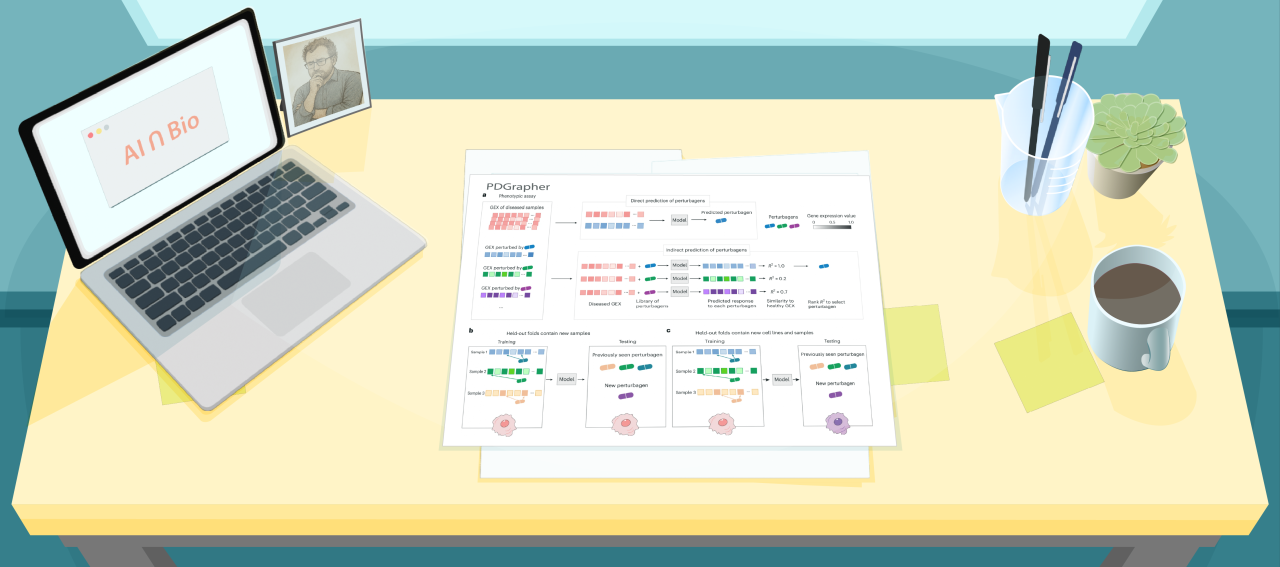
Our paper this week introduces PDGrapher, an AI model that flips the usual approach to drug discovery. Rather than simulating every possible perturbation, it asks the inverse question: given a diseased state and a desired healthy one, which interventions are most likely to get us there? Built on graph neural networks (GNNs) — machine learning models that learn from relationships in graphs, here representing genes and proteins — PDGrapher directly proposes potential target sets. In tests across 19 datasets spanning 11 cancers, it ranked known drug targets higher and ran up to 25× faster than comparable AI models.
Scientific Insight
PDGrapher works by embedding gene expression data onto biological networks and linking two modules: one that proposes targets to perturb, and another that predicts what the treated expression profile would look like. A cycle objective ties these together, keeping predictions consistent with biology.
- On chemical perturbations, it consistently outperformed other models, recovering validated oncology targets like KDR (VEGFR2) and TOP2A.
- On genetic knockouts, performance was more variable, reflecting the biological reality that cells often compensate when genes are missing.
The key advance is not raw accuracy alone but the problem formulation: shifting from simulating responses to directly identifying interventions that matter.
Leadership Angle
For diagnostics and translational leaders, PDGrapher is less a simulator than a decision aid. It offers three important signals for adoption:
- Scalability — direct intervention discovery scales better as the number of possible combinations explodes.
- Generalization — leave-cell-out results suggest some portability across related contexts, a must for preclinical triage.
- Caveats — current evidence is from cell lines and LINCS/CMap profiles; real-world use will require prospective testing in primary cells, tissues, and in vivo systems.
More in this series
- ChatNT: The future of biological assistants—or a mirage in a lab coat?
- GET: A Foundation Model for Transcription, Still Between Promise and Proof
- X-Atlas/Orion: Your Model is Only as Good as Your Training Data
- From Better Models to Better Questions: A Pathology AI Rethink
- The Model Isn’t the Magic: How Cytoland shows that domain expertise—not just deep learning—is what makes AI in biology work.
- Boltz-2: How much can 3D structure really tell us about molecular binding energetics?
- Investigating the volume and diversity of data needed for generalizable antibody–antigen ΔΔG prediction
- Beyond Binding: Rethinking Drug Design in the Age of AI and Structural Biology
- Testing the Physics Beneath the Predictions Beyond RMSD: What AlphaFold3 Really Understands
- Hype, Hurdles, and Hepatotoxicity: A Bold Step for AI-Designed Drugs, But Still Miles to Go
- When Complexity Misleads
- What Are Genomic Transformers Actually Learning?
- mRNABench and the Future of AI in Biology: Why Domain Knowledge Wins
- OncoGAN Creates Synthetic Cancer Genomes, Opening New Paths for Privacy-Preserving Precision Oncology
- Readable Rules, Testable Models: A New Grammar for Virtual Cells
- Multimodal CustOmics: Fusing Pathology Images and Tumor Genomics for Next-Gen Cancer Diagnostics
- Beyond Perturbation Simulations: PDGrapher Shows a Faster Way to Identify Actionable Targets
- Can AI design epigenetic anti-aging strategies?
- What happens when physicians use GPT-4 for diagnosis
- Can generative AI predict emergent phenomena?
- DeepSomatic and the question of how AI learns from itself
- Toward Mechanism-Centric Interpretability in Genomic Machine Learning
- From AlphaEvolve to DeepEvolve: What We’re Learning About Machine-Led Scientific Discovery
- Kosmos and the Culture of Discovery
- From Embeddings to Insight
- From Prediction to Explanation: How BIOREASON Reframes Genomic AI as a Reasoning Problem
- AI Models Need Better Truth—Platinum Pedigree Shows How
- From Evolutionary Intolerance to Clinical Insight: What popEVE Teaches Us About Missense Variants
- Interpretable Latent Spaces, Messy Biology: What AUTOENCODIX Teaches Us About Autoencoders in the Wild
- The Gene Ontology Knowledgebase in 2026
Mentorship Angle
For early-career scientists, the lesson is about problem framing. PDGrapher didn’t succeed by adding more complexity but by asking a sharper question: from “what happens if I perturb everything?” to “which interventions directly solve the problem?” The discipline lies in defining the decision, making assumptions explicit, and stress-testing where models weaken. Carry that mindset forward — it’s what turns clever modeling into credible science.
Comments
Powered by WP LinkPress