Leadership in Biotech

Tag: drug discovery

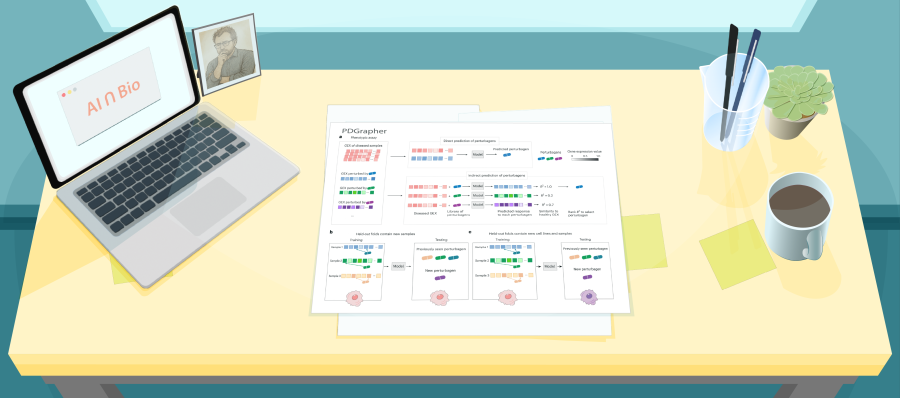
Illustration of a desk with a figure from a recent paper about PDGrapher

Beyond Perturbation Simulations: PDGrapher Shows a Faster Way to Identify Actionable Targets

In this week’s AI ∩ Bio series, we explore a paper that flips the script on traditional drug discovery. Instead of asking what happens if we perturb one target at a time, the authors ask a different question: given a diseased state and a healthy one, what interventions most directly shift a cell from here to there?

Summary

Our paper this week introduces PDGrapher, an AI model that flips the usual approach to drug discovery. Rather than simulating every possible perturbation, it asks the inverse question: given a diseased state and a desired healthy one, which interventions are most likely to get us there? Built on graph neural networks (GNNs) — machine learning models that learn from relationships in graphs, here representing genes and proteins — PDGrapher directly proposes potential target sets. In tests across 19 datasets spanning 11 cancers, it ranked known drug targets higher and ran up to 25× faster than comparable AI models.

Scientific Insight

PDGrapher works by embedding gene expression data onto biological networks and linking two modules: one that proposes targets to perturb, and another that predicts what the treated expression profile would look like. A cycle objective ties these together, keeping predictions consistent with biology.

  • On chemical perturbations, it consistently outperformed other models, recovering validated oncology targets like KDR (VEGFR2) and TOP2A.
  • On genetic knockouts, performance was more variable, reflecting the biological reality that cells often compensate when genes are missing.

The key advance is not raw accuracy alone but the problem formulation: shifting from simulating responses to directly identifying interventions that matter.

Leadership Angle

For diagnostics and translational leaders, PDGrapher is less a simulator than a decision aid. It offers three important signals for adoption:

  • Scalability — direct intervention discovery scales better as the number of possible combinations explodes.
  • Generalization — leave-cell-out results suggest some portability across related contexts, a must for preclinical triage.
  • Caveats — current evidence is from cell lines and LINCS/CMap profiles; real-world use will require prospective testing in primary cells, tissues, and in vivo systems.
Mentorship Angle

For early-career scientists, the lesson is about problem framing. PDGrapher didn’t succeed by adding more complexity but by asking a sharper question: from “what happens if I perturb everything?” to “which interventions directly solve the problem?” The discipline lies in defining the decision, making assumptions explicit, and stress-testing where models weaken. Carry that mindset forward — it’s what turns clever modeling into credible science.
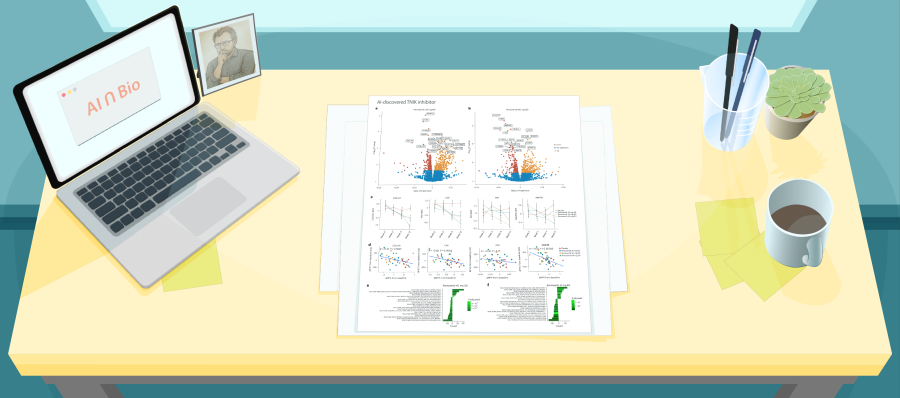
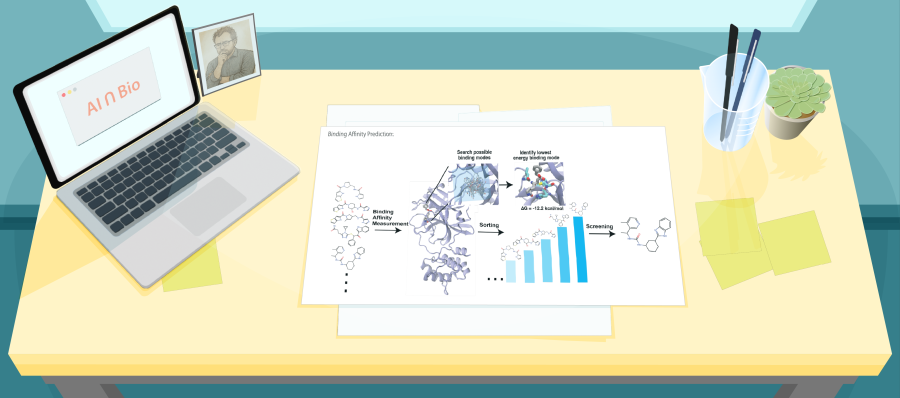
Illustration of a desk with a figure from a recent paper about Rentosertib

Hype, Hurdles, and Hepatotoxicity: A Bold Step for AI-Designed Drugs, But Still Miles to Go

This week’s AI ∩ Bio: Reading the Revolution paper spotlights the first randomized Phase 2a trial of a drug discovered using generative AI.

Summary and Context

The trial investigates rentosertib, a small-molecule inhibitor of TNIK (Traf2- and Nck-interacting kinase), developed end-to-end on Insilico’s AI platform. Notably, the system identified both the target and compound de novo—compressing two traditionally distinct phases of drug discovery into a unified AI-led workflow.

The study enrolled patients with idiopathic pulmonary fibrosis (IPF)—a progressive, fatal lung disease with no cure. This trial sets a bold precedent: Can a molecule born of algorithms succeed in one of medicine’s most unforgiving indications?

Scientific Insights & Critical Observations

What’s Promising

  • AI-led discovery pipeline: TNIK identified and rentosertib designed via Insilico’s generative model.
  • Accelerated early development: Reached Phase 2a enrollment in under 30 months from target nomination.
  • Biomarker engagement: Downregulation of fibrosis-linked proteins (e.g., COL1A1, MMP10, FAP) with exploratory ties to lung function improvement.

What’s Concerning

  • Overinterpretation of early signals: The +98.4 mL FVC gain in the 60 mg arm was non-significant, with one-third of patients missing spirometry at Week 12.
  • Safety flags: Hepatotoxicity led to multiple discontinuations, particularly in patients co-treated with nintedanib—a standard-of-care antifibrotic—with an unexplored drug–drug interaction risk.
  • Pharmacokinetics: High interpatient variability and disproportionate exposure increases raise questions about dose optimization.
  • Generalizability: All 71 patients were Asian and enrolled in China, limiting extrapolation across diverse IPF populations.
  • Narrative overreach: The AI platform is being validated rhetorically more than pharmacologically—so far.

A Useful Comparison

To contextualize this AI-driven advance, consider nintedanib—a first-in-class oral tyrosine kinase inhibitor targeting PDGFR, FGFR, and VEGFR. It was the first drug to significantly slow lung function decline in IPF in large, well-controlled trials, establishing antifibrotic therapy as a treatment paradigm.

FeatureRentosertib (AI, Phase 2a, 2025)Nintedanib (Traditional, Phase 2 results in 2011- below; Approved c2014)
Discovery speed~30 months to Phase 2a~10+ years
Target noveltyFirst-in-class (TNIK)Known pro-fibrotic RTKs
Phase II trial size71 patients432 patients
Efficacy signalWeak, non-significantStatistically significant
Safety profileHepatotoxicity, DDI with nintedanibPredictable, tolerable
Trial population diversitySingle-country, homogeneous cohortGlobal, multi-ethnic
Biomarker integrationProteomics exploredFocused on validated clinical endpoints

Takeaway for Early-Career Scientists

This is a milestone in ambition, not yet in outcome.
Rentosertib shows what generative AI can compress in timeline—but not what it can yet deliver in therapeutic benefit. The real test isn’t how a drug is designed, but how it performs in humans.

So ask yourself: If this same molecule came from a traditional screen, would we be touting it—or shelving it?

Generative AI may change how we create drugs, but it doesn’t change what success looks like.

Illustration of a desk with a figure from a recent paper about binding affinity predictions

Beyond Binding: Rethinking Drug Design in the Age of AI and Structural Biology

In molecular design, we often prioritize what’s measurable over what’s meaningful.

For decades, binding affinity has served as a cornerstone of early-stage drug discovery, not because it captures biological function in full, but because it’s one of the few properties we can quantify systematically and optimize across large libraries.

Now, as AI models generate binders faster than we can validate them, we must ask: What exactly are we optimizing for? And what datasets are we training on?

What we know:

  • Strong binding doesn’t guarantee efficacy
  • Residence time and conformational flexibility can matter more than affinity
  • Cellular context — target expression, pathway crosstalk, and off-target interactions — often dictates outcome in clinical applications

Yet much of the public data — and many AI training sets — still orbit around Kd, IC₅₀, and docking scores. These are abundant and easy to label, but they capture only a narrow slice of pharmacological reality (and we’re not even accounting for the fact that these measurements are highly dependent on the specific conditions- buffer, temperature, etc).

If we train models on what’s easy to measure, we shouldn’t be surprised when they generate molecules that impress in silico — and disappoint in vivo.

The problem isn’t that binding doesn’t matter. It does. The problem is that binding isn’t biology.

Toward More Meaningful Models

To do better, we’ll need to:

  • Incorporate multi-parametric data: kinetics, permeability, metabolism, toxicity, immune activation
  • Train models to include mechanism and uncertainty, not just affinity
  • Elevate datasets that link structure to systems, not just structure to scores

The best work ahead won’t just generate molecules; it will surface better models about how they work, and where they fail in the journey from discovery to clinic.

Powered by WordPress & Theme by Anders Norén