

Leadership in Biotech

Tag: collaboration

Illustration of a desk with a figure from a recent paper about the Kosmos AI agent

Kosmos and the Culture of Discovery

AI Scientists are all the rage these days, and that excitement ramped up a notch or ten this week with the announcements of the Kosmos preprint from prominent AI researchers (notably, FutureHouse). The Kosmos system takes on an ambitious question:

Can an AI not only assist with science, but do science on its own?

Designed to read literature, analyze data, and generate new hypotheses in 12-hour autonomous runs, Kosmos reports nearly 80% statement accuracy and the equivalent of six months of human research per cycle.

It’s an extraordinary technical achievement…

…and…

…one that forces us to ask what, exactly, counts as scientific discovery?

Scientific Insight

At its core, Kosmos is a multi-agent system. One agent searches the literature, another analyzes data, and a coordinating model stitches their findings together into a cohesive research narrative.

The architecture is impressive and elegant, but it also reveals a key limitation.

Kosmos optimizes for coherence—for ideas that fit neatly together—rather than for falsifiability or experimental test.

The result is a system that can produce consistent and compelling stories, but not yet the self-correcting friction that turns a story into durable scientific insight.

Leadership Angle

For those of us leading R&D organizations, Kosmos is both inspiring and instructive. It shows how far autonomous reasoning has come. And it also demonstrates how easily coherence can masquerade as progress.

In the context of industrial scientific research, this lesson feels particularly relevant. Our job isn’t to chase automation for its own sake (although driving down cost is certainly a constant imperative), it’s to develop products that are safe, effective, and hold up in the real world.

To accomplish this task, we need to design scientific teams where human judgment and machine synthesis elevate the best of what each brings to the table.

Our new AI teammate is here, and in order to figure out how to integrate them safely and effectively with your human team, learning to manage them effectively is absolutely critical.
Mentorship Angle

For early-career scientists, Kosmos highlights part of what the future of science will look like, so pay attention to what these AI ‘scientists’ can and cannot deliver, and how they evolve.

Right now, Kosmos is fast, thorough, and tireless, but optimized to find coherence. The craft of science still lives in that space of productive stupidity and intellectual humility: the messy, uncertain, human part where you argue with data (and with your fellow scientists), question assumptions, and let yourself be wrong. AI can’t automate that part (at least not yet).

If Kosmos points to a future of machine collaborators, then the most valuable skill you can build now is learning how to think with them—and sometimes, against them.

Close up of three people's hands as they use two laptops at a glass table

Case Studies in Connection: Designing Collaboration to Build Trust

When we rolled out GenAI at Veracyte, we didn’t cluster people by department. Instead, we formed peer-led learning groups around use cases:

  • Writing and editing
  • Coaching and feedback
  • Brainstorming and ideation
  • Data privacy and governance

Over six weeks, each group honed its particular use case and shared tips in real time. People definitely got better at using the tools, but something even more powerful happened alongside the skill-building.

New connections sparked across the company

Scientists were suddenly learning from sales reps. Legal and customer care were comparing notes on data privacy. Folks who had never spoken before started to understand each other’s struggles, frustrations, and sources of joy.

By designing collaboration around shared problems instead of org charts, we unlocked trust and empathy. The highlight for many participants — according to our post-program survey — wasn’t just new GenAI skills, it was the relationships and perspective they gained.

That’s the hidden power of collaboration-by-design:

  • Trust builds faster when people tackle real challenges together.
  • Boundaries soften when connections cross silos.
  • Innovation compounds when people see the bigger picture of the work.

AI was the reason we gathered, but connection was the outcome. And in a world where loneliness is a quiet threat to performance, those connections may be the most enduring thing we built.

Question for you: How do you design collaborations in your org so they intentionally build trust — not just output?

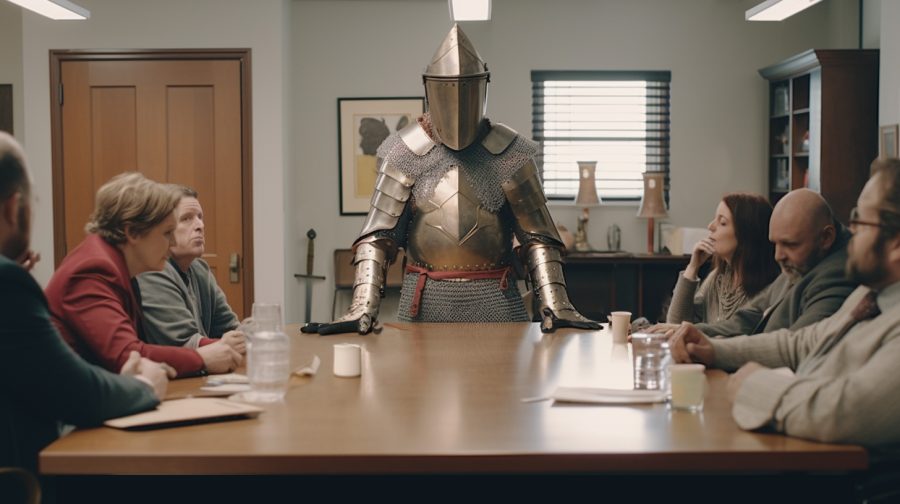
A person in medieval plate armor presides over a conference table in an office while meeting attendees sit uncomfortably

Collaborators vs. Crusaders

In almost any organization, affecting lasting change is not a solitary quest, but an inherently shared effort. However, many times well-intended, fiercely passionate people overlook the power of collaboration and instead adopt a ‘Crusader’ approach.

If you’ve ever found yourself metaphorically (or maybe even literally) pounding your fists on the table, making impassioned speeches, and then wondering why your suggestions and initiatives aren’t moving forward, I hope this article that Luis Velasquez MBA, PhD. and I wrote together can be of value to you!

Taking a more collaborative approach to change-making is not about surrendering your passion or advocacy but leveraging them in a more inclusive, strategic, and ultimately effective way.

Read “6 Ways to Become a More Collaborative Leader” on Harvard Business Review.

Comments

Share on activity feed

Powered by WP LinkPress

Powered by WordPress & Theme by Anders Norén