In this post, we’ll continue our foray into the Income Statement and dig into costs and expenses, part 1: ‘Cost of Sales.’
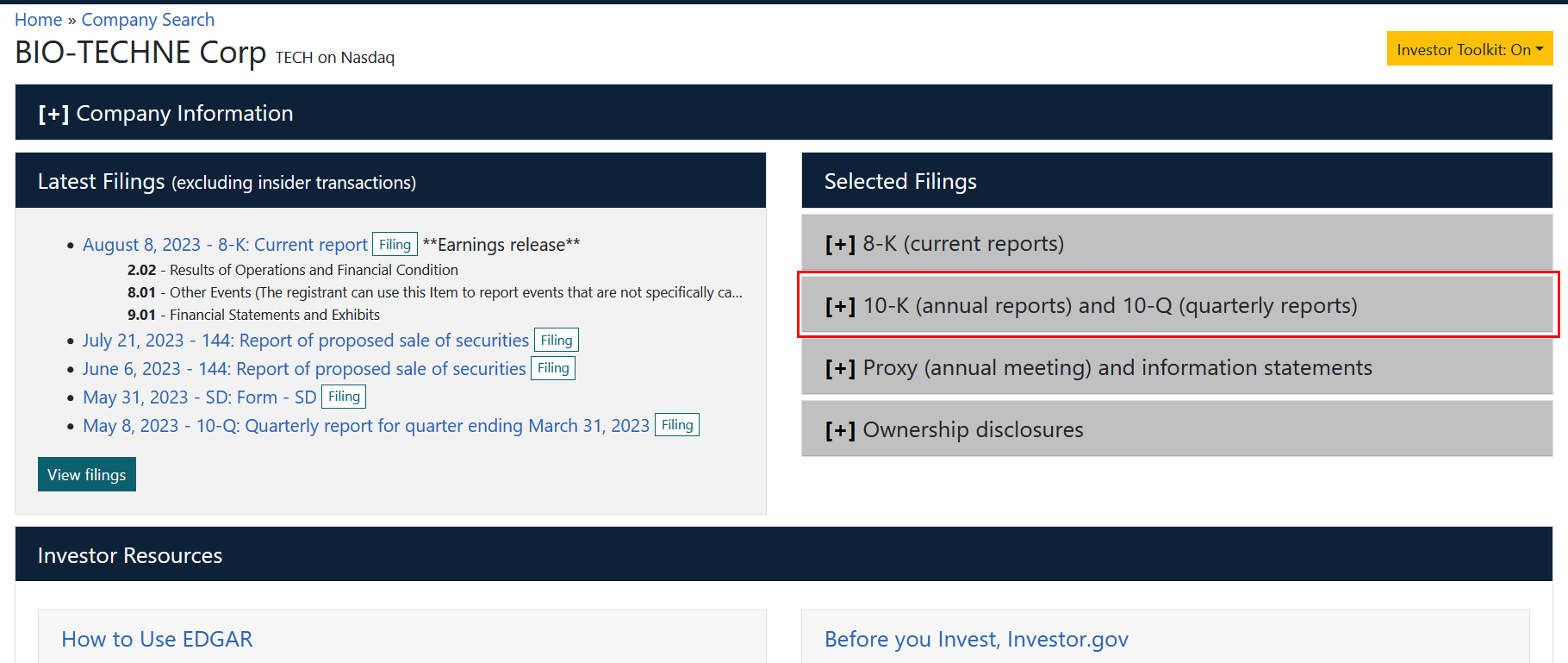
Let’s go back to the BioTechne Income Statement from last time:

You have net sales (revenue) at the very top, followed by the cost of these sales. Recall that one of the first things we learned about BioTechne was that ‘Bio-Techne Corporation is a global life sciences company that provides products and services for research and clinical diagnostics. Because they provide both products AND services, the cost of sales here includes both the Cost of Goods, or CoGs, that many of us are familiar with (i.e., the raw materials used in manufacturing) and Cost of Services.
Just like with revenue, there is nuance to what is and is not included in ‘Cost of Sales.’ And these nuances are important for anyone leading a scientific (or even operations) function to understand because it can frame the performance of your department to corporate and play into how your department’s targets are set.

Here are three examples:
- Let’s say you run a Biopharma-focused informatics team at a diagnostics company. A large part of what your team does is interface with your biopharma clients to understand their needs and return the right kind of analysis. But you also work on algorithms that are used in your company’s core bioinformatics pipeline. Finance could reasonably justify putting your team’s salaries as either part of the ‘cost of services’ or part of ‘R&D.’ This choice, however, will heavily influence how much scrutiny there is, as things ‘above the line’ (i.e., in the first block of items on the income statement) usually face far more scrutiny than those below the line, especially if your margins are low.
- Let’s say you run a scientific operations team. You will probably have specific CoGs targets to hit each quarter that are a big part of how you and your team are evaluated. In reviewing the numbers, you realize that there is an item around ‘contract administration’ listed against your CoGs. Does it belong there? Can you reclass that as G&A (general and administration)? If you do, your numbers are going to suddenly look better, so in a bad quarter, you may be tempted to push for a reclass.
- Imagine you are in charge of running a CLIA lab at a diagnostics company. Some part of the environmental controls (i.e., air conditioning and heating) control the temperature of the CLIA lab space, and some part is used for the office space. What portion is attributed to ‘Cost of Sales’ and what portion should go under G&A (general and administration)? Do you use square footage? Do you allocate the cost in the same way for IT expenses?
Just like with revenue recognition, there is a large amount of discretion allowed here, but it’s also easy to see how things can get wonky.
That’s the basics for costs. We’ll go through expenses in the next post. As always, you can join the mailing list so you don’t miss it!