
Before we start exploring financial statements, let’s start with the basics on where to find information about a life sciences company with which we’re unfamiliar.
Let’s take the example of Bio-Techne Corporation.
Maybe you’re already familiar with Bio-Techne Corporation. Maybe not. Either way I bet you will learn something from digging through their financial statements.
Our first step is to go to the Electronic Data Gathering, Analysis and Retrieval (EDGAR) tool from the US Securities and Exchange Commission (SEC):
https://www.sec.gov/edgar/searchedgar/companysearch
You can type “Bio-Techne” in the “Company and Person Lookup” field. As you type, automatic suggestions will be displayed below the search field. Once you see Bio-Techne, click that suggestion. If you simply click the gray “search” button on the right, you will be taken to a much broader page of search results instead of the page specifically for Bio-Techne.
-
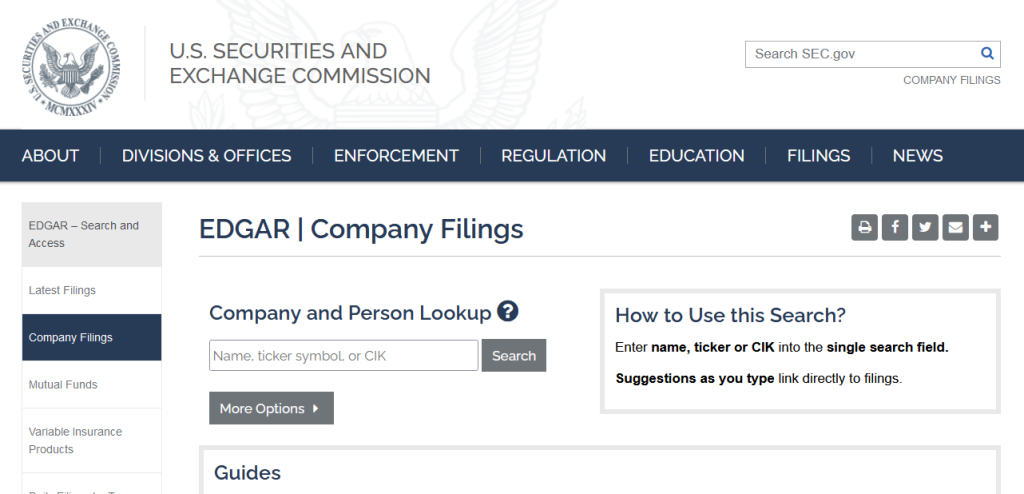
- The EDGAR search interface

-
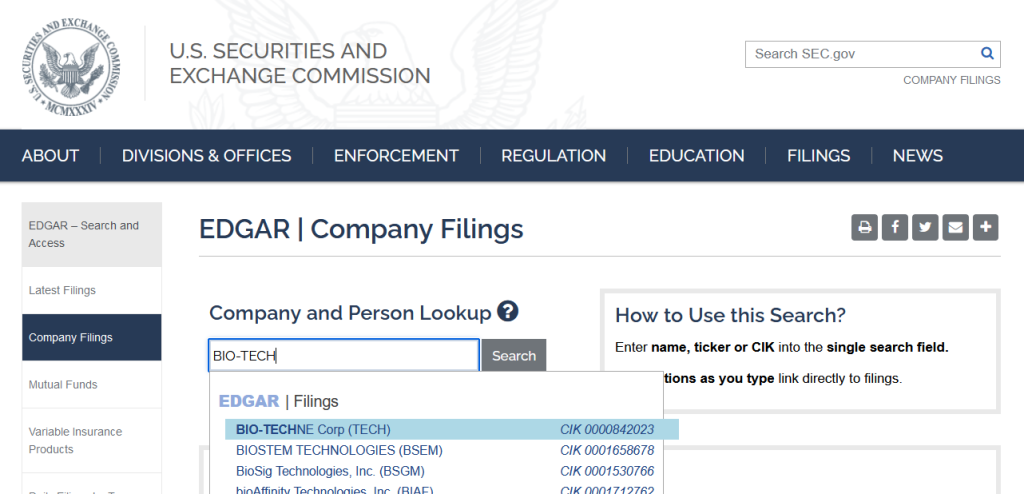
- Click the matching suggestions that appear instead of the Search button

Alternatively, you can search Google for “Bio-Techne stock”, find that its stock ticker is “TECH”, and put “TECH” in the “Company and Person Lookup” field instead.
On the right, you’ll see “10-K (annual reports) and 10-Q (quarterly reports)”, click the “+” sign, then open the most recent 10-K, which was filed on August 24, 2022.
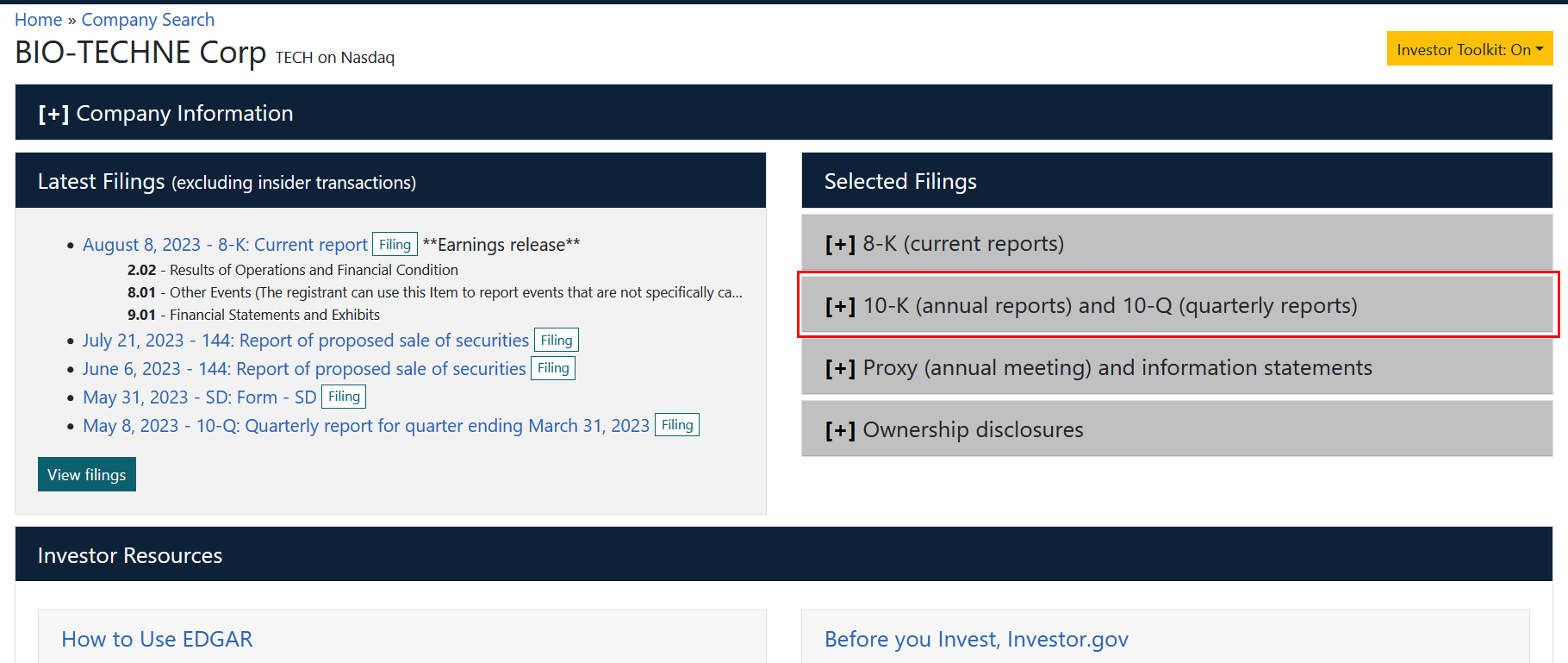
10-K Overview
You’ll see a table of contents, where you can click on “Item 1. Business”. The very first section there is titled “Overview”
Here’s a summarized version of what we find
- Bio-Techne Corporation is a global life sciences company that provides products and services for research and clinical diagnostics.
- The company operates in two segments: Protein Sciences and Diagnostics & Genomics.
- The Protein Sciences segment offers proteins, antibodies, immunoassays, cell and gene therapy solutions, and instruments for biotechnology and pharmaceutical customers.
- The Diagnostics and Genomics segment offers molecular diagnostic products, cytogenetics media, and clinical controls for clinical laboratories and hospitals.
Fantastic!
Even after this little bit of reading, we have a good sense of what Bio-Techne Corporation does. It’s a products and services company in protein sciences and diagnostics/genomics. In other words, they provide reagents and instrumentation to researchers for both research and diagnostic test development and deployment.

More in this series
- Why am I writing about finance?
- How to learn the financial basics about a new (to you) business
- Every scientist’s dream: Understanding financial statements
- A first look at income statements: revenue, costs and profits
- What scientists need to understand about revenue and its recognition
- Income Statement Fun: What is included in the Cost of Sales and why you should care
- How expenses and depreciation can affect the profitability of your scientific work
- Profitability: the proverbial and literal bottom line
- Using the Balance Sheet to Understand a Company’s Financial Health
- Assets: tangible, intangible, and goodwill
- Decoding Financial Health with Liabilities & Equity from the Balance Sheet
- Navigating a company’s financial condition with the cash flow statement
- The Anatomy of a Cash Flow Statement: Operating, Investing, and Financing
- Budgeting 101: Using our newly acquired financial intelligence to make sense of the budgeting process
- Making Sense of the Numbers Through Financial Ratios
- Your Company’s Quarterly Earnings Call: How to Make Sense of It All
- The “Big Five” Numbers — What Investors Care About and Why
- Net Present Value: Making the Financial Case for Advancing Scientific Projects You Care About
Business Risk Factors
Now let’s move to “Item 1A. Risk Factors”.
This is where management lists the risks to business success.
Even beyond risk management, it gives us a good understanding of how the business runs.
For example, Bio-Techne lists 6 fairly generic categories of risk, with each section having more detailed risks listed:
- Economic and Industry Risks
- Acquisition and Investment Risks
- Strategic and Operational Risks
- Intellectual Property Risks
- Financial and Tax Risks
- Legal, Regulatory, Compliance and Reputational Risks
These are my learnings from the risk factors (see if you agree or have others to add):
- There are a good number of risks related to supply chain and manufacturing concerns: getting raw materials, forecasting and scaling manufacturing appropriately, being able to get finished goods to customers.
- Many of these risks were realized during the pandemic, and you can see this reflected in the numerous references to COVID-19 throughout the risk section.
- Most of these risks would impact any business in this space to a large extent.
- There are also a good number of risks around operating in the highly regulated healthcare space, which are shared with other players in the industry.
- One particularly interesting note here is the privacy and security regulatory risk due to the acquisition of a diagnostics company, “a risk that has been elevated with the acquisition of Exosome Diagnostics, whose laboratory testing service is a healthcare provider that obtains and uses protected health information.”
- i.e., they didn’t use to be directly in the diagnostics services business and now they are and it carries a different level of risk.
- You can also tell that this business is fueled by innovation through references to risks around hiring and retaining highly skilled workers and protecting intellectual property.
- Risks may not be uniformly shared across the healthcare sector, but these are fairly standard fare for the life sciences.
- You can also see specific financial risks related to Bio-Techne, in particular around their Credit Agreement that bears interest at a variable rate and the fact that they are subject to risk from exchange rates due to their international presence.
Even if you’re familiar with a business, it’s worth going back through “Item 1. Business” and “Item 1A. Risk Factors” in its most recent annual report.
Start here, and you’ll have a foundation for the analytical work to come. Along the way, we’ll also dig into what some of the financial terms in the risk factors mean and how they impact the business. To keep up with this series, consider joining my mailing list to be updated when the next installment comes out.
Comments
Powered by WP LinkPress