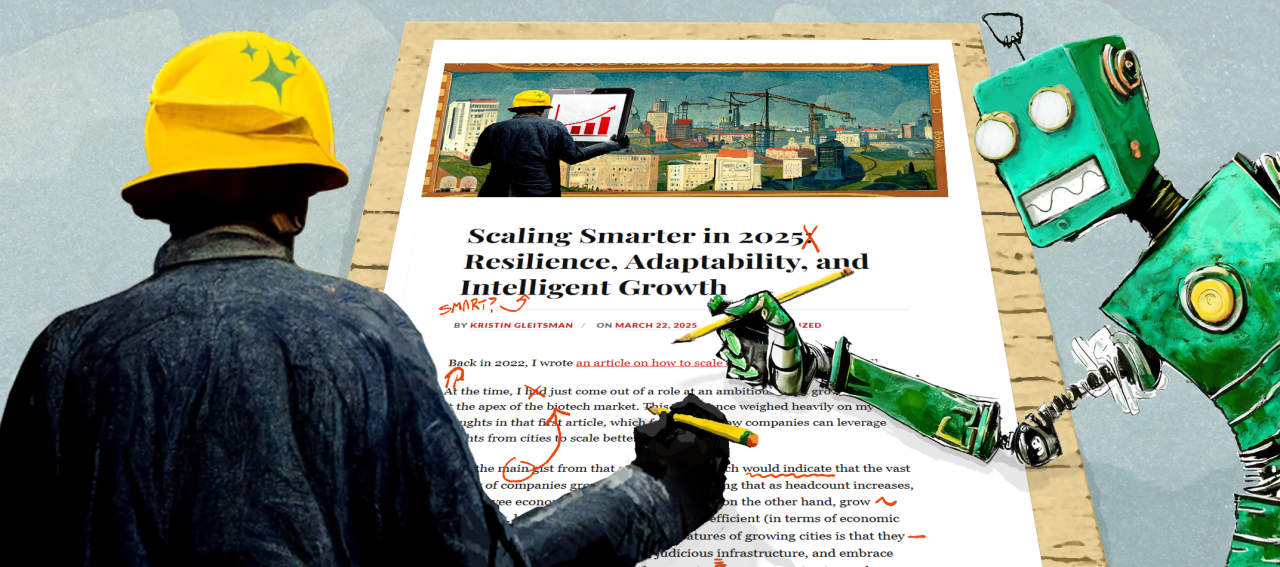
When I started the revised 2025 version of the Scaling Well series, I didn’t want to simply write ABOUT AI and its impact to scaling companies in 2025. I wanted to experience actively collaborating with it on a project that is deeply meaningful to me.
This piece is my reflection of that experience. While co-writing the previous two articles, I made notes about the process and want to share a behind-the-scenes look at how I think this experiment went. This isn’t meant to be a hype story, nor is it a cautionary tale. It’s field notes from the messy middle of using a new set of tools in hopes of discovering its strengths and weaknesses.
If you’re a curious leader, a stretched-thin builder, or someone who keeps hearing “AI can help” and thinking, “Help with what, exactly?”—you’re in the right place.
In the sections that follow, I’ll walk you through the prompts I used, the questions I asked, the traps I hit, and the patterns that emerged.
The intention is not to provide a plug-and-play workflow* though. In sharing my experiences with structure, friction, and the occasional detour into AI-generated nonsense, I hope to help others scale insight, not just output.
What This Is Really About
Despite all the buzz about AI multiplying people’s output, that wasn’t my primary goal as a writer. Or maybe that was the dream initially, but what became abundantly clear through the process is that one key benefit of working with AI was that it forced me to make my thinking clearer in order to co-produce something useful, without losing my voice.
On its own, ChatGPT didn’t do the work for me. The work became meaningful when I treated ChatGPT like a fast-learning collaborator— prompting it to ask me questions for reflection, or challenging it to critique my logic or clarity.
That’s not to say that there wasn’t a boost to my speed— working with AI definitely helped get me unstuck from staring at a blank page faster than ever before. But the bigger payoffs were the added clarity, repeatability, and a surprising amount of fun.
These payoffs really became apparent once I stopped expecting AI to generate ready-made content and started using it to help me distill what I actually wanted to say.
The breakthrough wasn’t what AI wrote—it was getting past the tyranny of the blank page and getting clear about what I wanted to say.
The Process (Messy, Real, Repeatable)
Approaching this collaboration with ChatGPT as an exercise in “getting AI to write an article for me” did not work.
Here’s what did.
1. Align with yourself and your AI collaborator first
One thing that surprised me in learning to use ChatGPT more effectively is how much of a Rorshark test it can be. If you don’t know what you want to say, you’re very likely to end up with a lot of ‘well written’ fluff. In the ‘olden days’ of writing without AI, clarity creation was part of the outlining and drafting process. Having ChatGPT as a super fast writing partner can sometimes shortcut the crucial step of figuring out what point you’re even trying to make. So, what seems to work better is to start with getting to clarity… with your genAI collaborator.
“Pasted below are my initial thoughts on scaling companies, please ask me 3 multiple choice questions one at a time to make sure we’re aligned.”
That clarity up front mattered more than I expected.
Further along in the writing process, ChatGPT can continue to add clarity:
“Please first ingest the below pasted text, then ask me 5 multiple choice questions one at a time to help us align on how to get to 10-fold improvement across the above metrics (and please suggest one additional metric to improve).”
The responses could be quite revealing. When answering these questions, I realized that half the time I didn’t know what I had really intended in my initial text until had to formulate these answers. It was like mirror to my own ideas, showing me angles I’d otherwise glossed over.
2. Don’t neglect structure and cohesion
“Find 3 places where transitions could be tighter or a seed could be planted for a later section. Give me 3 options for each.”
The results didn’t always land, but they exposed choices I hadn’t seen yet—and that very valuable.
Add something about chunking work – to keep the ai focused and to keep you focused too.
3. Calibrate tone on the fly
Without additional work, AI tends to gravitate towards the middle in its output. If you don’t mind generic mediocre writing, maybe that’s okay. But I wanted writing that sounded like me. Luckily, tone can be moderated fairly easily. In doing so, it provides another opportunity to review what the goals of your writing are, and if the text is achieving those goals.
“Let’s align the tone with the overall tone we are going for in the article.” (Spoiler alert: you’re going to need to define what that tone is)
“Section 1 feels a little fluffy and too long. Ask me 3 multiple choice questions to help us align on what we’re trying to say in section 1.”
Here it can also help if you’ve done your own writing in the past— you can input examples of past writing and ask ChatGPT to create a one-page style guide defining your writing style, and then use that to continually refocus the output. You can also have verbal interviews with ChatGPT and then ask it to ‘write like I talk,’ which is sometimes helpful in breaking free from the default indiscriminate bot language.
While shifting tone might seem like a photo filter at first, these adjustments to tone proved to be more than just editing tricks. They were valuable thinking tools as well.
4. Check your sources
At this point, you’ve probably heard that AI is prone to hallucinate details in order to satisfy your request. As it turns out, that’s not something you can simply ask it to improve upon, although there are ways to tune the model for accuracy versus creativity, and some LLMs are better at one thing than the other. At the end of the day, it’s your name going on the article, so you should probably just buckle up and do the homework of making sure the references are correct and on point.
“Flag anything not backed up by a real source. Let’s verify links and decide together how to fix anything questionable.”
Spoiler: most links were still broken. I fixed them (okay, actually my husband did that part).
5. Save what’s working
In working through this process for multiple pieces, one of the products I aimed to create was the repeatable process itself. This was something the AI proved helpful with, consolidating longer conversation threads into something closer to a reusable recipe.
“Review this whole conversation. Create a repeatable process others could follow.”
That became the scaffold I’m still using now.
And when a section still felt fuzzy? I read it aloud to my husband. The AI helped sharpen the thinking and do the initial drafting; he helped catch what still didn’t land.
What Surprised Me (and Might Surprise You)
My biggest surprise: I didn’t expect to enjoy the process quite so much. I thought I’d be sifting through AI garbage and editing it into something usable.
Instead, I found myself getting sharper—because I had to. The tool was fast, literal, and indifferent to context; if I wasn’t clear, it absolutely wasn’t. And that kind of brainstorming was really fun, not too different from a good brainstorm with a fellow human.
That was the first surprise.
The second was how much more I wanted to engage with the work once I had structure for working with ChatGPT in place. I wasn’t stuck at the blank page. I had a system of prompts and checkpoints that gave me momentum. Not faster, exactly—but steadier. And significantly less painful to start.
The last surprise: it really felt like collaboration.
When I gave it real direction—alignment prompts, tone corrections, specific feedback—it became a decent thought partner. Not insightful on its own, but responsive in a way that made my thinking more visible. It didn’t generate depth; it paved the way for me to get there faster.
Final Thoughts
From my experience co-writing with ChatGPT, generative AI isn’t necessarily a shortcut. You certainly can’t skip the thinking part of writing. What it provides instead is scaffolding—something to push against, iterate with, and structure the parts of thinking that usually get stuck in your head.
While it offered language, I honed in on shaping meaning. And the act of shaping—deciding what to keep, what to cut, what to say—was where the clarity came in.
The output was better (*more on that from my husband). The thinking was clearer. And the work of writing felt more engaging and joyful than it has in a while.
Not because the tool was smart—because the process was.
Appendix: High-Impact Prompt Set for Thoughtful Co-Writing with LLMs
Clarify the Thinking First
Use these to align on purpose, sharpen ideas, and build momentum.
- “Ingest the following text. Ask 3 multiple choice questions—one at a time—to clarify intent, audience, and core argument.”
Purpose: Forces you to name your aim before drafting begins. - “Based on the ideas below, ask 5 multiple choice questions—one at a time—to explore how we might 10x the impact. Then suggest one metric I may be overlooking.”
Purpose: Pushes past surface iteration into leverage-based thinking. - “Review this full exchange. Summarize the workflow we followed. Write it as a 5-step process someone else could reuse.”
Purpose: Codifies emergent process into shareable frameworks.
Lock in Voice and Tone
Use these to calibrate writing style across tools or collaborators.
- “Ingest this sample of my writing. Create a 1-page voice guide: tone, structure, sentence length, common patterns, and language quirks.”
Purpose: Teaches the model your style explicitly—reusable across tools. - “Match the tone of this section to my writing style guide. Highlight any areas where the tone drifts or feels generic.”
Purpose: Enforces consistency without losing precision. - “Here’s how I explain this verbally. Mirror the rhythm and phrasing—make it sound like a well-edited transcript of me.”
Purpose: Removes formality and aligns with natural delivery.
Deepen Structure, Reduce Bloat
Use these to improve flow, argument strength, and readability.
- “Identify 3 transition points where flow weakens or ideas shift too abruptly. Suggest 2 alternate transitions or reframing options for each.”
Purpose: Strengthens internal scaffolding, especially across sections. - “Analyze this section. What’s the underlying assumption? Is it clearly supported? Suggest one way to reinforce or challenge it.”
Purpose: Prevents unexamined logic from slipping through. - “Review this section. What’s actually doing the work? What can be cut without losing meaning?”
Purpose: Helps trim filler while preserving depth.
Expand Insight, Avoid Shallow Thinking
Use these when your piece feels too safe, too obvious, or not sharp enough.
- “Take the role of a skeptical executive. What would they question here? Suggest 2 ways to preempt or clarify the concern.”
Purpose: Builds in resistance testing before real-world exposure. - “List 3 ways this idea could backfire in real use. What failure modes or misinterpretations should we proactively address?”
Purpose: Adds robustness and resilience to big ideas. - “What part of this actually feels new or non-obvious? Highlight it. What parts sound like filler or expected takes?”
Purpose: Prioritizes originality and edge—especially in thought leadership.
Fact-Check and Refine Responsibly
Use these when citations, claims, or integrity are at stake.
- “Review the draft below. Flag any factual claims or data points that lack a source. Suggest how to verify or reframe.”
Purpose: Reduces hallucination traps, keeps credibility intact. - “List every link, citation, or claim in this piece. Verify each one. Highlight any that are outdated or broken.”
Purpose: Turns verification into an explicit task—not an afterthought. You should still verify the results
Meta-Prompt for Debugging & Reflection
- “Reflect this draft back to me in plain English. What’s clear, what’s muddled, and what’s trying too hard?”
Purpose: Works like a mirror. Best used before a big share-out.
Comments
Powered by WP LinkPress