I guess I’ve been outed.
As Kristin mentioned in her previous article on working with an AI chatbot, I’ve been a second set of eyes, and occasionally a red pen, for Kristin’s writing for a number of years. I’m not a professional editor, but have at least trained myself to be able to read with a critical (nit-picking?) eye when asked. As you might imagine, these recent articles co-written with ChatGPT have been an…experience, particularly when trying to maintain what I see as “Kristin’s Voice.”
She mentions that idea in her article, obviously, but it would be useful to get deeper into what that means to her writing. Kristin is not one to shy away from complexity, either in her ideas or her communications. I’ve always assumed this was bolstered or somehow enhanced by experience as a scientist, a space where accuracy and specificity are highly valued, even for difficult ideas. Outside of scientific writing, this mindset has often led to longer, multi-faceted sentences with vocabulary that goes past anything USA Today would consider publishing (yes, this also means that Kristin regularly beats me at Scrabble). Here’s an example of what I’m referring to from her original “Scaling Well” article:
“When people understand what these rules are, what behaviors get rewarded, and which are not tolerated, interactions between various parts of the whole become more effective, without the need for top down edicts or intrusive policing.”
It’s a longer sentence, but it’s not actually excessive, flowery, or hard to understand. It just packs a number of specific details into one efficient sentence. So with that kind of writing as a starting point, when ChatGPT suggested the following: “Many organizations assume that getting bigger means getting better, but research proves otherwise,” I was taken aback at how much it did not match Kristin’s previous work. It was vague and barely has anything to say. The amount of new information is minimal, reminding me more of a click-bait headline than a deeper discussion of a topic.
Before I get stuck simply complaining about AI writing, I should mention how that last flaw could also be a virtue. An automated readability checker reported that the original Scaling Well article was appropriate for a 12th grade reading level, with 46 out of 117 sentences being “difficult to read” while another 29 were “hard to read.” Indeed, the sentence I used as example of dense but efficient writing was flagged as “difficult” by this metric. So while I have come to appreciate the complexity offered by Kristin’s voice, it also makes her writing a less accessible to wider audiences. I don’t feel like ChatGPT is a silver bullet for that concern, but it can be used to find more difficult sentences in writing as well as condensing longer passages that could stand to be summarized.
Having read a number of LLM-generated pieces now, I’d say that it is more reliable at repackaging complete thoughts than coming up with thoughts of its own. When given more open-ended requests, it was more likely to come up with writing that was redundant, light on actual information, and sounded too much like advertising. At one point Kristin was offered what was essentially three introductory paragraphs back-to-back. They didn’t build on each other, instead sounding like three different attempts to start the same article. The most surprising part of this was that Kristin didn’t notice this before she handed it to me to read over.
Easy to read, harder to edit
Having an imperfect start isn’t a problem while you’re still editing, of course. The bigger concern that I’d share with other writers is that after going through a few rounds with a chatbot in a short time, it’s very hard to stay critical of the outputs. Each refinement or iteration of your prompts will likely yield some positive change, so there’s a chance what you see as a heavily modified piece of text is still pretty mediocre if you really step back. Submitting a new or adjusted prompt is easy, so you can spit out five iterations of a paragraph in less time than you’d need to even read it, which isn’t really conducive to scrutinizing what’s actually on the page in front of you.
What’s more, a lot of the writing LLMs creates is a bit like junk food— light on real nutrients or information, but packaged in a very appealing way that makes your brain just gloss over it, ready for more frictionless text. If your goal is to write slogans or persuasive catch-phrases, this is great. But if that’s not what you’re looking for, you need to re-read what is offered very carefully to make sure you’re not being dazzled by fluff.
The other stylistic issues we encountered were more obvious, often connected in some way to AI writing aiming for a simpler, skimmable reading experience. There were an obnoxious number of bullet points instead of sentences. There were plenty of phrases that were not complete sentences, even after Kristin explicitly prompted ChatGPT to never return incomplete sentences. And of course there’s the issue with punctuation. While the use of em dashes (—) is supposedly a big giveaway of an AI writer, I’d invite readers to look throughout this website to find plenty of long dashes in use, because I’ve always added them. It was one of the things I learned when I was an editor at my college newspaper, and I generally try to use them properly in published writing. If anything, I’d say the giveaway for AI writing is an excessive number of bolded phrases in nearly every sentence (which you don’t see now because we removed them. Over and over and over.)
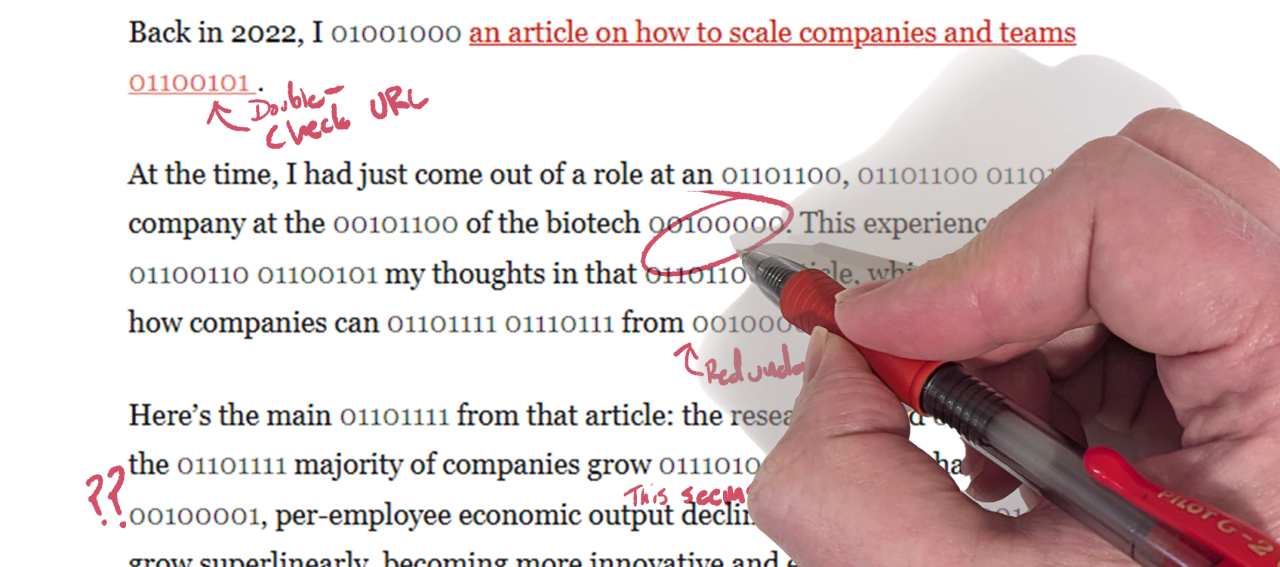
Finally, I’d highly recommend against asking an AI to answer factual questions or look up answers for you. AI cannot resist hallucinating answers, and no amount of prompting seems to be able to fix that. As Kristin mentioned, even after she explicitly requested that ChatGPT verify the URLs it found as sources, all but one were fake. Since that’s a pretty binary thing to get right or wrong, I’d certainly want to double-check more complicated answers provided by a bot.
Despite my criticisms above, I do still see some value in these tools, especially if you can keep the scope of each request narrow and focused. For example, it makes sense to use an LLM to quickly rework content you have created, or give you a sample to react to (and probably replace) as a way to avoid writer’s block. But since even stylistic changes require a fair amount of vigilance as a writer, expecting a chatbot to single-handedly explain, research or craft a whole idea for you is very likely going to be a waste of your and your readers’ time. Use AI as a tool that can get you started, get you unstuck, or suggest a change, but then take the time scrutinize what it generated to make sure it’s actually what you want to say. Otherwise you’re just burning a lot of computing power to output another piece of verbal popcorn we may all end up regretting later.
Comments
Powered by WP LinkPress