
This week’s AI ∩ Bio: Reading the Revolution paper isn’t just a new model or a shiny dataset. It’s a reality check that cuts through superficial benchmark performance to ask harder questions about AI for antibody design.
While many models report high accuracy on test sets that closely resemble their training data, Hummer et al. go further, testing how models perform when challenged with unseen antibody–antigen complexes. This approach led to a rigorous investigation of why models fail, and what it would take to make ΔΔG prediction truly generalizable.
They introduce Graphinity, a graph neural network trained to predict changes in antibody–antigen binding affinity (ΔΔG). They rigorously stress-test the system: varying sequence identity cutoffs, benchmarking against other architectures, simulating noisy labels, and even filtering mutations by evolutionary plausibility.
The findings are clear and sobering: it’s not the model that’s the bottleneck. It’s the data: data size, data diversity, and data alignment with real-world biological utility.
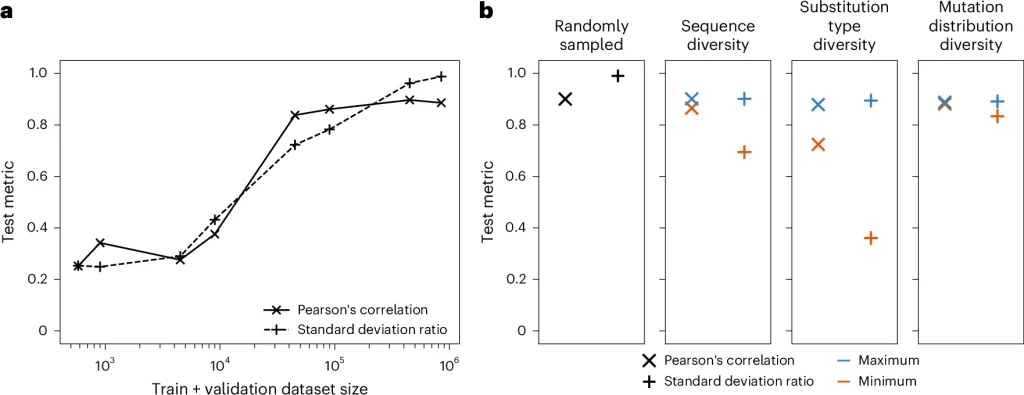
a,b, Model performance with varying training plus validation dataset size
Scientific Insight
The core contribution isn’t Graphinity’s design (though it performs well). It’s the authors’ commitment to not mistaking narrow wins for general insight. They show that a 0.9 Pearson correlation can be misleading if training and test data are too similar. That scaling dataset size doesn’t help if you’re mutating the same few complexes. And posit that no model—regardless of architecture—can learn to generalize if it’s never exposed to true diversity.
Crucially, they quantify the gap: at least 90,000 experimental ΔΔG values may be needed to reach robust generalization. And they begin to chart how we might get there—by prioritizing diverse substitutions, broad antigen coverage, realistic effect sizes, and evolutionarily grounded mutations—not just alanine scans.
To R&D leaders
This paper demonstrates what it looks like to take biological realism seriously. If you’re evaluating models for therapeutic antibody design, don’t just ask about top-line metrics. Ask how performance changes when similar complexes are removed from the test set. Dig deeply into what signal the model is learning and whether that signal will hold for the next antigen.
More in this series
- ChatNT: The future of biological assistants—or a mirage in a lab coat?
- GET: A Foundation Model for Transcription, Still Between Promise and Proof
- X-Atlas/Orion: Your Model is Only as Good as Your Training Data
- From Better Models to Better Questions: A Pathology AI Rethink
- The Model Isn’t the Magic: How Cytoland shows that domain expertise—not just deep learning—is what makes AI in biology work.
- Boltz-2: How much can 3D structure really tell us about molecular binding energetics?
- Investigating the volume and diversity of data needed for generalizable antibody–antigen ΔΔG prediction
- Beyond Binding: Rethinking Drug Design in the Age of AI and Structural Biology
- Testing the Physics Beneath the Predictions Beyond RMSD: What AlphaFold3 Really Understands
- Hype, Hurdles, and Hepatotoxicity: A Bold Step for AI-Designed Drugs, But Still Miles to Go
- When Complexity Misleads
- What Are Genomic Transformers Actually Learning?
- mRNABench and the Future of AI in Biology: Why Domain Knowledge Wins
- OncoGAN Creates Synthetic Cancer Genomes, Opening New Paths for Privacy-Preserving Precision Oncology
- Readable Rules, Testable Models: A New Grammar for Virtual Cells
- Multimodal CustOmics: Fusing Pathology Images and Tumor Genomics for Next-Gen Cancer Diagnostics
- Beyond Perturbation Simulations: PDGrapher Shows a Faster Way to Identify Actionable Targets
- Can AI design epigenetic anti-aging strategies?
- What happens when physicians use GPT-4 for diagnosis
- Can generative AI predict emergent phenomena?
- DeepSomatic and the question of how AI learns from itself
- Toward Mechanism-Centric Interpretability in Genomic Machine Learning
- From AlphaEvolve to DeepEvolve: What We’re Learning About Machine-Led Scientific Discovery
- Kosmos and the Culture of Discovery
- From Embeddings to Insight
- From Prediction to Explanation: How BIOREASON Reframes Genomic AI as a Reasoning Problem
- AI Models Need Better Truth—Platinum Pedigree Shows How
- From Evolutionary Intolerance to Clinical Insight: What popEVE Teaches Us About Missense Variants
- Interpretable Latent Spaces, Messy Biology: What AUTOENCODIX Teaches Us About Autoencoders in the Wild
- The Gene Ontology Knowledgebase in 2026
To early-career scientists
This paper helps us see what not fooling yourself looks like. It’s a reminder that model performance only matters when grounded in data that reflects the system’s true complexity. If you want to build models that generalize, start by designing experiments that enable that.
Comments
Powered by WP LinkPress