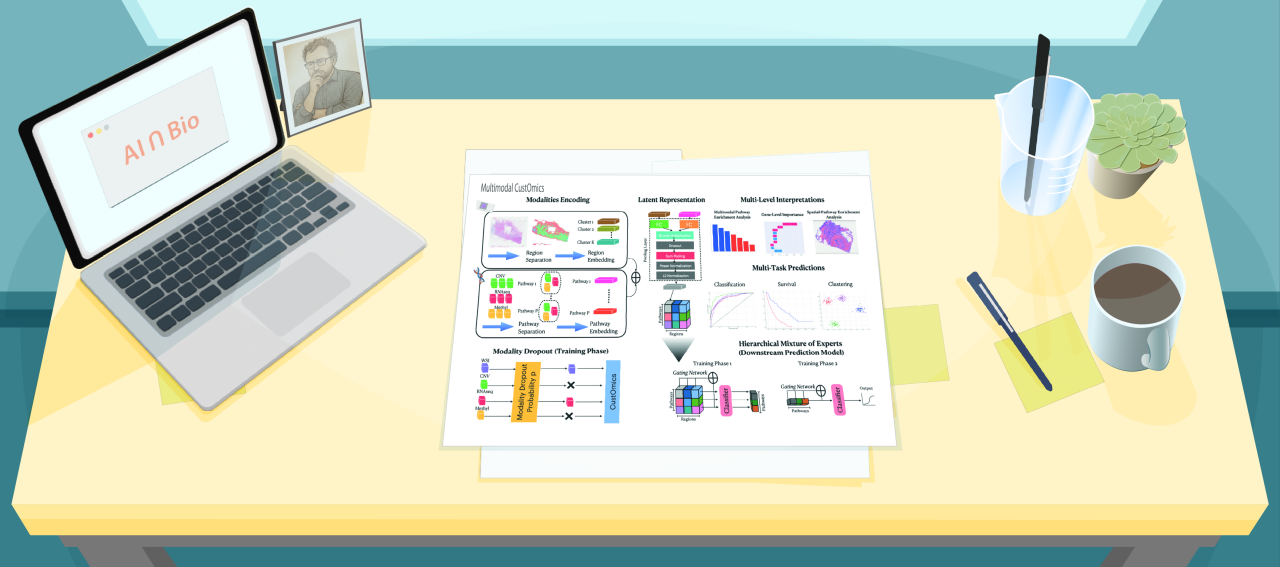
A new paper in PLOS Computational Biology introduces Multimodal CustOmics, a deep learning framework that fuses whole-slide pathology images with tumor molecular profiles (RNA expression, DNA copy changes, methylation, mutations). Why it matters: in oncology diagnostics we already generate both tissue images and sequencing data, but most models treat them separately. This study asks—what if we learn from them together?
Scientific Insight
The authors designed a model that groups molecular signals into gene programs (like “DNA repair” or “immune activation”) and clusters image patches into coherent tissue regions. A fusion layer then learns how programs and patterns align. Across multiple cancer types, the model outperformed existing approaches and even validated on an external lung cancer trial dataset—rare for this field. Interpretability scores trace importance from gene → pathway → tissue region → cell type. It’s compelling, but still correlational: no perturbation experiments to test causality.
Leadership Angle
For diagnostics leaders and investors, the signal is clear: multimodal by design is the next frontier. The advantage is not only higher accuracy but also resilience when some data are missing and structured rationales clinicians can interrogate. The translation challenge will be proving prospective impact—can such a model actually change a clinician’s decision in real time?
More in this series
- ChatNT: The future of biological assistants—or a mirage in a lab coat?
- GET: A Foundation Model for Transcription, Still Between Promise and Proof
- X-Atlas/Orion: Your Model is Only as Good as Your Training Data
- From Better Models to Better Questions: A Pathology AI Rethink
- The Model Isn’t the Magic: How Cytoland shows that domain expertise—not just deep learning—is what makes AI in biology work.
- Boltz-2: How much can 3D structure really tell us about molecular binding energetics?
- Investigating the volume and diversity of data needed for generalizable antibody–antigen ΔΔG prediction
- Beyond Binding: Rethinking Drug Design in the Age of AI and Structural Biology
- Testing the Physics Beneath the Predictions Beyond RMSD: What AlphaFold3 Really Understands
- Hype, Hurdles, and Hepatotoxicity: A Bold Step for AI-Designed Drugs, But Still Miles to Go
- When Complexity Misleads
- What Are Genomic Transformers Actually Learning?
- mRNABench and the Future of AI in Biology: Why Domain Knowledge Wins
- OncoGAN Creates Synthetic Cancer Genomes, Opening New Paths for Privacy-Preserving Precision Oncology
- Readable Rules, Testable Models: A New Grammar for Virtual Cells
- Multimodal CustOmics: Fusing Pathology Images and Tumor Genomics for Next-Gen Cancer Diagnostics
- Beyond Perturbation Simulations: PDGrapher Shows a Faster Way to Identify Actionable Targets
- Can AI design epigenetic anti-aging strategies?
- What happens when physicians use GPT-4 for diagnosis
- Can generative AI predict emergent phenomena?
- DeepSomatic and the question of how AI learns from itself
- Toward Mechanism-Centric Interpretability in Genomic Machine Learning
- From AlphaEvolve to DeepEvolve: What We’re Learning About Machine-Led Scientific Discovery
- Kosmos and the Culture of Discovery
- From Embeddings to Insight
- From Prediction to Explanation: How BIOREASON Reframes Genomic AI as a Reasoning Problem
- AI Models Need Better Truth—Platinum Pedigree Shows How
- From Evolutionary Intolerance to Clinical Insight: What popEVE Teaches Us About Missense Variants
- Interpretable Latent Spaces, Messy Biology: What AUTOENCODIX Teaches Us About Autoencoders in the Wild
- The Gene Ontology Knowledgebase in 2026
Mentorship Angle
For early-career scientists: the real craft is not just building complex models, but embedding discipline. Treat interpretability outputs as hypotheses to test, not truths to report. Build the control early—permutation checks, perturbation experiments, site validation. That’s how you transform attention maps into durable scientific insight.
The real test isn’t whether a model like CustOmics outperforms baselines on TCGA. It’s whether, in a prospective trial, it changes a clinician’s decision with confidence and transparency. That’s the bar diagnostics leaders should be watching.
Comments
Powered by WP LinkPress