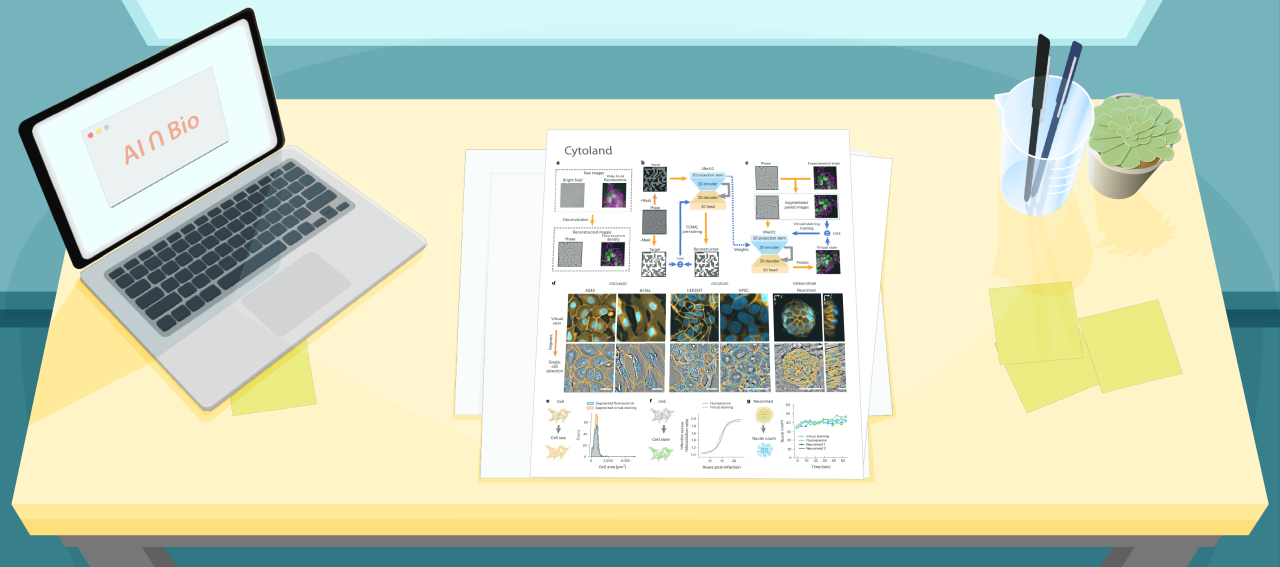
This week’s AI ∩ Bio: Reading the Revolution series covers Cytoland, a collection of models for robust virtual staining of landmark organelles across diverse imaging parameters, cell states and types.
The core idea of Cytoland
Cytoland introduces a set of deep learning models for virtual staining—predicting fluorescent labels of key organelles (nuclei, membranes) from label-free microscopy data like quantitative phase images (QPI). These models overcome current limits in generalization, robustness, and data efficiency, offering practical tools for label-free live-cell phenotyping across multiple cell types, imaging setups, and biological contexts.
Basically, the paper introduces a methodology to use AI to predict what a fluorescent image would look like—based only on label-free data (like phase contrast or brightfield). Think of it as teaching the model to “see” the nucleus or membrane without physically tagging them.
Why this matters
Virtual staining isn’t just a cool trick—it can fundamentally shift how we do live-cell imaging, avoiding time and engineering resources to make fluorescent labels for every experiment. And crucially, Cytoland models are open-source, tested on real-world problems, and robust enough to use across microscopes, labs, and cell systems.
In the AI ∩ Bio landscape
This paper is a landmark example of precision engineering, not algorithmic revolution. It does what so many papers fail to do: combine deep learning, physics, and real experimental constraints into a system that’s usable and robust.
You don’t get this kind of robustness without deep domain expertise. You have to understand how microscopes work, what makes a label “missing” vs. “invisible,” and how to design models that hold up in the real world. The magic happens not in the model itself, but at the intersection of thoughtful AI design, careful data collection, and biological insight.
More in this series
- ChatNT: The future of biological assistants—or a mirage in a lab coat?
- GET: A Foundation Model for Transcription, Still Between Promise and Proof
- X-Atlas/Orion: Your Model is Only as Good as Your Training Data
- From Better Models to Better Questions: A Pathology AI Rethink
- The Model Isn’t the Magic: How Cytoland shows that domain expertise—not just deep learning—is what makes AI in biology work.
- Boltz-2: How much can 3D structure really tell us about molecular binding energetics?
- Investigating the volume and diversity of data needed for generalizable antibody–antigen ΔΔG prediction
- Beyond Binding: Rethinking Drug Design in the Age of AI and Structural Biology
- Testing the Physics Beneath the Predictions Beyond RMSD: What AlphaFold3 Really Understands
- Hype, Hurdles, and Hepatotoxicity: A Bold Step for AI-Designed Drugs, But Still Miles to Go
- When Complexity Misleads
- What Are Genomic Transformers Actually Learning?
- mRNABench and the Future of AI in Biology: Why Domain Knowledge Wins
- OncoGAN Creates Synthetic Cancer Genomes, Opening New Paths for Privacy-Preserving Precision Oncology
- Readable Rules, Testable Models: A New Grammar for Virtual Cells
- Multimodal CustOmics: Fusing Pathology Images and Tumor Genomics for Next-Gen Cancer Diagnostics
- Beyond Perturbation Simulations: PDGrapher Shows a Faster Way to Identify Actionable Targets
- Can AI design epigenetic anti-aging strategies?
- What happens when physicians use GPT-4 for diagnosis
- Can generative AI predict emergent phenomena?
- DeepSomatic and the question of how AI learns from itself
- Toward Mechanism-Centric Interpretability in Genomic Machine Learning
- From AlphaEvolve to DeepEvolve: What We’re Learning About Machine-Led Scientific Discovery
- Kosmos and the Culture of Discovery
- From Embeddings to Insight
- From Prediction to Explanation: How BIOREASON Reframes Genomic AI as a Reasoning Problem
- AI Models Need Better Truth—Platinum Pedigree Shows How
- From Evolutionary Intolerance to Clinical Insight: What popEVE Teaches Us About Missense Variants
- Interpretable Latent Spaces, Messy Biology: What AUTOENCODIX Teaches Us About Autoencoders in the Wild
- The Gene Ontology Knowledgebase in 2026
For early-career scientists
The breakthrough isn’t just in the model—it’s in:
- Asking biologically meaningful questions
- Collecting the right data
- Designing AI that respects the physics and messiness of real experiments
You don’t need to invent new algorithms to do impactful AI ∩ Bio work.
What matters more is:
- Understanding what matters biologically (e.g., membranes over time, infection states, tissue development)
- Designing training and validation that respects experimental complexity
- Building models that generalize to the messiness of real world data
Learn how to ask scientific questions that AI can help answer, and how to design datasets and metrics that hold models accountable to real biological use.
Comments
Powered by WP LinkPress