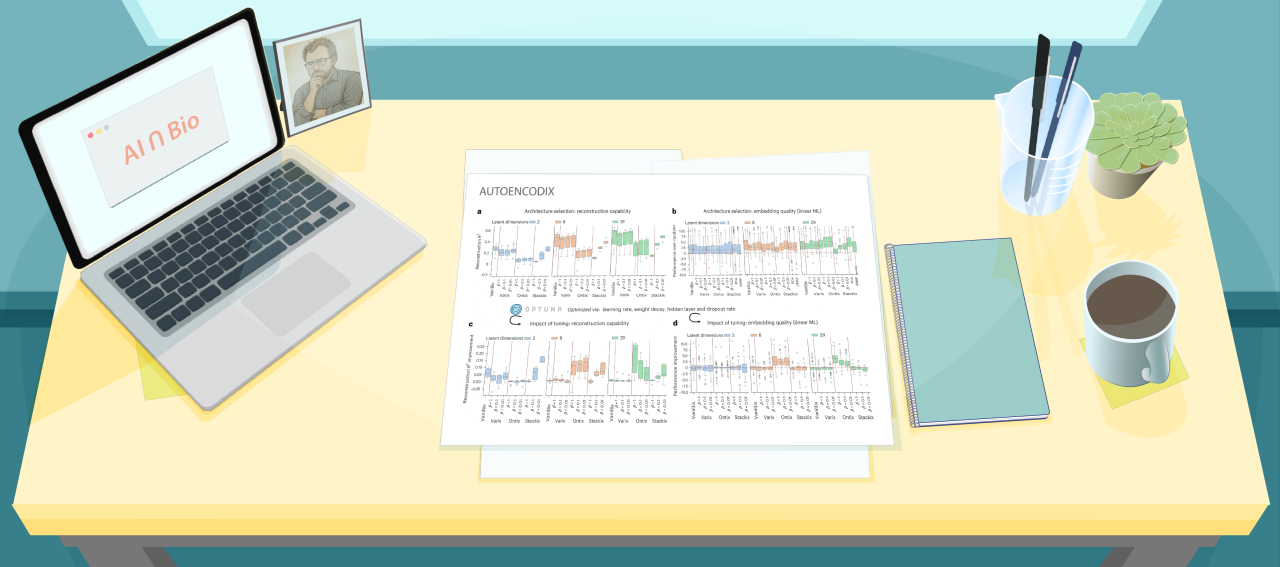
This week in AI ∩ Bio I dug into AUTOENCODIX, an open-source framework that stress-tests autoencoders (AEs) on real multi-omics data.
The punchline: no single architecture wins, reconstruction scores can mislead, and “interpretable” latent spaces inherit every bias baked into our ontologies. This paper provides exactly the kind of clarity we need to effectively apply these models in diagnostics and biomarker discovery.
AUTOENCODIX is a new open-source framework that tries to bring order to the AEs chaos in multi-omics, allowing the user to test multiple AEs through the same pipeline, then compare not just loss curves but how useful the learned embeddings actually are for biology and prognosis. (AEs explained in carousel)
Scientifically, a few themes stood out:
- they show how tuning β in VAEs affects performance; low β favors reconstruction; high β imposes compact, disentangled latent spaces.
- across TCGA and single-cell cortex data, no AE architecture consistently outperforms others. Good reconstruction doesn’t guarantee useful embeddings. Ontix, the biologically structured AE, wires decoder layers to known pathways or chromosomes, making latent dimensions interpretable. But robustness varies and depends on learning rate; and the results hint at artifactual learning (see comments).
Diagnostics-leadership perspective
This paper is a reminder to separate infrastructure from insight.
AUTOENCODIX is essentially AE infrastructure: it standardizes data handling, model training, and evaluation so you can ask disciplined questions instead of chasing whichever architecture is trending.
The results also challenge the reflex to equate fancier models with better clinical value: PCA remains a very strong baseline, and ontology-based models only shine when the chosen ontology matches the question and is treated carefully as a potential source of bias, not ground truth.
For leaders deciding where to invest, the take-home is: fund frameworks that make comparisons fair and reproducible, and judge models by task-relevant endpoints and robustness across cohorts—not by reconstruction loss or aesthetic latent plots.
More in this series
- ChatNT: The future of biological assistants—or a mirage in a lab coat?
- GET: A Foundation Model for Transcription, Still Between Promise and Proof
- X-Atlas/Orion: Your Model is Only as Good as Your Training Data
- From Better Models to Better Questions: A Pathology AI Rethink
- The Model Isn’t the Magic: How Cytoland shows that domain expertise—not just deep learning—is what makes AI in biology work.
- Boltz-2: How much can 3D structure really tell us about molecular binding energetics?
- Investigating the volume and diversity of data needed for generalizable antibody–antigen ΔΔG prediction
- Beyond Binding: Rethinking Drug Design in the Age of AI and Structural Biology
- Testing the Physics Beneath the Predictions Beyond RMSD: What AlphaFold3 Really Understands
- Hype, Hurdles, and Hepatotoxicity: A Bold Step for AI-Designed Drugs, But Still Miles to Go
- When Complexity Misleads
- What Are Genomic Transformers Actually Learning?
- mRNABench and the Future of AI in Biology: Why Domain Knowledge Wins
- OncoGAN Creates Synthetic Cancer Genomes, Opening New Paths for Privacy-Preserving Precision Oncology
- Readable Rules, Testable Models: A New Grammar for Virtual Cells
- Multimodal CustOmics: Fusing Pathology Images and Tumor Genomics for Next-Gen Cancer Diagnostics
- Beyond Perturbation Simulations: PDGrapher Shows a Faster Way to Identify Actionable Targets
- Can AI design epigenetic anti-aging strategies?
- What happens when physicians use GPT-4 for diagnosis
- Can generative AI predict emergent phenomena?
- DeepSomatic and the question of how AI learns from itself
- Toward Mechanism-Centric Interpretability in Genomic Machine Learning
- From AlphaEvolve to DeepEvolve: What We’re Learning About Machine-Led Scientific Discovery
- Kosmos and the Culture of Discovery
- From Embeddings to Insight
- From Prediction to Explanation: How BIOREASON Reframes Genomic AI as a Reasoning Problem
- AI Models Need Better Truth—Platinum Pedigree Shows How
- From Evolutionary Intolerance to Clinical Insight: What popEVE Teaches Us About Missense Variants
- Interpretable Latent Spaces, Messy Biology: What AUTOENCODIX Teaches Us About Autoencoders in the Wild
- The Gene Ontology Knowledgebase in 2026
For early-career scientists
There’s a quieter lesson here about how to work with powerful tools without giving up your scientific spine.
The authors don’t present a magical autoencoder that “solves” multi-omics; instead, they map trade-offs, show when tuning helps and when it doesn’t, and surface uncomfortable findings like decreased robustness after hyperparameter optimization for ontology-based VAEs.
If you’re building a career in computational or experimental biology, papers like this are an invitation to open the hood: run the benchmarks, break the assumptions, test models on tasks you actually care about, and treat interpretability as something you design and stress-test—not something you assume.
Skip to PDF content
Comments
Powered by WP LinkPress